Bajaj Auto targets FY28 electric motorcycle debut, export markets to get first shot before India
/ 3 min read
The Pune-based automaker's CFO Dinesh Thapar says electric motorcycle development is well underway as profitable EV operations and capacity expansion pave the way for the company's next growth phase.
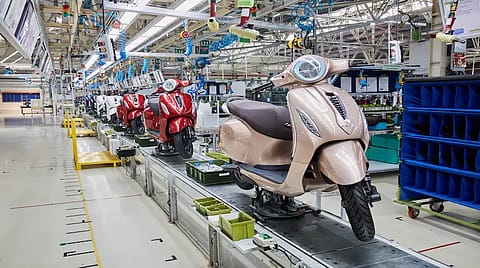
Credits: Bajaj Auto
Bajaj Auto Ltd. is targeting fiscal 2028 to launch its first electric motorcycle, with overseas markets set to receive the product ahead of India as it looks to expand its global electric vehicle (EV) footprint., revealed a senior company official.
The company has already begun development of the motorcycle and is working towards a defined launch timeline, signalling its next major step in electric mobility after establishing a strong presence in electric scooters and three-wheelers.
"Electric motorcycles are clearly under development and, all things going well, should start to see some launch happening sometime in FY28," Bajaj Auto Chief Financial Officer Dinesh Thapar said during the company's post-Q1 FY27 earnings call.
According to Thapar, the export-first strategy is expected to leverage Bajaj Auto's well-established international distribution network before the product is introduced in the domestic market.
"Our priority on the electric motorcycle will likely be the export markets first and then the domestic market. Development work is already well underway and we are beginning to see a clear timeline for when the product will hit the market," added Thapar.
Exports-first strategy shapes EV roadmap
The planned rollout underscores Bajaj Auto's broader electric mobility strategy, which extends beyond a single product. Alongside the Chetak electric scooter, the company is scaling up electric three-wheelers, expanding its e-rickshaw presence and developing an electric motorcycle to build a comprehensive EV portfolio across multiple vehicle segments.
The strategy also aligns with the company's growing international business. Bajaj Auto recently posted its highest-ever quarterly export volumes, with Latin America and Africa emerging as key growth markets. Prioritising exports for its electric motorcycle is expected to help the company strengthen its international EV presence before accelerating its domestic rollout.
Profitable EV business provides launchpad
Bajaj Auto's confidence in expanding its EV portfolio comes as the business achieves greater scale and profitability. The company said its EV operations have delivered double-digit EBITDA margins, with its electric scooter business turning EBITDA-positive after reaching breakeven a couple of quarters ago, while electric three-wheelers continue to generate double-digit EBITDA margins.
Bajaj Auto revealed that the Chetak electric scooter registered its strongest-ever quarterly performance during the April-June period, with volumes approaching 1.3 lakh units as demand continued to outstrip production capacity.
"The broader electric scooter market has gathered pace, with average monthly industry volumes rising from around 1.2 lakh units in FY26 to nearly 1.75 lakh units during the first quarter, touching close to 2 lakh units by the end of June," noted Thapar.
Bajaj Auto sold more than 1.5 lakh electric vehicles across electric two- and three-wheelers during the quarter, while electric mobility now contributes around 30% of the company's domestic revenues.
{{#most-powerful-women-snapshot-individual.slug}} {{/most-powerful-women-snapshot-individual.slug}} {{^most-powerful-women-snapshot-individual.slug}} {{/most-powerful-women-snapshot-individual.slug}} {{#showRanking}} {{current-rank}} {{/showRanking}} {{#photo.0.url}}
{{name}}
To meet rising demand, Bajaj Auto plans to increase Chetak's monthly production capacity from 50,000 units to 60,000 units over the next couple of months. The company is also expanding electric three-wheeler production capacity by 50% and will raise its overall manufacturing capacity by around 20% through a two-phase programme—adding 10% over the next three to four months and another 10% by the end of the current financial year or early next fiscal.
“The expansion spans motorcycle plants, commercial vehicle facilities at Waluj and the Chetak manufacturing unit at Akurdi, building on Bajaj Auto's installed manufacturing capacity of around 6 lakh units per month,” revealed Thapar.
Referring to Delhi's recently notified EV policy, which proposes phasing out registrations of new internal combustion engine two- and three-wheelers over the next few years, Thapar said such measures leave customers with "very little choice", reinforcing the long-term transition towards electric mobility.
The EV expansion follows a record June-quarter performance for Bajaj Auto. The homegrown automaker reported a 42% year-on-year rise in standalone net profit to ₹2,983 crore for Q1 FY27, while revenue from operations climbed 37% to a record ₹17,244 crore. Total vehicle sales rose 29% to 14.38 lakh units, driven by a 54% jump in exports and double-digit growth in the domestic market.
Follow Fortune India
NEXT STORY