West Asia crisis an inflection point for e-mobility, says NITI Aayog’s Rajiv Gauba, as states step on the gas on BEVs
/ 2 min read
India’s crude oil import dependence, automotive sector’s 7.1% GDP contribution and growing government support are adding urgency to the country’s shift towards electric mobility.
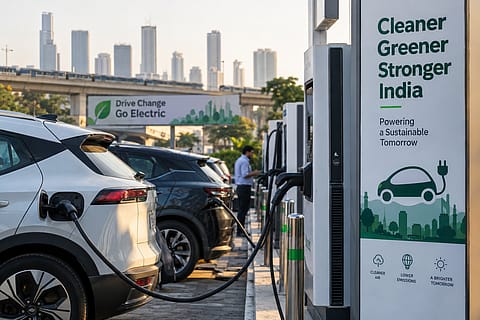
India’s electric mobility push is gaining momentum, with rising EV adoption, expanding charging infrastructure and 29 states and Union territories now having notified EV policies.
The global shift towards electric mobility is gathering pace, with electric cars accounting for about 10% of new car sales in the US, more than 25% in the European Union and over 50% in China in 2025, NITI Aayog member Rajiv Gauba said on Wednesday. He described the transition as an economic, environmental and strategic imperative for India’s Viksit Bharat 2047 vision.
Gauba was speaking at a NITI Aayog workshop on State EV policies, where the second edition of the India Electric Mobility Index (IEMI) was launched. He said the recent West Asia crisis could emerge as an inflection point for electric mobility, similar to how the oil shocks of the 1970s accelerated efforts towards fuel efficiency.
89% crude oil import dependence
India currently imports nearly 89% of its crude oil requirements, according to the PIB release. Gauba cautioned that import dependence could rise further as vehicle ownership increases unless electric mobility expands at a faster pace.
The automotive sector contributes around 7.1% of India’s GDP and supports nearly 1.9 crore jobs, making its alignment with the global transition to EVs economically significant. Gauba also pointed to the public health costs associated with vehicular emissions in cities including Delhi.
Government support crosses ₹92,000 crore
The Centre’s support for electric mobility has crossed ₹92,000 crore through initiatives including FAME, PM E-DRIVE and PM E-bus Sewa. Support is also being provided through production-linked incentive schemes covering automobiles and auto components, as well as Advanced Chemistry Cell battery storage.
At the same time, charging infrastructure is expanding through oil marketing companies and private-sector investment. The newly launched Unified Bharat e-Charge app is expected to improve consumer access to charging infrastructure.
IEMI scores show improvement
The latest IEMI data points to an improvement in states’ preparedness for electric mobility. As many as 29 of India’s 36 states and Union territories have notified EV policies.
The highest state score on the index increased from 77 to 84 over the past year, while the median score rose from 36 to 40. NITI Aayog said the index provides states with a data-driven framework to track progress and support evidence-based policymaking.
Gauba urged states to focus on electrifying public transport in selected cities, improve the geographical distribution and reliability of charging infrastructure, and encourage greater investment in research and innovation.
Follow Fortune India
NEXT STORY