India's EV charging infra woes
/ 5 min read
Public charging stations have multiplied in recent years, but India needs many more charging points for electric vehicles by 2030 as EV sales rise. The challenge is shifting from rollout to execution, economics and reliability.
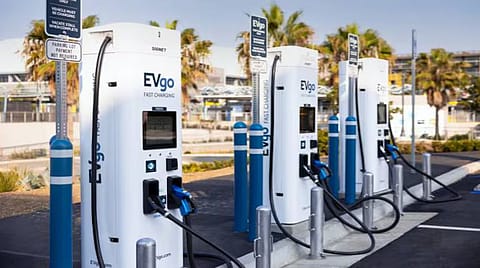
Representational Image
When Rajeshwar N. Chakravarty decided to ditch his petrol hatchback for an electric SUV, the chartered accountant from southwest Delhi wanted to eliminate petrol costs and reduce maintenance.
His EV, with a real-world range of around 350 km, has worked well for his daily NCR commute. A home charger installed by the automaker ensures overnight charging.
Long-distance travel, however, remains uncertain. “I can use the EV without any issues in the city, but I hesitate to take it on weekend trips to destinations such as Shimla or Mussoorie because charging infrastructure along many highways is still inadequate,” he says. “With a petrol car, fuel stations are available everywhere.”
Shimla is roughly 400 km from Delhi, while Mussoorie is closer (260 km), but Chakravarty does not want to push his luck.
EV adoption is outpacing supporting infrastructure. Electric mobility is no longer experimental in India. Electric two-wheelers are mainstream in cities, electric three-wheelers account for a large share of EV volumes, and passenger EV adoption is steadily rising. Yet the structural question persists: can charging infrastructure scale at the same pace?
India has expanded its public charging network in recent years, supported by policy incentives, private investment, and rising EV sales. But industry participants say deployment still trails demand. India had 52,718 public charging stations as of July 2026, including 16,561 equipped with fast chargers for cars, according to government data.
The Ministry of Power’s 2024 guidelines provide a framework for installing and operating EV charging infrastructure and aim to develop a connected, interoperable charging network. India also has defined standards for different charging technologies.
Srikumar Krishnamurthy, senior vice president and co-group head, corporate ratings, ICRA Ltd, says, “Inadequate charging infrastructure remains one of the key constraints on EV adoption in India, even as the government and private sector step up investments in charging networks, grid upgrades and ecosystem development.”
Standards exist, but the ecosystem still has multiple connector types and charging technologies. For instance, India has multiple recognised charging configurations. The five principal ones being: Type 2 AC, CCS2, CHAdeMO, Bharat AC-001 and Bharat DC-001. The challenge is interoperability across different vehicles, chargers, charging capacities and networks.
Challenging numbers
India’s EV market reached a record 2.45 million retail registrations in FY26, up roughly 25% year-on-year, driven largely by electric two-wheelers and three-wheelers, according to data by the Federation of Automobile Dealers Associations (FADA). Electric two-wheelers (E2W) alone accounted for nearly 57% of total EV sales, underlining the pace of expansion.
Passenger EV sales rose to nearly 200,000 units in FY26, up almost 84% over the previous year, pushing electric passenger-vehicle penetration above 4% for the first time, according to FADA data. Automakers expect momentum to build further as new models enter and ownership economics improve.
{{#most-powerful-women-snapshot-individual.slug}} {{/most-powerful-women-snapshot-individual.slug}} {{^most-powerful-women-snapshot-individual.slug}} {{/most-powerful-women-snapshot-individual.slug}} {{#showRanking}} {{current-rank}} {{/showRanking}} {{#photo.0.url}}
{{name}}
Even with a sharp rise in public charging stations, India still has only a fraction of the infrastructure required for large-scale electrification. The gap widens further when mapped against future demand.
Grant Thornton Bharat, a professional services and business advisory firm, says that if India is to meet its EV transition goals, charging deployment will need to scale sharply over the decade, requiring sustained investment from operators, utilities, automakers and infrastructure developers.
“The charger-to-EV ratio in India remains 1:215 to 1:235 [as of July 2025], significantly higher than global benchmarks of 1:6 to 1:20,” says Saket Mehra, partner and auto & EV industry leader, Grant Thornton Bharat. “This reflects a system still in an early build-out phase, where infrastructure is structurally lagging adoption.”
He says deployment must now move beyond opportunistic rollout toward coordinated planning aligned with demand density and grid readiness.
Execution constraints
The EV charging challenge is increasingly defined by execution complexity rather than intent.
Charging stations are being installed at petrol pumps as well as standalone/dedicated charging facilities. They are also being deployed in parking areas of malls, offices, hospitals, residential complexes and other commercial/public locations. Oil marketing companies have an advantage because of their existing fuel-station network.
Setting up charging stations requires land, parking access, transformer connectivity and reliable electricity supply—expensive in urban areas. Furthermore, the economics are tougher for fast chargers. While AC chargers cost `1–3 lakh, DC fast chargers can require `15-40 lakh or more depending on capacity and grid upgrades, according to industry estimates.
Costs extend beyond hardware. Operators also absorb land leases, power infrastructure, maintenance and software integration.
“Fast charging infrastructure is capital intensive, and returns take time,” says Anshuman Divyanshu, CEO, EVSE division, Exicom Tele-Systems Ltd. “Utilisation levels in many locations are still not high enough to make the business immediately profitable.”
This has kept deployment uneven, concentrated in metros and select highway corridors even as EV adoption spreads wider.
Quality over quantity
As adoption deepens, the focus is shifting from charger count to reliability.
Mercedes-Benz India says the ecosystem has improved but consistency should take priority now. “For all EV customers, charger reliability, interoperability and intercity charging access are key factors for a hassle-free experience,” says Santosh Iyer, MD & CEO, Mercedes-Benz India.
BMW India highlights a gap in fast-charging capability, noting that many highway chargers operate at around 60 kW, with effective speeds often lower.
Hardeep Singh Brar, president and MD, BMW Group India, says, “The country’s focus must shift toward 120 kW and higher-capacity chargers that can enable meaningful charging times of about an hour. It also flags uptime and maintenance as critical gaps.”
As EV adoption scales, reliability, speed and uptime are becoming as important as charger density.
Despite rising installations, profitability remains uneven. “Low utilisation outside metros, high upfront costs and long payback cycles continue to slow private investment,” says Kartikey Hariyani, founder and CEO of ChargeZone. “Grid upgrades, transformer capacity expansion and last-mile connectivity raise execution complexity.”
Even in high-demand areas, congestion is emerging at charging stations, pushing operators toward multi-bay, high-capacity hubs.
Infrastructure lag
Government initiatives such as PM E-DRIVE, along with investments from OMCs, utilities, automakers and private operators, are expanding coverage. But execution remains uneven.
“Charging infrastructure must be viewed as a strategic national asset, much like highways and digital connectivity,” says Uday Narang, founder & chairman, Omega Seiki Mobility. He calls for public-private coordination, faster approvals and integrated planning across the value chain.
Mehra of Grant Thornton Bharat adds that the challenge is now shifting from deployment to system design.
“Despite visible progress, infrastructure rollout remains concentrated in a few states, leaving Tier-II and Tier-III markets underserved,” he says. “The next phase must focus on grid-aligned planning, standardised frameworks and coordinated execution to ensure scalable growth.” Highway charging is explicitly covered under PM E-DRIVE. The scheme provides `2,000 crore for public charging infrastructure, including charging stations in selected cities and highways.
The challenge is now the pace and geographic consistency of deployment, as well as the commercial viability of highway charging.
Business outlook
India’s EV transition will depend not just on vehicles or policy support, but on whether charging becomes reliable, accessible and economically viable. The imbalance between rapid EV adoption and slower infrastructure deployment continues to define the sector’s near-term trajectory.
As Mehra from GTB puts it, “The result is a growing mismatch between EV adoption and infrastructure readiness, particularly outside major urban centres.”
The gap between EV sales and charger network is the industry’s central constraint. EVs are already practical in cities. Beyond them, the ecosystem is still catching up. Until that changes, India’s EV story will remain one of rapid adoption—and slower infrastructure alignment.
Follow Fortune India
NEXT STORY