Adani Wind bags 696 MW orders from five power producers, order book crosses 1 GW
/ 3 min read
The latest contracts take Adani Wind’s order book from independent power producers beyond 1 GW as the company plans to expand annual manufacturing capacity at Mundra to 5 GW.
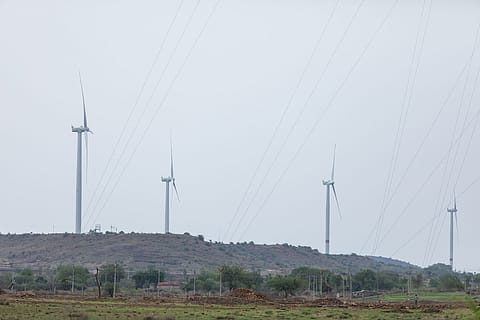
Adani wind farm in Sadla, Gujarat
Adani Wind, the wind energy business of Adani New Industries Ltd, has secured orders totalling 696.2 megawatts (MW) from five power producers, expanding its customer base beyond the Adani Group as India’s wind industry shifts towards higher-capacity turbines.
The orders comprise 300 MW from Purvah Green Power, part of the RP-Sanjiv Goenka Group; 155 MW from Jindal India Power, part of the BC Jindal Group; 109.2 MW from NTPC Renewable Energy; 82.5 MW from Aditya Birla Renewables; and 49.5 MW from Integrum Energy, according to people familiar with the matter.
The contracts cover three wind turbine generator platforms rated at 5.2 MW, 5 MW and 3.3 MW, with projects spread across Karnataka, Gujarat and Maharashtra.
Adani Wind’s order book from external customers crosses 1 GW
With the latest orders, Adani Wind’s cumulative order book from independent power producers outside its group has crossed 1 gigawatt (GW), marking a milestone in its efforts to build a third-party business in a market where turbine manufacturers are competing to supply equipment for India’s expanding renewable energy capacity, the people said.
The largest order, from Purvah Green Power, covers 60 wind turbines rated at 5 MW each for deployment in Bellary, Karnataka. Jindal India Power’s 155 MW order comprises 31 turbines of the same rating for installation in Davanagere, Karnataka.
NTPC Renewable Energy has ordered 21 turbines rated at 5.2 MW each for its Khavda project in Gujarat. The Aditya Birla Renewables and Integrum Energy orders will use Adani Wind’s 3.3 MW turbine platform for projects in Bhuj, Gujarat, and Nandurbar, Maharashtra, respectively, the people said.
Manufacturing expansion planned at Mundra
The order wins come as Adani Wind seeks to scale up its manufacturing capacity at Mundra, Gujarat, from 2.25 GW annually to 5 GW, with a longer-term target of 10 GW. The expansion would position the company to compete for a larger share of domestic turbine demand and potentially serve overseas markets.
Adani Wind’s 5 MW MWL-185 platform has a 185-metre rotor diameter and a 140-metre hub height and is designed for low- to moderate-wind conditions.
Its 5.2 MW MWL-160 platform is among the higher-capacity onshore turbine models listed under the Ministry of New and Renewable Energy’s Approved List of Models and Manufacturers (ALMM).
The company’s MWL-160 platform has crossed 2 GW of installations at Khavda, which hosts a large renewable energy development in Gujarat, according to the people. All four of Adani Wind’s turbine models are listed under the ministry’s approved list, and the company is the only Indian wind turbine manufacturer included in BloombergNEF’s global top 15 ranking for 2025.
India’s wind sector adds capacity as larger turbines gain traction
India, the world’s fourth-largest wind power market, has 59.2 GW of installed wind capacity, with a further 43 GW under implementation. The combined base of operational and under-development capacity exceeds 100 GW.
{{#most-powerful-women-snapshot-individual.slug}} {{/most-powerful-women-snapshot-individual.slug}} {{^most-powerful-women-snapshot-individual.slug}} {{/most-powerful-women-snapshot-individual.slug}} {{#showRanking}} {{current-rank}} {{/showRanking}} {{#photo.0.url}}
{{name}}
Domestic wind turbine manufacturing capacity has more than doubled from about 12 GW in fiscal 2023 to over 24 GW annually. The industry is targeting installations of around 8 GW in fiscal 2027, with annual additions projected to reach 13.2 GW by fiscal 2031.
India installed a record 6.05 GW of wind capacity in fiscal 2026.
The sector is also moving towards larger turbines and rotor diameters, which can capture more wind energy and improve project economics, depending on local wind conditions, site constraints and infrastructure requirements. Higher-capacity machines can also help developers optimise land use in established wind corridors.
Adani Wind has a portfolio of turbine platforms ranging from 3 MW to 5 MW-plus and is exploring international markets. It has exported blade sets equipped with anti-icing technology to Europe and is engaging with potential customers in the United States, Australia, Brazil and Southeast Asia.
The latest contracts give Adani Wind an opportunity to broaden its customer base as it scales up manufacturing. Securing orders from independent power producers and established energy companies could help demonstrate the commercial acceptance of its technology, although the ultimate contribution to revenue will depend on delivery schedules, project execution and commissioning, analysts said.
Follow Fortune India
NEXT STORY