Air India, IndiGo to shift flights to Navi Mumbai airport from December; 12 international routes to move
/ 2 min read
Phased transition ahead of Mumbai airport’s Terminal 1 redevelopment will begin with Air India Express domestic services, while IndiGo plans to launch international operations from February 2027.
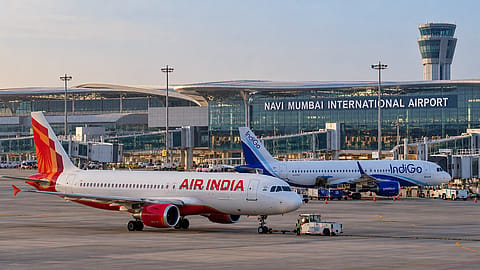
Representational Image
Air India Group and IndiGo will progressively shift domestic and international flight operations from Mumbai’s Chhatrapati Shivaji Maharaj International Airport (CSMIA) to the Navi Mumbai International Airport (NMIA), as the city prepares for the redevelopment of Terminal 1 and seeks to distribute aviation capacity across its two airports.
Air India Express will begin the transition in December 2026 with four daily domestic flights from NMIA, followed by international operations from January 2027. Planned services to Kuwait, subject to regulatory approvals, and existing services to Oman will move first, according to a joint statement issued by Air India Group and Adani Airport Holdings Ltd (AAHL) on Sunday.
Air India Express to shift West Asia services by summer 2027
The airline will progressively transfer services to Jeddah, Riyadh, Dammam, Doha, Muscat and Sharjah to the new airport, with the process expected to be completed by the International Air Transport Association’s Northern Summer 2027 season.
IndiGo, meanwhile, plans to commence international operations from NMIA in February 2027 and progressively transfer 12 daily international departures from CSMIA. These services currently connect Mumbai with Bahrain, Riyadh, Dammam, Jeddah, Madinah, Kuwait, Ras Al Khaimah, Fujairah, Muscat, Dhaka and Jakarta.
An additional daily service to Kathmandu will take IndiGo’s international network at NMIA to 12 destinations between February and July 2027. The airline will also shift the domestic connectivity required to support these international services and facilitate passenger transfers.
IndiGo to transfer 12 daily international departures
The capacity reallocation is expected to ease pressure on the existing Mumbai airport, which faces constraints as it prepares for Terminal 1’s redevelopment. IndiGo said the move would also create room for its planned international expansion across Asia, Africa and Europe in 2027, using its expanding fleet of A320/A321 and A321XLR aircraft.
IndiGo and AAHL said further adjustments to IndiGo’s operations at CSMIA Terminal 1 would be accommodated at Terminal 2. Final transition dates will be announced after project coordination and the necessary operating approvals are completed.
Dual-airport system to boost Mumbai’s aviation capacity
The phased shift is intended to strengthen Mumbai’s dual-airport system, improve connectivity across the Mumbai Metropolitan Region and provide airlines with greater capacity to expand. AAHL operates eight airports, including CSMIA and NMIA, while Air India Group operates more than 300 aircraft across 60 domestic and 51 international destinations.
IndiGo operates a fleet of more than 430 aircraft and nearly 2,200 daily flights, connecting over 95 domestic and 40 international destinations. As the transition unfolds, passengers will need to check their departure airport carefully, as services move in phases.
Follow Fortune India
NEXT STORY