Akash Ambani’s post-IPO playbook: Monetising Jio’s technology beyond connectivity
/ 3 min read
From mobility and homes to enterprise solutions and global expansion, Jio Platforms is preparing to turn its infrastructure and proprietary technology stack into multiple revenue streams.
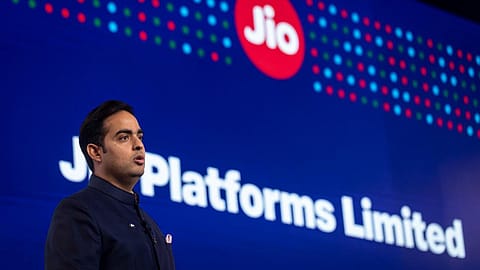
Akash Ambani, managing director of Jio Platforms Ltd | Credits: Apoorva Salkade
Akash Ambani, managing director of Jio Platforms Ltd (JPL), is convinced that the next leap in growth for the IPO-bound firm will not come from tariff hikes. He believes JPL can launch more services beyond its licensed offerings to improve EBITDA margins from current levels.
"We have the price lever that we can always play. But our first endeavour is to deliver more services to users and extract value that our competitors have left,” he said recently.
So, what are the other levers for JPL, which is set to be listed in the coming week following its ₹30,000-crore IPO?
The strategy rests on four core growth engines—mobility, homes, enterprise services and its technology stack. The opportunity lies in generating revenue not merely from carrying data, but from the services and technology layered on top of the network, said company executives. "We are inventing services and products everyday to add to the digital bouquet," said a senior executive.
Akash believes that nearly 340 million potential subscribers could enter its addressable mobility market over the next five years, comprising 100 million first-time SIM users and 240 million customers migrating from 2G to 4G and 5G. JPL's ability to combine affordable mobility with digital services will be central to capturing this opportunity, according to the Ambani scion.
The home segment presents an equally significant growth opportunity for JPL. It has a footprint of around 40 million broadband connections against an estimated 300 million households nationally. Its target is to expand its serviceable base to 100 million homes by integrating broadband, television and digital applications rather than selling connectivity alone.
Its proprietary unlicensed-band radio (UBR) technology makes the last-mile connection wireless, reducing dependence on fibre installation and permissions. JPL says 6.5 million customers are already using the technology, which accounts for 40% of new additions.
Enterprise services form the third growth engine. Jio is targeting a digital-services opportunity estimated at $56 billion, moving beyond connectivity into secure broadband, video surveillance, private 5G, IoT and cloud-based solutions. Its network already connects 65% of India's bank branches, giving it an established base from which to cross-sell technology services.
The larger ambition is to monetise JPL's technology globally. Rather than enter foreign markets as a conventional telecom operator or hardware vendor, the company intends to partner with operators and offer its integrated technology stack as a managed service. The model could open up developed and emerging markets without requiring Jio to replicate its entire domestic infrastructure overseas.
“Our international strategy is a bit different. Today, what we have is our end-to-end stack that is already operated on our network. Now we want to find the right partners that we can roll this out again,” Ambani says.
The approach would allow Jio to monetise its investments in proprietary platforms beyond India, while partners use the technology to expand their own networks and services.
{{#most-powerful-women-snapshot-individual.slug}} {{/most-powerful-women-snapshot-individual.slug}} {{^most-powerful-women-snapshot-individual.slug}} {{/most-powerful-women-snapshot-individual.slug}} {{#showRanking}} {{current-rank}} {{/showRanking}} {{#photo.0.url}}
{{name}}
The digital services giant is also deepening strategic partnerships and joint ventures with global technology leaders, including Qualcomm, Google, Meta and Nvidia. These collaborations span connectivity, devices, cloud and AI, and are expected to play a significant role in shaping Jio’s next phase of growth.
"For me, what that makes sure is that we have an infrastructure footprint and the largest spectrum bank that makes our business hard to replicate," said Ambani. Connectivity remains the foundation for JPL, which has over 530 million customers and carries over 60% of the country’s digital traffic. Its infrastructure includes more than 360,000 towers and over one million route-kilometres of fibre. It has also deployed more than 250 million 5G connections and established a nationwide network footprint.
This infrastructure gives JPL a distribution advantage as it moves into higher-value services. Its proprietary technology stack also includes cloud platforms, network and business support systems, automation, AI and machine learning, smart IoT and blockchain. JioBrain, its 5G-integrated machine-learning platform, extends these capabilities to telecom operators and enterprises.
JPL is also building a bouquet of products, including connected digital devices for homes, vehicles and offices. These include JioGlass, vehicle mobility solutions such as JioMotive, and home solutions that bring together live TV, streaming content and online gaming. By connecting devices to the cloud and integrating connectivity, content and applications, Jio aims to move beyond mobile tariffs and monetise a wider range of digital offerings.
Follow Fortune India
NEXT STORY