Convert local businesses into global ones: Piyush Goyal asks auto component makers to expand overseas
/ 2 min read
The Commerce Minister says nine trade deals have opened access to markets representing $60 trillion GDP; urges industry to manufacture globally, move up value chain and build resilient supply chain.
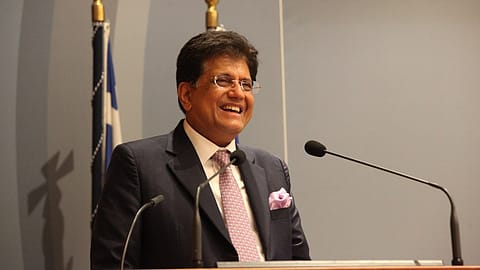
Union Commerce and Industry Minister Piyush Goyal. | Credits: Piyush Goyal's X account
Commerce and Industry Minister Piyush Goyal on Wednesday called on India's auto component manufacturers to shift from an export-led approach to establishing a global manufacturing footprint, as the government seeks to leverage a series of free trade agreements to accelerate the industry's international expansion.
Addressing the Automotive Component Manufacturers Association of India’s (ACMA) 66th annual session, Goyal said the industry had already demonstrated its ability to manufacture globally competitive products from India and should now take that capability overseas.
“Now it is time that we go to the world. We start manufacturing across the world. We start making our footprint in developed countries,” Goyal said.
His remarks come as the government seeks to deepen India's integration with developed markets through trade agreements. Goyal said nine FTAs finalised over the past four-and-a-half years had collectively provided India access to markets representing a $60 trillion GDP across 38 countries.
$60 trillion market access opens new playbook
Goyal said the latest trade agreements covered prosperous economies with high per-capita incomes, offering Indian companies greater complementarity and relatively lower competitive pressures.
He urged ACMA members to capitalise on this access by expanding their international operations rather than limiting themselves to exports from India.
The auto component industry already accounts for nearly $50 billion in international trade, with imports and exports broadly evenly divided, Goyal said. However, he pressed the industry to increase overseas investments and build a larger global presence. “I believe that business prospers when we look globally,” he said, adding that ACMA members had built a reputation for quality and competitive pricing that could now be leveraged across international markets.
From resilience to global manufacturing
Goyal also asked component makers to actively indigenise products critical to their supply chains, while simultaneously moving up the value chain and developing integrated, high-value solutions for global customers.
He said the government’s support for semiconductors, speciality steel, technical textiles and industrial infrastructure was aimed at strengthening the wider manufacturing ecosystem and reducing supply-chain vulnerabilities.
“We need your ideas. We need your inputs. We need your demands,” Goyal said, calling for closer industry-government dialogue on regulatory and business challenges.
He also urged the sector to step up investment in technology, including artificial intelligence for quality control and customer assessment, while strengthening vehicle safety and supporting vehicle scrappage.
{{#most-powerful-women-snapshot-individual.slug}} {{/most-powerful-women-snapshot-individual.slug}} {{^most-powerful-women-snapshot-individual.slug}} {{/most-powerful-women-snapshot-individual.slug}} {{#showRanking}} {{current-rank}} {{/showRanking}} {{#photo.0.url}}
{{name}}
Goyal reiterated his expectation that the auto component industry would move towards its $500 billion industry target, saying the next phase of growth would require companies to become global players.
“Now convert your local businesses to global businesses,” he said, outlining his first of several specific asks to the industry.
NEXT STORY