FMCG festive demand seen rising 9-11%, but West Asia costs threaten margin recovery
/ 2 min read
A decade low inflation run in 2025 has released real purchasing power that consumers are now carrying into the festive period.
THIS STORY FEATURES
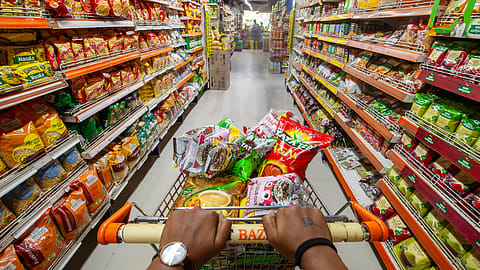
Credits: Sanjay Rawat
India’s FMCG sector is heading into the festive season with a stronger consumer tailwind, but companies may have to navigate a difficult trade-off between recovering volumes and rising input costs.
FMCG demand is expected to grow 9% to 11% between August and November, as lower inflation improves consumers’ purchasing power, even as higher palm oil, crude and packaging costs weigh on margins, according to Equirus Capital’s July 2026 Consumer Sector Tracker.
The demand outlook marks a meaningful improvement for the sector.
Equirus, citing Bizom (retail intelligence), said FMCG demand is poised for a 9% to 11% increase during the August to November festive window. The report also cited BCG’s assessment that a decade low inflation run in 2025 has released real purchasing power that consumers are now carrying into the festive period.
The recovery is already visible in company performance. In Q1 FY27, Hindustan Unilever posted its fastest volume growth in 13 quarters, while Nestlé India’s revenue rose around 25%, the report said. However, the improvement in demand has not translated into an equally strong earnings picture, with higher costs linked to the West Asia conflict putting pressure on profitability.
Palm oil, crude and packaging costs rose enough to offset the benefit of resilient demand and price increases, according to brokerages cited by Equirus.
The competitive moat
The pressure comes at a time when the competitive structure of FMCG is also changing. HDFC Securities, in its July sector thematic, described the shift as a 'great moat reset'.
Legacy brands and traditional advantages, such as distribution scale & mass advertising, are losing some of their strength as premium, personalised and quick commerce-led propositions gain ground. The report argues that data driven consumer insights and faster innovation are becoming more important to incumbents, with speed and relevance increasingly determining competitive advantage.
Quick commerce is central to this change. The combined dark store network of Blinkit, Zepto and Swiggy Instamart had crossed 5,600 stores across 408 cities by July 2026, according to the report. At the same time, Flipkart is scaling its Minutes business with a target of about 1,500 fulfilment centres across more than 180 cities.
For FMCG companies, this means the festive opportunity is no longer simply about pushing more products through traditional distribution. The shift towards premium products and faster digital channels is changing where growth comes from and how brands reach consumers.
At the same time, the cost environment remains a constraint. The Nifty FMCG index has fallen around 11.8% in 2026, compared with a 7.4% decline in the Nifty 50, highlighting investor concerns around profitability even as consumption indicators improve.
{{#most-powerful-women-snapshot-individual.slug}} {{/most-powerful-women-snapshot-individual.slug}} {{^most-powerful-women-snapshot-individual.slug}} {{/most-powerful-women-snapshot-individual.slug}} {{#showRanking}} {{current-rank}} {{/showRanking}} {{#photo.0.url}}
{{name}}
Equirus’ estimates also show that FY27 growth expectations remain positive across major FMCG categories. In foods, ITC is estimated to grow sales 1.9%, Nestlé India 10.8%, Britannia 12.1% and Dabur 9.2%. The numbers suggest that the sector’s next phase of growth could be driven less by a broad-based consumption rebound alone and more by a combination of premiumisation, channel shifts and companies’ ability to protect margins as input costs remain volatile.





Follow Fortune India
NEXT STORY