Fortune India Banking & NBFCs Summit 2026: Banks must go beyond compliance to protect governance premium, say industry leaders
/ 3 min read
At the Fortune India Banking & NBFCs Summit 2026, panellists said that transparency, independent board oversight, and cyber resilience are essential to sustaining stakeholder trust amid technological disruption and economic uncertainty.
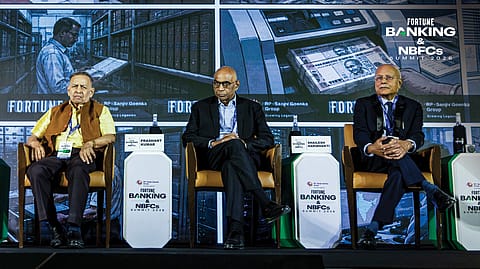
L-R: Satish Marathe, Director, Central Board, RBI; Prashant Kumar, former MD & CEO, YES Bank; and Shailesh Haribhakti, Chairman, Shailesh Haribhakti & Associates, at the Fortune India Banking & NBFCs Summit 2026. | Credits: Fortune India
Banks must look beyond regulatory compliance and strengthen governance practices to sustain stakeholder trust and protect their market valuations, industry leaders said at the Fortune India Banking & NBFCs Summit 2026.
Speaking at a panel titled 'Are banks losing their governance premium?' Shailesh Haribhakti, Chairman, Shailesh Haribhakti & Associates; Satish Marathe, Director, Central Board, Reserve Bank of India (RBI); and Prashant Kumar, former MD & CEO of YES Bank, talked about the challenges facing lenders amid economic uncertainty, technological disruption, and heightened regulatory scrutiny.
Marathe said the volatility in the global economic environment was forcing banks to reassess traditional business models and adapt their governance frameworks. “See, we are in the age of VUCA (Volatility, Uncertainty, Complexity, and Ambiguity). It's all volatility and uncertainty. And this situation has remained for a very long time now. And with that, what has come into question, or under deep scrutiny, is a business model that the banks have been pursuing for all these years.”
He said conventional operating procedures and oversight mechanisms needed to evolve with changing circumstances. However, despite the uncertainty, he remained optimistic about the banking sector's performance. “You see, the half-year results of most of the banks, they have done well, and I don't see any reason that the bank should be at the receiving end in the markets.”
Kumar said banks must distinguish governance from compliance, particularly when leadership teams face pressure to deliver results. “When people start thinking that governance is something which is a burden, which is not in the interest of the organisation for a long term. And when people start mixing governance and compliance, and if they are saying 'if I am doing the compliance, I'm actually very good on the governance', I think that starts creating the problem.”
He said building a strong governance culture required continuous communication, leadership development and a commitment to ethical decision-making.
“The real governance is a continuous process. Where you nurture people, where you develop people, start believing by your own action in the thought process. That doing the right things is the only way for it.”
Trust and boardroom accountability
Haribhakti said trust had to be earned rather than taken for granted, particularly as technology transformed the banking and NBFC sectors.
“Trust has to be... earned. It cannot be inherited. That is the big challenge of the whole banking and NBFC sector.” He proposed a “trust-adjusted return on intelligence” to assess whether banks could continue to build trust while innovating and expanding their reach to underserved customers. Using technology to assess creditworthiness, he said, could make governance more predictive rather than merely compliance-oriented.
Haribhakti also highlighted the role of independent directors in challenging management decisions and strengthening boardroom accountability. “But an independent director will have to carry the moral capital into the boardroom. To be in a position to ask the tough questions, and to make sure that those questions are answered.” He said that bank management must encourage independent thinking as lenders navigate challenges related to artificial intelligence and sustainability.
Marathe said the RBI's focus on supervision had strengthened oversight across regulated entities. The central bank had combined regulation and supervision under one head about four years ago, recognising their complementary roles.
{{#most-powerful-women-snapshot-individual.slug}} {{/most-powerful-women-snapshot-individual.slug}} {{^most-powerful-women-snapshot-individual.slug}} {{/most-powerful-women-snapshot-individual.slug}} {{#showRanking}} {{current-rank}} {{/showRanking}} {{#photo.0.url}}
{{name}}
"We said they are the two sides of the same coin. And the focus in the Reserve Bank has been on prudential regulation and supervision of all regulated entities.” He said that machine learning, AI, and other technologies had improved the regulator's ability to monitor institutions and strengthen oversight.
Cybersecurity emerges as a priority
Kumar, who led YES Bank through a crisis, said transparency was crucial when an institution faced difficulties and needed to restore stakeholder confidence. “I think we need to be transparent in terms of where we are, what we are going to do, what is the road there?”
On the priorities for incoming bank leaders, Marathe called for adherence to rules, transparency and timely disclosures. “Stick to the rulebook. Be transparent, make disclosures wherever necessary and build a trust. That is the road forward, I believe.”
Kumar stressed the importance of developing talent and nurturing future leaders, saying institutions could not depend on a single individual to succeed.
Haribhakti identified cybersecurity as a key competitive differentiator as banks accelerate AI adoption. "So for me, the most important competitive advantage will be delivered if the centrepiece of governance becomes cyber resilience. Today, there is no challenge bigger than the cybersecurity challenge. And if you were to conflict that with the AI adoption challenge, that's the recipe for all the new CEOs who have come into the banks," he added.
Follow Fortune India
NEXT STORY