Fortune India Luxury Summit: Luxury is about preserving excellence, not making wine every year, says Pierre Lurton
/ 3 min read
The president of Château d’Yquem and Château Cheval Blanc says winemaking is as much about taking risks and respecting nature as it is about maintaining tradition and craftsmanship.
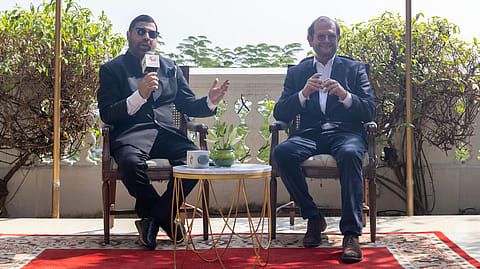
(L to R) Tikka Shatrujit Singh, Chairman & Founder, JMC, with Pierre Lurton, president of Château d’Yquem and Château Cheval Blanc. | Credits: Sanjay Rawat
Pierre Lurton, president of Château d’Yquem and Château Cheval Blanc, believes that the essence of luxury lies not just in the quality of a product but in the commitment to preserving its standards, even when that means making difficult business decisions.
During a discussion with luxury expert Tikka Shatrujit Singh, Chairman & Founder, JMC, at the Fortune India Business of Luxury Summit in Hyderabad, Lurton said that producing a great wine requires a deep understanding of the relationship between terroir, climate, and people. He said that winemakers must be willing to take risks and, at times, refrain from producing a particular vintage if the quality does not meet the standards associated with the brand.
Drawing on his experience managing two of Bordeaux's most celebrated wine estates, Lurton said luxury is built on a combination of heritage, consistency, craftsmanship, and an uncompromising approach to quality. For him, the ability to preserve excellence over generations is what distinguishes an iconic luxury brand.
Importance of maintaining quality
Explaining the importance of maintaining quality, Lurton recalled the decision to skip the 2012 vintage of Château d’Yquem, the renowned French sweet wine estate.
He said the decision was taken after discussions with his team and Bernard Arnault, chairman and CEO of LVMH, which owns Château d’Yquem. Despite the estate's long-standing tradition, Lurton felt the grapes had not achieved the quality and complexity required to produce a wine worthy of the Château d’Yquem label.
The estate eventually decided against producing its signature wine for that year, demonstrating that protecting a luxury brand's reputation can take precedence over maintaining annual production.
The decision was rooted in the belief that every bottle carrying the estate's name must reflect its commitment to excellence. For Lurton, the strength of a luxury brand lies in the consistency of its standards, rather than simply the volume of products it sells.
The role of nature and terroir in winemaking
Lurton also explained how the unique geographical and climatic conditions around Château d’Yquem contribute to the character of its wines. This naturally occurring fungus plays a crucial role in producing Sauternes wines by concentrating the sugars and flavours in the grapes. However, the process is highly dependent on weather conditions and requires meticulous attention. Grapes are picked selectively over multiple passes, with vineyard workers identifying berries that have reached the desired level of concentration.
Lurton said the process involves considerable uncertainty, as rainfall can disrupt the development of noble rot and compromise the quality of the harvest. The estate must therefore exercise patience and make careful decisions about when and what to harvest.
He described the production of Château d’Yquem as an exercise in managing risk, where the final quality depends on the interaction between nature, the land, and the people working on it.
Cheval Blanc: Balancing heritage with craftsmanship
Discussing Château Cheval Blanc, Lurton described its wines as distinctive for their balance of Merlot and Cabernet Franc, which together contribute richness, freshness, and elegance. He said maintaining the identity of an established wine estate requires a combination of respect for its heritage and a willingness to adapt. While tradition provides the foundation, the people behind the wine must continue to work with humility, attention to detail, and a willingness to experiment.
{{#most-powerful-women-snapshot-individual.slug}} {{/most-powerful-women-snapshot-individual.slug}} {{^most-powerful-women-snapshot-individual.slug}} {{/most-powerful-women-snapshot-individual.slug}} {{#showRanking}} {{current-rank}} {{/showRanking}} {{#photo.0.url}}
{{name}}
Lurton also stressed that the objective should not be to pursue an idea of absolute perfection. Instead, winemakers must understand the character of the raw material and allow the natural variations of each vintage to contribute to the wine's individuality. Lurton also highlighted the importance of experiencing fine wine over time, allowing consumers to appreciate how its colour, aroma, and character evolve with age.
Follow Fortune India
NEXT STORY