From BARC to AI: Prasar Bharati CEO on the new battle for trust in news
/ 2 min read
With BARC under review and AI blurring lines between fact and fabrication, Prasar Bharati pushes ground reporting and clear labelling to rebuild credibility in television news.
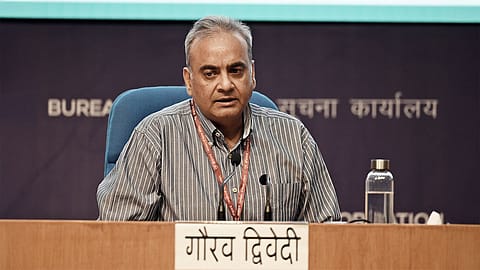
Credits: Credit: Getty Images
The television news industry could see more than one ratings currency as the government weighs proposals from BARC India and other rating agencies, Prasar Bharati CEO Gaurav Dwivedi said at FICCI Frames 2026. He said the structural issues at BARC have largely been resolved, but the industry’s larger challenge remains rebuilding audience trust in an era of algorithms, echo chambers and AI-generated content.
Dwivedi said the organisation has submitted its reports and representations to the government. Other media associations have also made representations, he said, adding that the matter is now under consideration at the ministry level.
“There’s also been a thought that there could be possibly multiple currencies, and there are other organisations who also put in their applications as far as ratings are concerned,” Dwivedi said. Since ratings remain an important currency for television advertising, the issue has implications for broadcasters’ ability to monetise their audiences, especially ahead of the festive season.
Dwivedi also spoke about the larger challenge facing news media which goes beyond ratings.
“The trust element has really taken quite a beating,” he said, attributing this not only to mainstream media but also to the widespread interpretation and opinionating of news on non-traditional platforms. Algorithms, he added, push particular kinds of content up and down, leaving audiences increasingly trapped in “echo-chambers”.
“We are hearing particular kinds of interpretations, and therefore the same interpretation is being re-served to us,” Dwivedi said. This, he argued, affects the ability of audiences to encounter multiple perspectives and build a comprehensive picture. “Even when the facts are the same, the interpretations are actually affecting the trust equity,” he added.
This creates a different role for public service broadcasting, according to Dwivedi. With audiences increasingly consuming news in shorter, bite-sized formats, the challenge is to provide context without overwhelming them. Breaking news, he said, is essentially a “snapshot in time”, while understanding what happened, why it happened and the backstory requires deeper reportage.
Prasar Bharati is therefore placing priority on ground-level reporting. Dwivedi pointed out that India has 36 states and union territories, with hundreds of events unfolding across the country on any given day. Instead of focusing only on four or five major developments, he said, a national broadcaster should aim to present “the widest and the broadest possible picture” to audiences.
In the age of AI
At the same time, AI is creating another layer of complexity. Dwivedi said AI-generated audio-visual content should be clearly labelled, drawing a distinction between legitimate AI-assisted content and deepfakes.
“There’s a very, very fine line, which divides the properly labelled AI content from the fake,” he said, adding that AI should remain a tool rather than become an end in itself. He cited translations and graphics as examples of legitimate uses.
For news organisations, however, Dwivedi said the responsibility ultimately rests with the industry itself. Media has historically taken pride in being self-governed and self-regulated, he said, and organisations need to demonstrate that they are worthy of the trust placed in them by audiences and regulators.
{{#most-powerful-women-snapshot-individual.slug}} {{/most-powerful-women-snapshot-individual.slug}} {{^most-powerful-women-snapshot-individual.slug}} {{/most-powerful-women-snapshot-individual.slug}} {{#showRanking}} {{current-rank}} {{/showRanking}} {{#photo.0.url}}
{{name}}
That, he said, means avoiding content that is “unnecessarily sensational” and using technology responsibly, particularly when AI-generated or manipulated content can quickly enter the news cycle and spread before its veracity is established.
Follow Fortune India
NEXT STORY