Government must shift from telecom regulator to facilitator: Scindia
/ 3 min read
Scindia outlines shift in government role from telecom regulator to industry partner at IMC 2026.
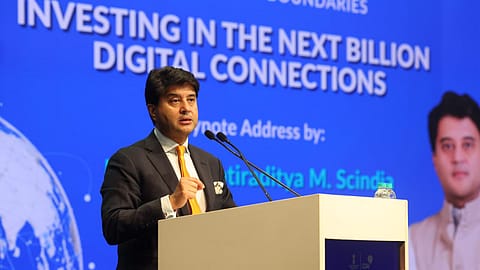
Communications Minister Jyotiraditya Scindia on Thursday said the government’s role in India’s telecom sector had shifted from being a regulator to becoming a facilitator and partner for industry, as the country seeks to attract more investment and build out next-generation digital infrastructure.
“The government has to move in a country from its earlier role of being a regulator to its newer role of being a facilitator. We are partners in the ecosystem,” Scindia said at India Mobile Congress 2026 in New Delhi.
He said the government needed to work across the telecom value chain, including network and optical fibre equipment manufacturers, telecom operators, internet service providers and companies building applications and platforms on top of the infrastructure. “I want to emphasise that a little, not a rectangular table, but a round one. Because then the concept of partnership sinks in,” Scindia said.
He added that the minister should not sit at the head of the table but “in the middle of the table”, reflecting the government’s role as a partner in the ecosystem.
Scindia flags Telecommunications Act, spectrum reforms
Scindia said the government had overhauled a regulatory framework that had its origins in 1885, replacing it with the Telecommunications Act, 2023. He described the new law as “future forward facing” and said it had simplified the licensing architecture while introducing a voluntary migration mechanism for existing service providers. “We made it very simple from a regulatory standpoint, made the process very transparent,” he said.
The minister also highlighted the shift towards a fully digital regulatory framework, saying telecom companies should not have to keep running to government offices. "We have made all provisions on the Telecommunications Act completely paperless and fully digital,” he said.
Scindia said the government had also removed spectrum usage charges and changed the erstwhile adjusted gross revenue framework, while reducing the burden of bank guarantees on service providers. He also pointed to changes in spectrum management, including provisions for spectrum surrender, transfer and trading. “We put in place a spectrum management process where if there are certain incumbents that don’t require spectrum, they can surrender it, they can transfer spectrum, and they can do spectrum trading,” he said.
The minister said the reforms were also aimed at allowing companies to specialise in different parts of the telecom value chain instead of having to operate across the entire ecosystem.“The network provider has a different nomenclature. The equipment provider has a different nomenclature. The service provider has a different nomenclature,” he said.
Scindia also highlighted the government’s production-linked incentive scheme for telecom equipment, saying it had resulted in close to ₹1.1 lakh crore in incremental sales and around ₹25,000 crore in investment. The minister said infrastructure sharing was another area where the government was seeking to lower costs for private operators.
According to Scindia, infrastructure-sharing measures have resulted in around a 25% reduction in capital expenditure and a 33% reduction in operating expenditure. He said the government was also investing around ₹12,000-15,000 crore to extend mobile connectivity to about 35,000 villages that still do not have signals, with around 26,000 towers being set up.
The comments come as the government seeks to push India deeper into the next phase of telecom development. Earlier at IMC, Scindia said India was targeting one billion 5G users by 2030, up from around 550 million currently, while aiming to lead in 6G.
{{#most-powerful-women-snapshot-individual.slug}} {{/most-powerful-women-snapshot-individual.slug}} {{^most-powerful-women-snapshot-individual.slug}} {{/most-powerful-women-snapshot-individual.slug}} {{#showRanking}} {{current-rank}} {{/showRanking}} {{#photo.0.url}}
{{name}}
Scindia said the broader objective was to make government intervention complementary to private investment rather than replace it. “Government should not substitute markets where they can succeed, but it should help create markets where they cannot emerge on their own,” he said. The approach, he added, would be particularly important in areas where commercial returns are not sufficient to justify private investment.
The government would therefore focus on building shared infrastructure that private operators can use, while allowing the private sector to drive services and last-mile connectivity.
Follow Fortune India
NEXT STORY