Defence Ministry clears ₹2.12 lakh crore military procurement; 82% of acquisitions to come from Indian industry
/ 2 min read
Defence Acquisition Council approves light multi-role helicopters, long-range Kamikaze drones, air defence systems and surveillance platforms for the Army, Navy and Air Force.
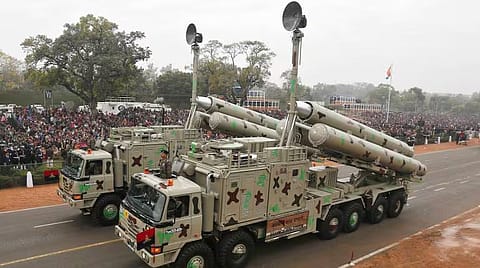
Representational Image | Credits: File photo
The Defence Ministry on Monday approved military procurement proposals worth ₹2.12 lakh crore, with approximately 82% of the acquisitions to be sourced from Indian industry.
The clearances cover a broad range of military platforms and weapons, including light multi-role helicopters, long-range Kamikaze drone systems, artillery equipment, surveillance platforms and air defence systems, providing a potential boost to the domestic defence manufacturing ecosystem.
The proposals were cleared by the Defence Acquisition Council (DAC), chaired by Defence Minister Rajnath Singh. The approvals span the Indian Army, Navy and Air Force, reflecting demand across multiple equipment categories. However, the Acceptance of Necessity (AoN) clearances mark an initial stage in the procurement process and should not be construed as final contract awards.
Army procurement spans helicopters, artillery and drones
For the Indian Army, the DAC approved high-mobility vehicles, a self-propelled tracked gun system, light multi-role helicopters (LMRH), very short-range air defence systems and counter-unmanned aerial systems (C-UAS).
The approvals also cover other unmanned aerial systems, surveillance unmanned aerial vehicles, an integrated surveillance and strike system, and a long-range Kamikaze drone system. These categories could create opportunities for Indian manufacturers operating across aerospace, artillery, electronics, sensors and unmanned systems, subject to subsequent tendering and contract allocation.
The inclusion of counter-drone capabilities and long-range unmanned strike platforms also highlights the growing importance of technologies designed for surveillance, threat detection and precision operations.
Navy, Air Force clearances widen addressable market
For the Indian Navy, the council approved the procurement of an active offboard decoy system (AODS) and other major naval platforms. The Indian Air Force received clearance for helicopters, air defence systems and radars.
The spread of approvals across the three services potentially widens the range of domestic suppliers eligible to participate in future procurement programmes. Businesses involved in radar technology, electronic warfare, aviation systems, naval equipment and defence electronics could benefit as the proposals move through subsequent stages.
Nevertheless, the eventual allocation of business will depend on procurement specifications, competitive bidding, eligibility requirements and the terms of individual contracts.
82% domestic sourcing underlines localisation push
The decision to source approximately 82% of the approved procurements from Indian industry reinforces the government’s emphasis on indigenisation and expanding domestic defence production.
For manufacturers, the proposed acquisitions represent a sizeable pipeline of potential business, although the ₹2.12 lakh crore figure refers to the value of approved procurement proposals, not confirmed orders or immediate revenue for defence companies.
{{#most-powerful-women-snapshot-individual.slug}} {{/most-powerful-women-snapshot-individual.slug}} {{^most-powerful-women-snapshot-individual.slug}} {{/most-powerful-women-snapshot-individual.slug}} {{#showRanking}} {{current-rank}} {{/showRanking}} {{#photo.0.url}}
{{name}}
The next milestones will be the progression of individual proposals through the acquisition process, followed by tenders and contract awards. These stages will determine the beneficiaries, execution schedules and eventual revenue opportunities arising from Monday’s approvals.
Follow Fortune India
NEXT STORY