Hotels beat airlines on earnings growth as RevPAR rises 15%, aviation struggles with capacity cuts
/ 3 min read
Revenue per available room (RevPAR) grew 15% year-on-year in the September quarter.
THIS STORY FEATURES
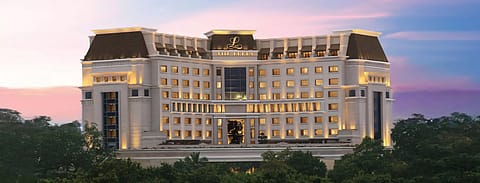
Credits: The Leela
India's hotel industry is heading into a busy second half of FY27, with rising room rates, strong wedding bookings and a packed events calendar keeping demand ahead of new supply. Hotel room rates in Mumbai, Delhi, Bengaluru and Hyderabad rose as much as 35% year-on-year in September, even as airline capacity cuts and geopolitical tensions weighed on travel, according to a report by Ambit Capital.
While hotel companies reported healthy earnings growth, the aviation sector continued to face pressure from elevated fuel costs and capacity constraints. Domestic air traffic declined around 6% year-on-year in August-September, while industry seat deployment was down approximately 5% in the September quarter. IndiGo's available seat kilometres fell 1% to 40.8 billion, with its load factor declining 2.2 percentage points to 80.3%.
The airline also reported a net loss of ₹1,880 crore, as fuel cost per available seat kilometre surged 68.9% year-on-year. IndiGo has since guided for capacity growth in the low single digits for FY27, a step down from its earlier expectations of high single-digit to early-to-mid double-digit growth.
The brokerage estimates that revenue per available room (RevPAR), a key measure of hotel performance, grew 15% year-on-year in the September quarter, with growth across the six listed hotel companies in its coverage ranging from 7% to 30%. Industry revenue is expected to grow 7-9% in FY27, while occupancy at premium hotels is projected at 72-74%.
What is particularly interesting is that the industry's expansion pipeline is yet to translate into a comparable increase in actual room availability. While hotel companies signed up 28,268 new rooms in the first half of calendar year 2026, up 8% from a year earlier, only 6,269 rooms were opened during the period, a 9% increase. New signings are running at 4.5 times actual openings, with project development delays holding back capacity additions.
The gap between demand and supply is also supporting room rates in major business destinations. Average room rates (ARR) in Mumbai, Delhi, Bengaluru and Hyderabad grew 9-35% in September, compared with growth of 0-8% in Chennai, Pune, Kochi, Ahmedabad and Chandigarh.
Weddings, corporate travel keep hotel demand buoyant
A significant part of the demand is coming from corporate travel, meetings, incentives, conferences and exhibitions (MICE), and large-scale events. Commercial office leasing, which drives business travel and hotel occupancy, touched a record 61 million square feet in the first nine months of calendar year 2026, growing 8% year-on-year. Global capability centres (GCCs) accounted for 43% of this, or a record 26 million square feet, with Bengaluru and Hyderabad leading demand.
The events calendar is providing another boost. The BRICS Summit, Global Fintech Fest and Semicon India helped lift national room rates by 10-12% year-on-year in September, while rates in New Delhi rose 33-35%. The second half of FY27 has 40 auspicious wedding dates, while next year is expected to have around 95 wedding nights, compared with the usual 60-65.
"Demand is broad-based across corporate, MICE, weddings and leisure, and it has absorbed a difficult quarter of airline capacity cuts, higher fuel costs and West Asia tensions," notes the report. It expects the stronger second half to sustain the industry's momentum.
"We prefer luxury and upper-upscale owners with iconic assets in supply-constrained cities, plus operators with scalable fee engines," the brokerage says with Leela being its top pick.
Indian Hotels Company (IHCL) reported 28% RevPAR growth at 82% occupancy in the September quarter, while Leela recorded 30% growth despite occupancy of 69%. ITC Hotels reported 21% growth at 76% occupancy, and Lemon Tree Hotels posted 18% growth at 76% occupancy.
{{#most-powerful-women-snapshot-individual.slug}} {{/most-powerful-women-snapshot-individual.slug}} {{^most-powerful-women-snapshot-individual.slug}} {{/most-powerful-women-snapshot-individual.slug}} {{#showRanking}} {{current-rank}} {{/showRanking}} {{#photo.0.url}}
{{name}}
IHCL also raised its FY27 revenue growth guidance to 15-17%, from 12-14% earlier. Its Taj Palace hotel in New Delhi recorded 132% growth in room revenue and crossed Rs 100 crore in monthly revenue in September.
The brokerage, however, flagged risks from a potential slowdown in corporate and IT hiring, airline connectivity constraints and an eventual pickup in hotel supply. As the 28,268 rooms signed in the first half begin translating into actual openings from FY28-29, pricing pressure could emerge, particularly in smaller cities and leisure destinations.
"Signings are running at 4.5x openings, as on- ground developments often run into delays, especially in the asset-light route, where the onus of development is on individual asset owners and not the branded operator," according to the report.
For now, Ambit remains more positive on hotels than aviation, citing lower cyclicality and stronger earnings visibility. It has retained Leela and IHCL as its top picks in the sector.


Follow Fortune India
NEXT STORY