How Aswath Damodaran arrived at Anthropic’s $1.475 trillion valuation
/ 3 min read
In his blog, Damodaran examined the company's financial disclosures and outlined the assumptions underpinning his valuation.
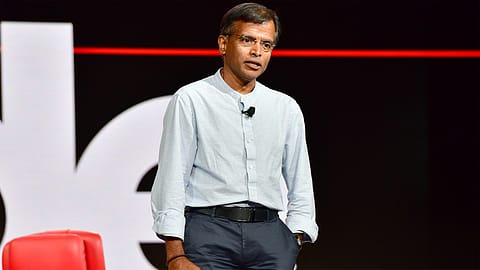
Aswath Damodaran | Credits: Getty Images
Aswath Damodaran, Professor of Finance at New York University's Stern School of Business, has valued artificial intelligence (AI) company Anthropic at $1.475 trillion, putting it near the lower end of the $1.5 trillion to $2 trillion IPO valuation range discussed in his analysis. In a blog post published on October 28, 2026, Damodaran assessed the company's growth prospects, profitability, capital requirements, and risks following its prospectus filing on October 26.
In his blog, Musings on Markets, titled “The Anthropic Prospectus Arrives: My (but not the) IPO Valuation!”, Damodaran examined the company's financial disclosures and outlined the assumptions underpinning his valuation.
Revenue grows 14-fold, but growth slows
Anthropic's revenue in the first two quarters of 2026 was approximately 14 times the level recorded in the corresponding period a year earlier. However, growth slowed in the third quarter as competition from OpenAI intensified, computing capacity constraints persisted and some enterprises shifted towards cheaper open-source models.
The company has also expanded its enterprise customer base. The number of customers spending more than $1 million annually on its Claude AI products increased to 1,900 from fewer than 100 a year earlier. However, customer concentration remains a concern, with the top five customers accounting for 25% of revenue.
Operating losses narrow as computing costs decline
Anthropic reported an operating loss of more than $8 billion for the first half of 2026, excluding non-cash and one-time charges. Its reported loss stood at $80 billion, including a $72 billion non-cash charge related to the conversion option of a convertible bond.
Damodaran noted that Anthropic's expenses were declining as a proportion of revenue. Computing costs, its largest expense, fell from more than 250% of revenue to 48% on a quarterly basis. The company also reported an operating profit in its most recent quarter, indicating progress towards profitability. However, sustaining profitability will depend on whether revenue growth can keep pace with future computing and research expenditure.
$600 billion in computing commitments
Anthropic has disclosed more than $600 billion in computing-related commitments, reflecting the substantial infrastructure required to develop and deploy advanced AI models.
While these commitments could help the company secure the computing capacity needed to expand, they also expose it to significant future costs. Computing infrastructure requires regular upgrades and replacement, while data centres face rising power requirements, higher costs and potential opposition from local communities.
Damodaran cautioned that the company's investment needs would continue as it expands its computing capacity and develops more powerful models.
AI market could exceed $5 trillion
Damodaran estimates that the addressable market for AI products and services could reach $5 trillion or more, depending on the extent to which AI replaces employees, disrupts industries and expands across geographies.
He expects Anthropic to focus on the premium segment, where advanced models and enterprise applications could command higher margins. The company could also enter industries disrupted by its technology, including pharmaceuticals, by using AI agents for drug research and testing. Based on this outlook, Damodaran believes Anthropic's revenue could approach $1 trillion within a decade. For comparison, Walmart and Amazon currently generate annual revenues of approximately $700 billion to $750 billion each.
{{#most-powerful-women-snapshot-individual.slug}} {{/most-powerful-women-snapshot-individual.slug}} {{^most-powerful-women-snapshot-individual.slug}} {{/most-powerful-women-snapshot-individual.slug}} {{#showRanking}} {{current-rank}} {{/showRanking}} {{#photo.0.url}}
{{name}}
Premium products could deliver 32.5% operating margins
Damodaran expects the AI market to develop into two broad segments: lower-cost products competing primarily on price and premium offerings built around advanced models and enterprise requirements.
He estimates operating margins of around 10% for the mass-market segment and close to 40% for premium AI businesses, comparable to leading enterprise software companies.
Assuming premium products account for 75% of Anthropic's revenue and mass-market offerings contribute the remaining 25%, he estimates a pre-tax operating margin of 32.5%. However, achieving these margins will require the company to sustain revenue growth while managing the costs of computing infrastructure and research and development.
Cash reserves provide a buffer against risks
Anthropic's cash balance of $114 billion provides a cushion against its substantial financial commitments. Damodaran noted that a potential additional $100 billion from the IPO could further strengthen its ability to meet near-term obligations. Nevertheless, he identified operating leverage, financing commitments and dependence on continued growth as key risks. Enterprise customers could reduce AI spending during economic downturns, while the company's large computing commitments could strain its finances if revenue growth disappoints.
Damodaran estimates Anthropic's cost of capital at 9.74%, reflecting the risks associated with its business model and infrastructure commitments. This compares with a median cost of capital of 9.16% for US companies in September 2026. He cautioned investors against treating the prospectus as a definitive assessment of AI's future, arguing that it represents a snapshot of a young and evolving business. Anthropic's long-term valuation will ultimately depend on its ability to translate rapid growth into sustainable earnings and cash flows.
Follow Fortune India
NEXT STORY