India is the world’s greatest investment opportunity and growth story: Harsh Gupta Madhusudan
/ 5 min read
In his new book, Long India, launched this week, Harsh has propounded the view that India’s growth will be higher than what people expect. He also projects rupee to witness an appreciation in the coming decade
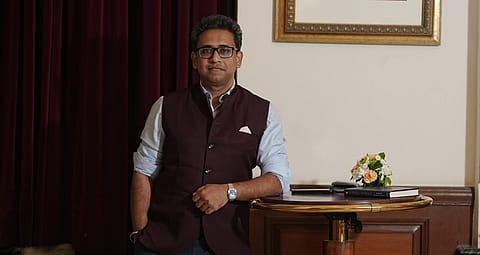
Harsh Gupta Madhusudan, Chief India Strategist at Ionic Wealth by Angel One
Harsh Gupta Madhusudan, Chief India Strategist at Ionic Asset, argues that India can embark on a journey to high growth building on scale, rewarding capital models, and a stable macro environment. In exclusive interview with Fortune India, Madhusudan says that for this to happen, policy thrust, state capacity, and political economy consensus will have to come together.
Ashutosh Kumar: Let me begin by asking you a devil's advocate kind of a question. At a time when we have seen the FIIs extinguish their positions, rupee depreciate, geopolitics exposing us to vulnerabilities on energy, rare earth etc and the overall uncertainty of the VUCA world, what makes you advocate the long position on India?
Harsh Gupta Madhusudan: Right. So, I begin the book by saying that before you read the book, let me read the room. And I exactly count the things you mentioned, FIIs selling, the rupee falling, the AI story not having clear benefit when you have a downside, our cities failing in terms of infrastructure given the pollution, and perceived safety issues, and people wanting to emigrate etc.
So, I spend good two pages saying that listen, I recognize the reality. So, I want to begin by setting the tone that I am not living in La La Land, and I am not delusional. But I will talk in the book is about the delta, the change, the space of the change.
The book's message is for 20 years not for twenty days. My message is obviously for the next decade, next generation and even to some extent beyond. I am very optimistic and there are three key messages in the book. I am optimistic on Indian growth for reasons that are less explored.
The first message is that India’s growth will be higher than what people expect. Secondly, unlike China, Indian capital model rewards investors, both domestic and foreign. Thirdly, India’s macro environment is genuinely at an inflection point.
I also make a claim that the Indian rupee is likely to see appreciation in the coming decades, after a century of depreciation. If you combine the three together, it offers a tsunami of growth opportunities. But this requires policy thrust, state capacity, and political economy consensus for it to play out. But India is the world’s greatest investment opportunity and growth story. The underlying variable in the entire book is the variable of scale.
Question. So, what are the unexplored reasons on which your India’s growth prognosis is based and how does the concept of scale fit in?
Answer: So, on the unexplored aspect, we all know demographics, but I bring a new point - scale.
Scale is very important in a world that is geoeconomically fracturing, where WTO has stooped low, America itself is leading tariff wars, efficiently run city states like Singapore or earlier Dubai, are not as attractive suddenly, and the seas around you are not safe.
We are signing FTAs with the European Union now, the US maybe, Canada, Australia, and the UK. And on the other hand, we are also doing smart industrial policy, which was almost heterodoxy and anathema about a decade ago.
{{#most-powerful-women-snapshot-individual.slug}} {{/most-powerful-women-snapshot-individual.slug}} {{^most-powerful-women-snapshot-individual.slug}} {{/most-powerful-women-snapshot-individual.slug}} {{#showRanking}} {{current-rank}} {{/showRanking}} {{#photo.0.url}}
{{name}}
The Indian establishment, the Indian technocrats have come to that conclusion that even if the import substitution license model did not work in the 60s and 70s, we may have overcorrected it 90s. And so, we want free markets, we also want some import substitution, but this time the import substitution should be pro-scale and not anti-scale. Also, the main story remains structural reforms domestically, GST, IBC, state level reforms. West Bengal recently just repealed the Land Celing Act.
Question: What, according to you are the downside risks to the India story? We have distribution challenges, gaps in health and education. What are the probable downsides and how do we address those?
Answer: You're right. I think human capital is the main thing on which we have to focus. In the second chapter, I cover a lot of human capital. Okay. it's not just quantity, it's also quality.
See, everybody with age of 25 is literate. The average years of schooling is increasing. The malnutrition, undernutrition rates are falling, although they have to fall more. The maternal mortality rates, infant mortality rates are now near or below global averages and they are falling. India had a great deworming campaign, which is very useful for long-term IQ development and certain disease prevention. And that is, of course, all of this is generally downstream of prosperity.
And as you saw, the World Bank numbers on poverty, at least extreme absolute poverty, are going down. So human capital, to me, is very important, but I don't see it as a risk given the trajectory. Of course, if it dramatically slows, it is a risk. But when I see geopolitical risk, I see it as a short-term risk. I see it as a long-term benefit.
Question: Why do you say so? What is your prognosis?
Answer: Because, again, if the world is fracturing, you want to be in some large market. You want to have one leg in a large market. India now has a PLI scheme. After initial assembly, it is now coming out with PLI 2.0 called Electronic Component Manufacturing Scheme (ECMS). So, now we have to do more value-addition.
With these kinds of things, you can show the long runway to a corporate board sitting in Seoul or New York or LA or London. So, I think, in India, the scale is a way of collectively bargaining, while still having maximal domestic competition. And even maximum foreign competition, so long as the company invests here.
Question: ……so scale has to be the big thrust and the next frontier, according to you, right?
Answer: See, in India, scale ends up pulling in certain investment and talent because it is one market. Even European Union is not one market. And if you really look beyond America and China, there is no other large growth story.
In fact, America and China are slowing, but they're already rich at least. America more so, China less so, but China has four times the population of America and India's population. There is nowhere on earth where you can go and put serious capital and actually expect it to give decent returns over 10-20 years.
Question: In fact, India has exhibited outlier growth even in the face of world’s biggest ever energy crisis recorded in history. What is your take on the factors behind the resilience shown till now by the Indian economy amidst wars, tariff crisis etc?
Answer: We had built a lot of macro buffers before the shock. We were on a fiscal consolidation glide path. We had a lot of wiggle room on the monetary policy side. And we did not immediately pass on the energy cost to the consumer. It may have been a political economy decision. But because of that, it did not have second order effects on the consumption. OMC took the hit on their books, which could later be cross subsidized by the government. So, I think there was an element of preparation.
There is an element of political economy. There is an element of luck also. Because no matter what we did, had it gone longer, it would not have worked.
Follow Fortune India
NEXT STORY