“Indian companies must focus on R&D and innovation outside their organisation,” Kris Gopalakrishnan
/ 7 min read
The former CEO and co-founder of Infosys says that Indian start-ups are primarily looking for an IPO unlike in the US where 85% of exits happen through acquisition, allowing companies such as Meta, Google or Microsoft to leverage such acquisitions
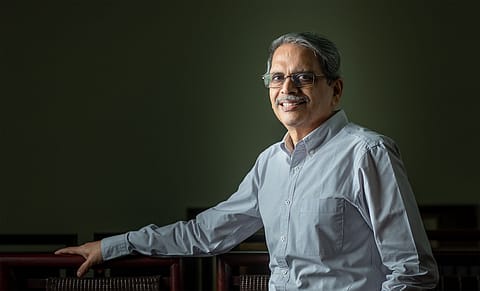
Kris Gopalakrishnan, Chairman of Axilor Ventures. | Credits: Nishant Ratnakar
Kris Gopalakrishnan has always had a ringside view of India’s fast-evolving IT sector. As one of the seven co-founders of Infosys, he was instrumental in building a company that helped put India on the global technology map and, in many ways, continues to remain the torchbearer of India’s famed IT revolution. Today, as the technology sector witnesses one of its biggest disruptions, led by geopolitical factors and AI, Gopalakrishnan continues to bet on India, its Deep tech ecosystem, and the opportunities available for India’s IT sector.
Critical to that, he maintains, is the role of private industry in India’s innovation. In FY 24, the private sector contributed 51.8% of India’s R&D expenditure, up from 33.8% in FY20. With total R&D spending at Rs 2.45 lakh crore, India’s next challenge will remain stronger university-industry partnerships, nurturing research talent, and ensuring adequate spending by the private sector.
In an interview with Fortune India, Gopalakrishnan, who is also the Chairman of Axilor Ventures, an accelerator that helps start-ups during the early stage of their business journey, talks about India’s Deep tech ecosystem, industry-academia collaboration, new areas of opportunity, and what lies ahead for India’s IT sector—edited excerpts.
Q. India still lags many countries when it comes to spending on innovation. How can we improve that to ensure global leadership in fundamental research and innovation?
On the optimistic side, spending on R&D is increasing and moving in the right direction. But there are areas for improvement, and we still need to increase the investment further. It is 0.84 percent of GDP right now, up from 0.7 percent last year. I would like to see this closer to 3%. Because when you look at Israel, it is probably closer to 4%. In South Korea and the US, the percentage is about 2.5%. The government is priming this by setting up missions such as the AI mission, the semiconductor mission, the quantum mission, and other missions in advanced manufacturing, advanced materials, and rare earth, among others. So, the private sector also needs to step up.
The other thing we need to see is innovation through mergers and acquisitions. If you are a startup, you are primarily looking for an IPO. If you look at the US, 85% of exits happen through acquisition. So, we need to create a climate for acquisitions. Companies need to look at innovation happening outside the company, leveraging venture funding, risk funding, and then, when something is proven, they acquire it. If you look at Meta or Google or Microsoft or any fast-growing US company, you will find that they leverage acquisitions significantly.
In contrast, in India, you don't have many examples of companies growing through acquisition. They typically do their R&D in-house. So, I would like to see more R&D or innovation done outside the organization.
Q. There are concerns that India has been missing out in Deep tech. What are your thoughts on where India stands today, and are there areas of improvement?
So, some data points. From 450 deep tech startups registered, let's say 10 years back, right now we have 4,500. I would like to see a 10x growth in the next 10 years. Deep tech is defined as something that is created in a lab, worked on in a lab, and then taken to market. So, we need to simultaneously increase the amount of research that's happening, create translational capabilities in our research labs, like IIT Madras Research Park or ART Park in the Indian Institute of Science, and get more research translated.
And that's how you will see more startups. It will require funding and for the industry to get involved in understanding what is happening in our lab, identifying those products that are interesting to them, and supporting this translation. So, the translation typically should be funded by industry. Right now, most of the funding is coming from government and some from VCs. But we will need to see more participation from industry. So, the industry-academia collaboration is something that is recently increasing in India, and I hope we will see more of that in the future.
Boards also need to start asking the question. What percentage of your revenue comes from products introduced in the last 3 years or last 5 years? That means there is continuous renewal. How much are you spending on R&D? How much are you spending on R&D outside the company? I think when these discussions start happening, you will see more products and technology created here.
{{#most-powerful-women-snapshot-individual.slug}} {{/most-powerful-women-snapshot-individual.slug}} {{^most-powerful-women-snapshot-individual.slug}} {{/most-powerful-women-snapshot-individual.slug}} {{#showRanking}} {{current-rank}} {{/showRanking}} {{#photo.0.url}}
{{name}}
The other thing is geopolitics and denial of technology. We are seeing that our dependence on imports of raw materials or sub-assemblies is a problem. In the pharma industry, when we see that it can be denied, then we need to create those. We need to do so for every product category that we believe to be strategic, which will generate export revenue. We need to see whether the complete value and supply chain can be created in India, all the way to research, backward integrated and into the research. I think those things are starting to happen.
Q: But can we realistically compete in areas such as semiconductors or quantum, competing with countries such as China or Korea?
It will not happen overnight. It requires significant investment, and it will take time. Just look at our efforts in semiconductors or electronics. We are making progress. And I am very confident that, category by category, if we make a concerted effort, we will get there. For example, in space, private companies are sending rockets or basic satellites. In defence, we are now talking about domestic manufacturing. I am optimistic that concerted efforts will happen in quantum. For example, we have QPiAI producing quantum computers in India. In the biotech sector, we have companies looking at antimicrobial resistance. In vaccines, we are 70% of the world's capacity. So, I think we need to pick up sectors where we have an advantage.
We have a domestic market, which will allow us to create a sustainable business, and then we need to look at exports to scale up and accelerate. So, we need to have a systematic plan. I know that there are efforts now, both in government and industry bodies, to make that happen, and that's what gives me hope.
Q: But there is no dearth of talent?
It is not a talent issue. It is the issue of resources, money, and time. Every GCC that's coming to India is coming to India for talent. Every technology that's out there has an element of Indianness in it.
Q: The IT sector has been hit hard in recent times due to numerous factors, both internal and external. Where are you seeing the Indian IT sector going forward?
IT services are going through some transformation, but I'm optimistic about its capability to continue to do well and continue to grow. It is growing; it is profitable, and it has a very loyal customer base. They work with the Global 2000. It has an experienced leadership. It has gone through many transitions, all the way from mainframe and Cobalt to Python and the like today.
So, it has gone through many such transitions, many ups and downs, and they have their expertise and experience in going through transitions. They have the training capability and capacity.
Now, in the short term, I think what is happening globally is that every company is figuring out what their response must be to AI; it does affect certain jobs, for example, programming. A lot of the programs now can be done by AI, but you still need human beings to review it and then go through the process of checking and integrating it with the rest of the systems. And then, as the economy grows, industry grows. So, I feel that well-run companies should do very well if they retrain their talent and keep up with the technology changes.
If you look at banking, computers were introduced in India in 1985. Today there is banking has completely changed, and the number of employees is significantly higher, and banking as an industry is big, much bigger. The services they deliver are much bigger. So, I am very optimistic because the talent that is necessary for the growth of the services industry is in India. That is why GCCs are growing. The flexible talent, which is trainable, which can absorb new technologies, which understands global business, all that is in India.
Now, if I go beyond IT services into the product category, I am again very hopeful that you will see products emerging out of India. We have companies now working on large language models, small language models, and vernacular language models. And then when it comes to the app economy, given that we are a large market, we have a huge talent pool of 6 million people well-versed in developing systems; I think the app economy also will do very well in India.
The last aspect of this is software. If you look at Ather, an electric 2-wheeler maker, there is a lot of software in it, and we have done it. We need to own the IP and that's where we need to work on, and that's the reason why I say it all starts with research. It all starts in academia. The focus there is shifting to do more applied research. More importantly, focus on translation, focus on incubating and creating startups.
Q: From a geopolitical point of view, what’s the impact on the IT sector with countries becoming more protectionist?
Yes, and no. See, India has its own challenges. In the 20th century, all the countries developed by burning fossil fuels. India is constrained to develop without burning fossil fuels. In the second half of the 20th century, it was about globalization, and all these countries developed when markets were open.
India is constrained from developing when markets are not open. But still, we are doing well, growing at 7-8%. I think we have a robust domestic market. We should explore new markets. We should look at these free trade agreements. But I think these constraints allow us to create new models for development, what I call the 21st-century development model for India. In financial services, for example, the entire payment infrastructure that we have created is amazing and super-efficient.
When I look back to 1993, India was a $600 billion economy. In 30 years, we are now $4 trillion. That is about 6 times. So, I am very optimistic. I think we have the talent, the people, the market, and the resources. The larger we grow, the more money we must invest in innovation. That's why the number of startups has increased. More risk funding and more VC funding are available. Philanthropy is supporting research. So is the government. So, I am optimistic. Irrespective of what the politics is, one thing everybody agrees, I believe, is that India must develop.
In the 70s and 80s, the first generation of startups were the IT services companies. Then the second generation of IT services companies happened in the 90s, with Mindtree, Cognizant, and Satyam. In the 2000s, the likes of Flipkart came. Now we have the first generation of deep tech startups. Look at IdeaForge and Ather. So, you have the next generation of startups emerging. So, every generation finds new winners.
Follow Fortune India
NEXT STORY