India’s $13.5-billion chip bet: PM Modi signals bigger semiconductor push at SEMICON 2026
/ 2 min read
So far, 12 semiconductor manufacturing projects have been approved under the government’s semiconductor programme, says PM.
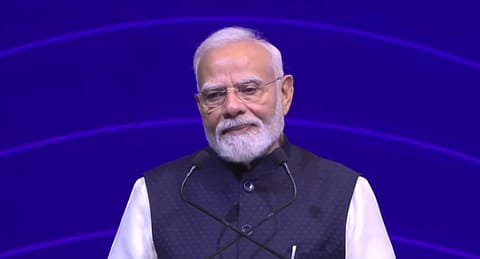
Prime Minister Narendra Modi, who turned 76 on Wednesday, visited the SEMICON India 2026 exhibition at Yashobhoomi and interacted with participants before inaugurating the fifth edition of the event.
India will expand the outlay for the second phase of the India Semiconductor Mission (ISM) to $13.5 billion from $8 billion in the first phase, Prime Minister Narendra Modi said on Thursday at the inauguration of SEMICON India 2026 in New Delhi.
Modi, who turned 76 on Wednesday, visited the SEMICON India 2026 exhibition at Yashobhoomi and interacted with participants before inaugurating the fifth edition of the event. “India’s economy is expanding rapidly and so is the world’s confidence in India,” Modi said, citing the country’s strong first-quarter GDP growth and JCRA’s upgrade of India’s rating.
India looks to scale up chip manufacturing
So far, 12 semiconductor manufacturing projects have been approved under the government’s semiconductor programme, Modi said, adding that the number is expected to rise further in the next phase.
“India is taking all steps to become a preferred destination for semiconductor manufacturing,” Modi said, adding that the country’s semiconductor ecosystem is expanding rapidly and creating new opportunities for innovation, investment and growth.
The prime minister said the global semiconductor industry needs new and trusted locations for chip manufacturing and India is preparing itself to play a larger role in the sector.
“World needs new and trusted locations for chip manufacturing and India is preparing itself for this,” Modi said at the conference.
From chip factories to a wider semiconductor ecosystem
The government has positioned SEMICON India 2026 as a platform for industry engagement, policy discussions, investment and international partnerships. The event is being held from September 17 to 19 at Yashobhoomi in New Delhi and is being organised by the India Semiconductor Mission, the Ministry of Electronics and Information Technology (MeitY) and SEMI, the global semiconductor industry association.
The theme for this year’s event is “Silicon to Systems: Building the Ecosystem”, reflecting India’s broader ambition to build an end-to-end semiconductor ecosystem rather than focus only on chip fabrication.
The ecosystem push envisages bringing together chip designers, manufacturers, suppliers, equipment makers, engineers and electronics manufacturers to integrate India’s semiconductor capabilities with global supply chains.
The PM said the government has set a target of training 1 lakh engineering students for the semiconductor industry, of which more than 70,000 have already been trained. He urged young researchers, both in India and abroad, to come forward and contribute to the development of advanced technologies in the country.
Global chipmakers deepen India investment
Meanwhile, Applied Materials announced a $5 billion investment under its Vision 2035 initiative to strengthen India’s semiconductor ecosystem and integrate it with the global value chain.
{{#most-powerful-women-snapshot-individual.slug}} {{/most-powerful-women-snapshot-individual.slug}} {{^most-powerful-women-snapshot-individual.slug}} {{/most-powerful-women-snapshot-individual.slug}} {{#showRanking}} {{current-rank}} {{/showRanking}} {{#photo.0.url}}
{{name}}
Micron Technology CEO Sanjay Mehrotra said India’s semiconductor policy push has provided the industry with a strong foundation, with the country now moving from “vision to execution”. He also announced plans to scale up the company’s chip assembly and testing facility in India several-fold next year.
“For decades, people have talked about India’s semiconductor potential. I have been in many of those conversations. Potential does not ship products. What I see in India today is execution,” Mehrotra said at the inauguration of SEMICON India 2026.
Follow Fortune India
NEXT STORY