India's textile-apparel exports stuck at $37 billion for a decade; $100-billion FY31 target needs 20% annual growth
/ 3 min read
Bangladesh and Vietnam have increased their global apparel export shares by four and three percentage points, respectively, while India's share has declined, highlighting the country's struggle to convert its manufacturing strength into export growth, according to a BCG-CII report.
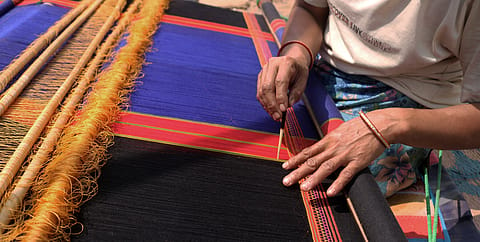
Textile Industry | Credits: Shutterstock
India's textile and apparel exports have remained largely stagnant at around $37 billion over the past decade, even as competing manufacturing destinations Bangladesh and Vietnam expanded their presence in global markets. India will now need to grow exports by more than 20% annually to achieve its $100-billion export ambition by FY31, according to a report by Boston Consulting Group (BCG) and the Confederation of Indian Industry (CII).
The report, Winning the Global Wardrobe: India's Roadmap to Textile and Apparel Leadership, estimates India's textile and apparel industry at $190–200 billion, with domestic consumption accounting for nearly 80% of the market. The sector employs more than 45 million people and contributes around 13% to India's industrial output.
While the industry is targeting a size of $350 billion by FY31, the report identifies exports as a major area requiring improvement. India's combined textile and apparel exports stood at around $37 billion in 2015 and remained at the same level in 2025.
Bangladesh, Vietnam gain as India loses ground
The competitive gap is particularly visible in global apparel exports. China's share declined by 10 percentage points, from 37% in 2015 to 27% in 2025. Bangladesh increased its share from 7% to 11%, while Vietnam's share rose from 5% to 8%. India's share, meanwhile, slipped from 4% to 3%.
The report said global sourcing strategies were changing as brands diversified beyond China and increasingly consolidated orders with fewer, larger suppliers. However, Bangladesh and Vietnam were better positioned to capture the shift.
India accounts for around 6% of global textile exports but only 3% of global garment exports, pointing to a gap between its upstream manufacturing capabilities and finished apparel production.
“India has already established its manufacturing credentials, and the next opportunity is to translate its upstream strength into a stronger position in finished apparel,” said Nishant Shekhar, managing director and Partner, India Head, Consumer Practice at BCG.
He said India had an opportunity to increase the share of integrated clusters connecting spinning to garmenting from the current 5–6%, while expanding its presence in synthetic-led categories such as knitwear, outerwear and sportswear.
Productivity, fibre availability remain challenges
The report identified manufacturing productivity, fragmented capacity and limited automation as key constraints. Bangladesh's factories were found to have around 20% higher labour productivity, 1.5 times greater automation and 10–15% lower labour costs than Indian counterparts. The report's illustrative benchmark also estimated that Bangladesh could manufacture a basic shirt in around 20% fewer minutes.
India's limited presence in synthetic-led apparel is another concern. The country has less than 1% share in global knitwear, outerwear and sportswear exports, despite the growing importance of these categories.
Textiles Secretary Neelam Shami Rao said fibre availability and affordability would be critical to improving competitiveness. With per-capita fibre consumption projected to increase from around 5 kg to 10–15 kg over the next 20 years, India's fibre production would need to rise from 14–15 million metric tonnes to 22–26 million metric tonnes over the next eight years.
{{#most-powerful-women-snapshot-individual.slug}} {{/most-powerful-women-snapshot-individual.slug}} {{^most-powerful-women-snapshot-individual.slug}} {{/most-powerful-women-snapshot-individual.slug}} {{#showRanking}} {{current-rank}} {{/showRanking}} {{#photo.0.url}}
{{name}}
“The current global realignment of sourcing presents an important window for India, but it is not one that will remain open indefinitely,” she said, calling on businesses to move beyond transactional trade and build long-term relationships with global buyers.
CII's Kulin Lalbhai said garmenting alone generates approximately 30 jobs for every ₹1 crore invested, underlining the employment potential of expanding finished-apparel manufacturing.
The report also identified AI and automation as important productivity levers. BCG said AI-led interventions could improve manufacturing productivity by more than 20%, reduce defect rates by over 20% and lower material waste by 6–9%.
Follow Fortune India
NEXT STORY