New Delhi Declaration: What BRICS conveys to US President Trump
/ 3 min read
Similarly, the New Delhi Declaration’s significance lies in bringing BRICS members like Iran and UAE into a consensus position on the escalating tensions in West Asia.
The Declaration also prefers dialogue and diplomacy over armed conflict, towards a long-term understanding that will contribute to lasting peace, security and stability in the region.
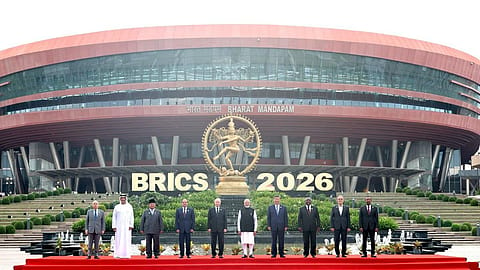
The New Delhi Declaration, unanimously adopted by the leaders of BRICS member countries on September 11 at the18th BRICS Summit hosted by India, stands out as a subtle, yet clear rebuttal of several policies pursued by US President Donald Trump, many of which are having geopolitical and economic implications across the world.
While the overall tone of the Declaration emphasises mutual respect and understanding, sovereign equality, openness, inclusiveness, collaboration and consensus – principles that stand in contrast to some of the unilateral policy and often abrupt announcements of the Trump administration - there are several specific instances where its message appears clearly directed at actions taken by the US President, even though he is not named.
For instance, the New Delhi Declaration expresses concern over the rise of unilateral tariff and non-tariff measures that distort trade and are inconsistent with WTO rules. The BRICS leaders stated that such measures could further constrain global trade, disrupt global supply chains, and create uncertainty for global economic and trade activities. They said such developments could potentially exacerbate existing economic disparities and negatively affect prospects for global economic development. The reference is relevant in the context of US Trade Policy under Trump. Since Trump revised existing tariffs upwards and introduced the concept of ‘reciprocal tariffs’ against most of the trade partners of the US last year, “unilateral tariff” measures have emerged as a major irritant for several countries, including most BRICS nations.
Similarly, the New Delhi Declaration’s significance lies in bringing BRICS members like Iran and UAE into a consensus position on the escalating tensions in West Asia. The Declaration calls for exercising maximum restraint, as well as avoiding actions that could further aggravate the situation. It goes on to ask for ‘the protection of civilians and civilian infrastructure in accordance with the purposes and principles of the Charter of the United Nations in their entirety and interconnectedness, including respect for the sovereignty and territorial integrity of the States’.
The Declaration also prefers dialogue and diplomacy over armed conflict, towards a long-term understanding that will contribute to lasting peace, security and stability in the region. It has condemned deliberate attacks on civilian infrastructure and peaceful nuclear facilities under full safeguards of the International Atomic Energy Agency (IAEA), in violation of international law and relevant resolutions of the IAEA. The BRICS position assumes significance given the central role played by the US in the ongoing West Asian conflict.
Unilateral economic sanctions and secondary sanctions are another frequently used US policy instrument that gets criticised in the New Delhi Declaration. The BRICS leaders have found such sanctions that have far-reaching negative implications for the human rights, including the rights to development, health and food security, of the general population of targeted states, disproportionally affecting the poor and people in vulnerable situations, to be the most troublesome ones.
The BRICS nations’ support for established multilateral organisations particularly the United Nations also stands in contrast with Trump’s policy against several UN organisations. The Declaration deplores attempts, including by deliberately withholding assessed contributions, to unilaterally undermine the work of global multilateral institutions and impair the implementation of their respective mandates. In February 2025, President Trump had announced the US withdrawal from and ending of funding to certain United Nations organisations while also reviewing funding support to all international organisations.
The BRICS leaders may not have named any country, but New Delhi Declaration is loaded enough. That in itself should be considered as one of the key outcomes of the Summit.
Follow Fortune India
NEXT STORY