Race to 500 GW: India’s renewable energy titans battle for leadership
/ 4 min read
The country is now the third-largest in solar power capacity (150.26 GW), fourth in wind energy (56.09 GW), and fifth in hydroelectric power capacity (51.41 GW of large hydro and 5.17 GW of small hydro).
THIS STORY FEATURES
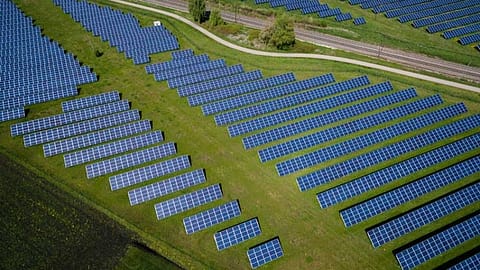
Adani Green Energy Ltd continues to lead India’s renewable energy sector in terms of operational capacity. | Credits: Aditya Birla Renewables
Competition is heating up among India’s leading renewable energy developers—including the Adani Group, Tata Power, ReNew, public sector giant NTPC Green Energy and JSW Energy—as they vie for leadership in one of the world’s fastest-growing clean energy markets.
With India targeting 500 GW of non-fossil fuel capacity by 2030, the rapid pace of capacity addition in recent years has already propelled India into the top ranks globally. The country is now the third-largest in solar power capacity (150.26 GW), fourth in wind energy (56.09 GW), and fifth in hydroelectric power capacity (51.41 GW of large hydro and 5.17 GW of small hydro).
Adani Green Energy: Crosses 20 GW milestone
Adani Group's Adani Green Energy Limited (AGEL) continues to lead India’s renewable energy sector in terms of operational capacity. The company’s operational portfolio grew 27% year-on-year to 20.142 GW, driven by a greenfield addition of 4,327 MW.
During the latest quarter alone, AGEL commissioned 848 MW. Its annual additions comprised 3,051 MW of solar capacity—including 2,662 MW at Khavda in Gujarat and 389 MW in Rajasthan—along with 684 MW of wind capacity and 592 MW of solar-wind hybrid capacity, all at Khavda.
“We are on track to add greenfield capacity of 5 GW of renewable and more than 10,000 MWh of BESS capacity by FY27. We commenced FY27 with strong momentum, underpinned by disciplined execution that enabled us to surpass the 20 GW milestone, alongside a strengthening demand environment,” according to Ashish Khanna, CEO, Adani Green Energy.
Tata Power: Creating an integrated clean energy platform
Tata Power has expanded its total renewable portfolio to 12 GW, comprising 6.7 GW operational (5.4 GW solar and 1.3 GW wind) and 5.3 GW under implementation. The company’s total operational and under-construction generation capacity has now crossed 26 GW, including approximately 17.7 GW of clean and green energy capacity and around 8.8 GW of thermal generation capacity.
The company recently commissioned Ladakh’s first commercial rooftop solar project, a 50 kWp system in Leh, marking the region’s entry into distributed clean energy. It also commissioned the 100.8 MW Jewali Wind Project in Dharashiv, Maharashtra, which is expected to generate 299 million units annually and supply clean electricity to Tata Power Mumbai Distribution.
Tata Power continues to lead India’s rooftop solar segment, installing 371 MWp during the quarter, a 37 per cent year-on-year increase.
“With more than ₹5,000 crore deployed towards capex during Q1, we have begun FY27 with a strong project implementation roadmap,” says Praveer Sinha, CEO and Managing Director, Tata Power.
ReNew: Big utility-scale and storage play
ReNew has continued its rapid expansion, with its portfolio increasing to 20 GW as of March 31, including 1.7 GW/6.2 GWh of Battery Energy Storage Systems (BESS), compared with 17.3 GW a year earlier.
The company commissioned 2.4 GW during FY26, its highest-ever annual capacity addition, and expects to complete another 1.6-2.4 GW during FY27.
{{#most-powerful-women-snapshot-individual.slug}} {{/most-powerful-women-snapshot-individual.slug}} {{^most-powerful-women-snapshot-individual.slug}} {{/most-powerful-women-snapshot-individual.slug}} {{#showRanking}} {{current-rank}} {{/showRanking}} {{#photo.0.url}}
{{name}}
Its commissioned capacity rose 16.6 per cent year-on-year to around 12.6 GW, including 100 MW/250 MWh of BESS, by March 31, 2026. Subsequently, ReNew commissioned another 247 MW, taking its operational capacity to 12.8 GW.
JSW Energy: Diversifying across renewables
JSW Energy commissioned 1,081 MW of renewable energy capacity since April 2026, increasing its total installed capacity to 14,535 MW.
The additions comprise 442 MW of solar, 108 MW of wind, 381 MW of hybrid and 150 MW of hydroelectric capacity.
Renewable energy now accounts for 61 per cent of the company’s installed capacity, including 3,764 MW of wind, 2,500 MW of solar, 832 MW of hybrid and 1,781 MW of hydro, while its thermal portfolio stands at 5,658 MW.
JSW Energy has a total locked-in generation capacity of 32.1 GW, comprising 14.53 GW operational, 13.0 GW under construction across thermal, hydro and renewable assets, along with a 4.6 GW development pipeline.
The company remains on track to achieve its FY27 renewable capacity addition target of 3 GW, having already commissioned about one-third of this target by July—equivalent to nearly 87 per cent of the total greenfield capacity added during FY26.
JSW Energy aims to reach 30 GW of generation capacity and 40 GWh of energy storage capacity by 2030, while achieving carbon neutrality by 2050. It has already secured 29.6 GWh of locked-in energy storage capacity, comprising 26.4 GWh of pumped hydro storage and 3.2 GWh of battery energy storage systems.
NTPC Green Energy: PSU renewable powerhouse
NTPC Green Energy Ltd (NGEL) has emerged as the country’s largest public-sector renewable energy developer, commissioning over 10 GW of renewable energy capacity and reaching 10,126 MW as of March 31, 2026. The company commissioned 4,225 MW during FY26, including 2,116 MW during the fourth quarter alone.
The annual additions include 2,560 MW from the Khavda Renewable Energy Park, 500 MW at Bhadla, 250 MW at Pavagada, 250 MW at Kadapa, along with several other projects across multiple states. NGEL has set an ambitious target of achieving 60 GW of renewable energy capacity by 2032.
Other emerging contenders
The competition extends well beyond the top five developers. The Greenko Group has built around 7.5 GW of wind, solar and advanced pumped-storage hydro assets, making it one of India’s largest integrated renewable-plus-storage companies.
Meanwhile, the Avaada Group has developed a 17.7 GWp portfolio—operational and under construction—spanning utility-scale solar generation, green hydrogen and solar module manufacturing, positioning itself as another major integrated clean energy player.


Follow Fortune India
NEXT STORY