RBI Governor defends Tata Sons' upper-layer NBFC classification, says such entities must list
/ 2 min read
Malhotra clarified that CICs without direct or indirect access to public funds are exempt from the registration requirement. However, entities that qualify as NBFCs under the RBI's definition and have access to public funds must register, while those classified in the upper layer are required to list.
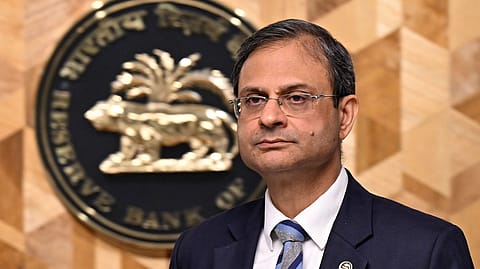
Sanjay Malhotra, Governor, RBI | Credits: Getty Images
Reserve Bank of India (RBI) Governor Sanjay Malhotra on Friday defended the regulatory requirements for large non-banking financial companies (NBFCs) and core investment companies (CICs), saying entities classified in the upper layer must be listed on stock exchanges if they fall within the central bank's framework.
Speaking at an event on Friday, Malhotra said large NBFCs and CICs that access public funds need to be registered with the RBI because of the systemic risks they can pose.
“These CICs, or NBFCs, are required to be registered,” he said, explaining that such entities sit at the top of corporate groups, raise funds and may rely on the balance sheets of group companies to repay them.
“The funds of the public, whether it is through corporate bonds, banks and other means, that is at risk,” he said.
Malhotra clarified that CICs without direct or indirect access to public funds are exempt from the registration requirement. However, entities that qualify as NBFCs under the RBI's definition and have access to public funds must register, while those classified in the upper layer are required to list.
“As long as it is an NBFC within our definition, it is a CIC, it has access to funds, direct or indirect, it's required to be registered, and if it is in the upper layer, then it is required to list,” he said.
Tata Sons listing remains under scrutiny
The remarks come after the RBI rejected Tata Sons' application to surrender its registration as a non-banking financial company in September, leaving the holding company of the Tata Group subject to the existing regulatory framework.
Tata Sons was classified as an upper-layer NBFC in September 2022. It applied to surrender its registration in March 2024 after repaying its debt in an effort to qualify for deregistration.
Under the RBI's scale-based regulatory framework, NBFCs classified in the upper layer are required to list within three years of identification. Tata Sons' original listing deadline passed in September 2025.
The RBI's rejection of its deregistration application leaves Tata Sons facing the listing requirement under the existing framework. However, the timing and outcome remain uncertain as the group considers alternatives.
The Tata Sons board has moved ahead with steps linked to a possible public listing while indicating that other options would also be examined amid differences within the group.
{{#most-powerful-women-snapshot-individual.slug}} {{/most-powerful-women-snapshot-individual.slug}} {{^most-powerful-women-snapshot-individual.slug}} {{/most-powerful-women-snapshot-individual.slug}} {{#showRanking}} {{current-rank}} {{/showRanking}} {{#photo.0.url}}
{{name}}
RBI prioritises price stability alongside growth
Separately, Malhotra reiterated that maintaining price stability through inflation targeting remains a key priority for the central bank, alongside supporting long-term economic growth.
He said India's macroeconomic fundamentals remained supportive of economic activity, with high-frequency indicators pointing to resilient growth across sectors. Cement and steel sales, credit growth, tax collections and automobile sales were among the indicators cited as evidence of broad-based momentum.
Malhotra said inflation remained within the RBI's tolerance band, although supply-side pressures, particularly from food and fuel, continued to pose challenges. He referred to an average inflation projection of 5.1% for the current fiscal year, attributing the outlook to supply-side factors.
On the rupee, the governor said the RBI was not targeting any particular exchange-rate level. The central bank's focus, he said, was on maintaining orderly conditions in the foreign exchange market and managing volatility rather than defending a specific value of the currency.
Follow Fortune India
NEXT STORY