Sebi chairman Pandey calls for setting up of a ‘capacity building’ network to strengthen corporate governance at boardrooms
/ 2 min read
"The capabilities of a boardroom must change as the nature of risk changes," he said.
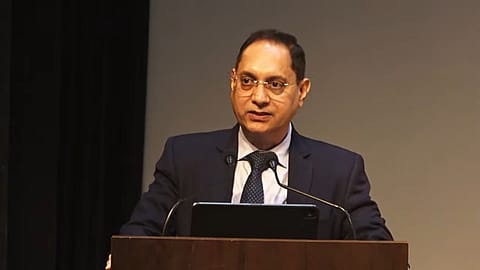
Sebi Chairman Tuhin Kanta Pandey
The Securities and Exchange Board of India chairman Tuhin Kanta Pandey on Saturday urged that the National Institute of Securities Markets (NISM) – a public trust created by Sebi – along with industry associations, professional institutes, academic institutions and other stakeholders work together to create a capacity building network.
Pandey called capacity building the next frontier of governance. “This network may suggest effective ways for capacity development of independent directors at scale and quality. We propose to invite the willing and capable partners, including IOD, soon to give shape to this idea,” Pandey told the Institute of Directors (IoD) Annual Directors’ Conclave 2026 in New Delhi.
In May 2026, Sebi, NISM, and Indian Institute of Corporate Affairs (IIFA) had signed an MoU to advance corporate governance, ESG and capital markets in India.
“If the nature of risk is changing, the capabilities of the board must change as well, Pandey told the audience.
“An independent director does not need to be the organisation's technology expert. But the director must know enough to ask the right questions. The same applies to AI, financial innovation, market structure, ESG risks, regulatory developments, behavioural risks and geopolitical developments.” He said it was “unrealistic” to expect that every director will come equipped with all these perspectives,” he added.
The role of corporate governance amongst boardrooms in corporate India has become a critical issue not just for the listed entities but also the market regulators, particularly at a time when more companies are tapping the capital markets to raise capital and sophistical financial products are entering India.
Pandey also highlighted that technology risk is business risk. “And therefore, it is board risk. This is why cyber resilience, technology governance, operational resilience and risk management are becoming increasingly important components of the wider governance framework.”
“Regulators can set standards. Exchanges can build systems. Auditors can provide assurance. Institutional investors can exercise stewardship. But ultimately, governance lives in the boardroom,” he said.
Pandey said the IoD can help create a culture where boardrooms do not merely ask, “Are we compliant? They ask: Are we being responsible? Are we being fair? Are we prepared for what comes next? And perhaps the most important question of all: Would our decisions strengthen or weaken the trust that stakeholders place in us?”
Follow Fortune India
NEXT STORY