The FAQs are AI-generated, and Fortune India is not responsible for its content or any associated copyright issues.
Sun Pharma’s Organon acquisition: Dilip Shanghvi’s high stakes bet for big growth
/ 3 min read
The deal will give Sun Pharma access to Organon’s biosimilars portfolio, a missing link in the Indian pharma company’s product basket.
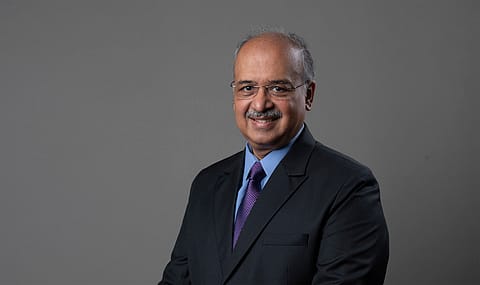
Dilip Shanghvi, Founder, Sun Pharmaceuticals | Credits: Padmini B
What prompted India’s largest pharmaceuticals company, Sun Pharmaceutical Industries—operating smoothly with revenues of over $6.2 billion in FY25 and a strong balance sheet with $3.1 billion in cash—to go for a risky acquisition of almost same-sized Organon, with $6.2 billion revenues in FY25, debt of $8.6 billion and a de-growing company, in an all‑cash transaction for nearly $12 billion?
Dilip Shanghvi, founder of Sun Pharma, who has done such risky and complex acquisitions in the past—though smaller in size than this, such as Ranbaxy Laboratories in 2015 and a hostile acquisition of Taro of Israel in 2010—knows he is taking a calculated risk to fill some missing dots in his current growth trajectory and is investing for the future.
“'Organon’s growth has been flat in recent years, and with some investment and focus to improve processes and tools can reignite the growth trajectory of that company,” Shanghvi said at a press conference today, announcing the deal.
The deal, expected to close in early next year, will help Sun Pharma leapfrog into the Top 25 global pharmaceutical companies with a combined revenue of $12.4 billion and with access to newer geographies like China and Korea. Further, Sun will have access to some of the key missing portfolios for future growth.
Organon, which was first part of Akzo Nobel, was sold to Schering-Plough Corp. in 2007 and to MSD two years later, was formed as a separate company in 2021 through a spinoff from Merck, with women’s health products, biosimilars, and established brands. Merck is known as MSD outside of the US and Canada. Organon has six manufacturing facilities across the EU and emerging markets.
Organon is a global leader in women’s health, with a portfolio of more than 70 products across Women’s Health and General Medicines, which includes biosimilars, commercialised across 140 countries, with the US, Europe, China, Canada, and Brazil among its largest markets.
Big in women’s health
The acquisition will make Sun Pharma the third-largest player in the women’s health category across the globe. Sun’s main drivers in the past were dermatology, oncology, ophthalmology, and neurology, and it was missing women’s health, a major growth platform.
Organon has a leading position in the US contraceptives and fertility segment and is globally second in hormonal contraceptives and third in fertility. It had revenues of $1.752 million from women’s health sales in FY25, of which contraceptive Nexplanon alone contributed $921 million. Other major products include fertility drug Follistim ($264 million), contraceptive Marvelon/Mercilon ($127 million), and Ganirelix Acetate fertility injection with revenues of $101 million. About 22 products contribute 33% of Organon’s total revenues.
The global women’s health market is currently worth about $35 billion, with a CAGR of 6-10%.
Established products
About 55% of Organon’s revenues comes from established brands, which are growing at a 6-10% CAGR. This portfolio, including 50 brands and about 15 of them each with sales of over $100 million, spans across therapies, including cardiovascular, respiratory, bone and dermatology, which complements Sun’s product basket. These products had $3.691 billion in revenues, of which the cardiovascular products contributed the maximum—$ 1.135 billion in FY25. Sun reckons it can leverage its extensive branded generics portfolio to rejuvenate Organon’s products.
Biosimilars
One major missing link in Sun Pharma’s product basket was its inability to build a portfolio of the biggest opportunity in next decade—biosimilars or reverse-engineered versions of patented biotech drugs. Currently, it is a $20-billion plus global market, with a CAGR of 15%, and there are only six to seven major global players; this includes Biocon from India, which has launched 10 products. About $320 billion worth of cumulative peak sales of patented drugs are losing patent exclusivity by 2035, and the potential biosimilar opportunity is about $70 billion.
{{#most-powerful-women-snapshot-individual.slug}} {{/most-powerful-women-snapshot-individual.slug}} {{^most-powerful-women-snapshot-individual.slug}} {{/most-powerful-women-snapshot-individual.slug}} {{#showRanking}} {{current-rank}} {{/showRanking}} {{#photo.0.url}}
{{name}}
Organon is the seventh largest player in this, with revenues of $691 million and growing at a pace of 13% CAGR over the past five years. Two of its products—Renflexis and Hadlima—had sales of $251 million and $228 million, respectively, in FY25.
Follow Fortune India
Frequently Asked Questions
NEXT STORY