Tata battle turns legal: Trusts prepare to challenge Chandrasekaran's reappointment in Bombay High Court
/ 2 min read
Sir Dorabji Tata Trust and R.D. Tata Trust are moving the Bombay High Court today, questioning the validity of the September 17 board decision.
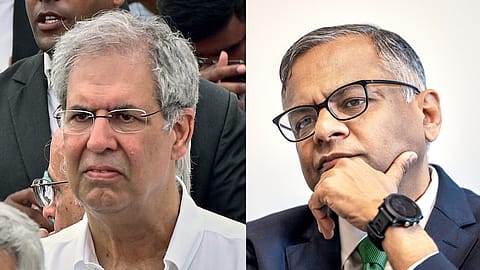
The battle for control of Tata Sons is entering a new phase, with Tata Trusts preparing to take the dispute to court. Sir Dorabji Tata Trust (SDTT) and R.D. Tata Trust are set to challenge the reappointment of N. Chandrasekaran as executive chairman of Tata Sons before the Bombay High Court, arguing that the September 17 board decision did not meet the voting requirements prescribed under the company's Articles of Association (AoA), according to sources.
The Trusts are seeking ₹65 crore in damages and judicial directions to ensure that voting procedures are followed in future. Lawyers from Cyril Amarchand Mangaldas are expected to represent the Trusts.
The legal move comes as Tata Sons explores ways to convert itself into a public company by amending its AoA. The board is also looking to convene an extraordinary general meeting (EGM) to consider Chandrasekaran's reappointment for a third term and approvals related to preparations for a listing, in compliance with RBI directions.
The proposed challenge takes the differences between Tata Trusts chairman Noel Tata and the Tata Sons board beyond Chandrasekaran's tenure. While Noel wants Tata Sons to remain private, the board is examining a listing, citing RBI regulations governing upper-layer NBFCs. The two sides are increasingly divided over the future ownership and governance structure of the holding company.
Why Tata Trusts are challenging the September 17 resolution
At the centre of the dispute over Chandrasekaran's reappointment is Article 118 of Tata Sons' AoA, which grants special voting rights to Tata Trusts' nominee directors on decisions concerning the appointment of the chairman. The Trusts maintain that such decisions require the support of a majority of their nominee directors and argue that the September 17 resolution failed to meet this requirement.
At the meeting, Noel voted against Chandrasekaran's continuation, while Venu Srinivasan supported it. Four other directors backed the resolution. Harish Manwani, who chaired the Nomination and Remuneration Committee, then exercised his casting vote to carry the decision. The Trusts are questioning whether this casting vote could override the special voting rights conferred on their nominees under the AoA.
The dispute gained momentum after Chandrasekaran indicated on August 12 that he would not seek another term when his tenure ended on February 20, 2027. Tata Trusts accepted his position the following day and expected the succession process to begin. However, the board subsequently persuaded Chandrasekaran to reconsider, reversing the course of the transition.
Noel opposed the board's move and questioned the procedure adopted to secure Chandrasekaran's continuation. In letters to the directors, he argued that the provisions of the AoA had not been followed.
Tata Trusts collectively own 66% of Tata Sons and are its controlling shareholders. A judicial examination of the voting provisions could have far-reaching implications for the relationship between the board and its principal shareholder, as well as the validity of the September 17 resolution. The proposed court battle could thus become a defining chapter in the ongoing Tata power struggle.
Follow Fortune India
NEXT STORY