Thomas Cook India sees 30% rise in Q3 forward bookings despite Middle East conflict, says CFO Brijesh Modi
/ 4 min read
Middle East conflict influences Indian travel preferences, with travellers shifting towards Southeast Asia, the Far East, Bhutan, Australia and New Zealand, says CFO Brijesh Modi.
THIS STORY FEATURES
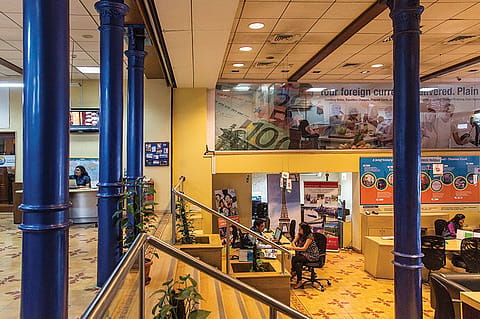
Inside View: Thomas Cook India's office in Mumbai
Thomas Cook (India) is seeing a revival in travel demand, with its India leisure travel business reporting 30% growth in forward bookings for the third quarter of FY27. The recovery was led by long-haul destinations such as Europe, Australia, Japan and New Zealand, even as domestic and short-haul travel continue to support business momentum.
The improving demand outlook comes after a challenging September quarter for the Mumbai-headquartered travel services company. Thomas Cook India reported a 24% year-on-year (YoY) decline in consolidated net profit to ₹53.7 crore in Q2FY27, compared with ₹70.7 crore in the corresponding quarter last year. Revenue from operations fell 6.2% to ₹1,944.2 crore from ₹2,073.8 crore a year earlier. However, earnings before interest, tax, depreciation and amortisation (EBITDA) rose 3% to ₹151.2 crore from ₹147 crore.
In an interview with Fortune India, Brijesh Modi, president and chief financial officer of Thomas Cook India, said the company had maintained its profit before tax (PBT), before exceptional items, at ₹84.8 crore, broadly at last year's level, despite geopolitical disruptions and rising prices. He pointed out that the previous year's results included an exceptional gain from the sale of a property, which also influenced the year-on-year comparison.
"Our India Travel business staged a sharp recovery in Q2 FY27, ending just 6% below the previous year, while delivering healthy EBIT margins of 3.8%," Modi said.
The domestic and short-haul segments led the recovery in the India travel business. However, the overseas destination management services (DMS) business continued to face pressure from the West Asia conflict. Although revenue recovered during the quarter, disruptions in specific geographies affected the segment's revenue and EBIT margins.
Modi said the impact of the conflict had been more destination-specific than a broad-based slowdown in outbound travel. Indian travellers were reassessing their destination choices, with some redirecting their plans towards Southeast Asia, the Far East, Bhutan, Australia and New Zealand.
At the same time, the company continues to see interest in international holidays, particularly for the upcoming winter season, including travel to Europe and experiences such as the Northern Lights.
"We have seen a strong recovery in business momentum over the last two months. While July and August witnessed a moderate recovery, September and October saw a considerably stronger pick-up across our Travel and Financial Services businesses," Modi said.
Financial services continued to provide stability to the group's earnings, with revenue from operations in the segment growing 21% YoY in Q2FY27 and 14% in the first half of FY27. EBIT increased 10% and 9%, respectively, during the two periods. According to Modi, demand in the corporate and student segments has supported growth, aided by new acquisitions and partnerships.
Long-haul travel drives 30% growth in Q3 bookings
Looking ahead, the company expects the improving business momentum to continue in the second half of FY27. The 30% growth in forward bookings for its India leisure travel business in Q3FY27 provides visibility on demand, despite geopolitical uncertainties, elevated airfares and rising input costs.
"The 30% growth in forward bookings for our India leisure travel business for Q3 FY27 is an encouraging indicator of demand visibility for the second half," Modi said. He added that the revival in long-haul travel, particularly to Europe, Australia, Japan and New Zealand, was driving the current growth.
{{#most-powerful-women-snapshot-individual.slug}} {{/most-powerful-women-snapshot-individual.slug}} {{^most-powerful-women-snapshot-individual.slug}} {{/most-powerful-women-snapshot-individual.slug}} {{#showRanking}} {{current-rank}} {{/showRanking}} {{#photo.0.url}}
{{name}}
Corporate travel and MICE are other potential growth drivers, supported by business travel demand and interest in corporate meetings and events. The company is also seeing a gradual improvement in its Middle East-based overseas businesses, which were among the worst affected during the first half of FY27.
Pilgrimage, domestic tourism to support growth
Domestic and short-haul travel are also expected to remain important growth drivers, with pilgrimage emerging as one of the fastest-growing domestic travel verticals. Thomas Cook India is seeing demand for destinations such as Kashmir, Ladakh, Himachal Pradesh, Uttarakhand, Goa, Kerala and the Andamans, alongside wildlife and nature-based holidays.
"Pilgrimage is the biggest growth driver, with curated circuits covering Char Dham, Kailash Mansarovar and Kashi–Prayagraj–Ayodhya," Modi said. The company is also witnessing interest in differentiated spiritual journeys, including helicopter darshans, guided experiences and escorted pilgrimages.
The company does not, however, see the growing popularity of domestic holidays as a structural shift away from international travel. Instead, Modi said, domestic tourism was becoming a stronger part of the Indian traveller's overall holiday calendar, with consumers exploring a wider range of destinations and experiences.
The depreciation of the rupee and geopolitical uncertainty have influenced destination choices, but have not materially weakened the underlying appetite for travel, according to Modi. Travellers are increasingly prioritising certainty, visa accessibility and air connectivity while selecting destinations. Japan, for instance, has benefited from the depreciation of the yen against the rupee, making it an increasingly attractive destination for Indian tourists.
Thomas Cook India is also adjusting its portfolio through shorter-duration tours and packages across different price points to respond to changing consumer preferences. The company is expanding its offerings in luxury rail journeys, cruises and seasonal experiences while strengthening domestic and short-haul charter operations.
On profitability, Modi said the company would focus on improving business mix, operating efficiencies and cost discipline. Higher volumes and operating leverage could support margin improvement, although the extent of the recovery would depend on input costs, the external environment and consumer demand.
"Our focus remains on revenue growth, cost discipline, operating efficiencies and sustainable profitability across our businesses," Modi said.

Follow Fortune India
NEXT STORY