US Polo Association crosses ₹4,000 crore in India, eyes doubling business in 4-5 years
/ 4 min read
US Polo Assn. sets sights on becoming India's first billion-dollar apparel brand as it crosses ₹4,000 crore milestone.
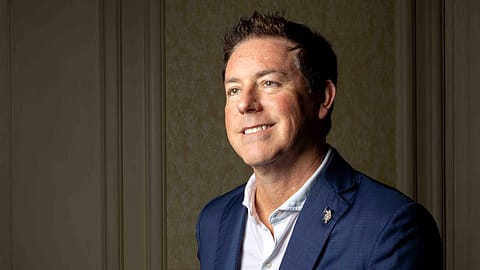
J. Michael Prince, President and CEO of USPA | Credits: Narendra Bisht
For a brand born on the polo fields of the United States more than a century ago, one of US Polo Assn.'s biggest growth story today is unfolding in India, where it has grown from a sportswear label into one of the country's largest menswear businesses. The brand, which entered India in 2009, is set to cross ₹4,000 crore in consumer sales this year, growing 20% on an already large base. Its next target is to double that number over the next four to five years.
For J Michael Prince, president, CEO and board member of USPA Global, the brand's India journey has become an important part of its global growth story. When he took charge nearly a decade ago, the global business was worth $1.2 billion. It is expected to close this year at $2.8 billion to $2.9 billion, with a longer-term ambition of reaching $4 billion in the next five to seven years.
"India is going to be a big part of that growth opportunity for us," Prince told Fortune India, describing the country as the brand's fastest-growing market globally. While the US remains its largest market, India has been growing faster than other key geographies. Prince said the brand's global business grew around 20%, with India outpacing most markets.
He added, "It's not been an easy marketplace; you had the pandemic, a lot of great brands struggled and we've continued to grow and part of that growth has been due to India and the tremendous growth India's had, wonderful consumers who embrace and love this brand and as we grow to $4 billion, India is going to be a big part of that growth opportunity for us."
The ₹4,000 crore milestone also puts the brand on course to potentially become India's first billion-dollar apparel brand, said Kulin Lalbhai, vice chairman of Arvind Ltd, which operates US Polo Assn. in India. The company is preparing to open its 500th store this year and plans to add another 60 to 70 stores annually, taking its network towards 1,000 over the coming years.
From polo shirts to a wider lifestyle play in India
Much of the Indian growth has come from widening the brand's appeal beyond its traditional shirts and polos. These three categories, including polos and shirts, remain its biggest contributors, accounting for around 60% of the business. The remaining 40% comes from categories such as kidswear, footwear and innerwear.
Women's wear, launched around two years ago, has till now crossed ₹100 crore in sales. Until now, the category has largely been online-led, with a presence in leading department stores. Arvind plans to bring it into US Polo Assn.'s own retail network as stores become larger. The brand is increasingly opening outlets spanning 3,000 to 4,000 sq. ft., compared with its earlier, smaller formats.
The expansion is accompanied by an inclination towards premiumisation, mirrored in the Indian market. Average transaction values and entry price points have risen as the company introduces a wider product range and upgrades its retail experience. Lalbhai said the brand is also moving away from traditional advertising towards a digital-first model. Digital now accounts for 30% of its business, supported by an in-house content studio and sustained online engagement
The India playbook combines global brand positioning with local product development. The company has around 50 designers and product professionals working on the Indian range, with 85% of sourcing coming from India and the remaining 15% from Asia.
"We have not let the global positioning and essence in any way get diluted," Lalbhai said, adding that the ability to retain the brand's international identity while adapting products and distribution for Indian consumers has been central to its growth.
Marketing is another area where investments are set to rise. Arvind has historically spent 3% to 4% of sales on marketing across its portfolio, but intends to increase this to 5% to 7% over time, raising the share by 50 to 100 basis points annually. Most US Polo Assn. stores are franchisee-operated, keeping capital expenditure relatively low.
{{#most-powerful-women-snapshot-individual.slug}} {{/most-powerful-women-snapshot-individual.slug}} {{^most-powerful-women-snapshot-individual.slug}} {{/most-powerful-women-snapshot-individual.slug}} {{#showRanking}} {{current-rank}} {{/showRanking}} {{#photo.0.url}}
{{name}}
The company is also betting on quick commerce, which currently contributes between 5% and 10% of its business and is growing at triple digits. Lalbhai expects the channel to eventually account for 20% to 30% of online apparel sales, with innerwear, basic polo shirts and accessories emerging as key categories.
For Prince, the brand's appeal lies in retaining its connection to polo while reaching consumers across generations. "We're the official sports brand of the United States Polo Association, founded in 1890," he said, pointing to the importance of maintaining that sporting heritage as the business expands.
India's growing consumption market and its domestic sourcing base offer another advantage. With 85% of the brand's products made in India, Lalbhai said global currency volatility and disruptions to trade routes have had limited impact on its operations. The company, for the first time, might also explore the possibility of supplying products manufactured in India to other international markets.
"We have not started that yet but that's a conversation we are exploring. We think that's a potentially great opportunity for us," shared Prince.
Follow Fortune India
NEXT STORY