Why SpiceJet’s ₹5,500-crore fundraise may not be enough to prevent the inevitable
/ 7 min read
SpiceJet has gone scouting in the market once again. Only this time, it’s unlikely to be an easy affair.
THIS STORY FEATURES
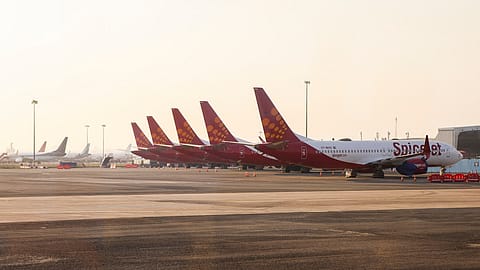
The fundraising, despite SpiceJet’s confidence, comes a little over a decade after the airline came to Ajay Singh from the Maran family of the South. | Credits: Sanjay Rawat
A little over two years since SpiceJet last raised ₹3,000 crore to keep itself afloat, the airline is back to raise more funds to fix its deepening financial crisis that has pushed it to the brink of a shutdown. The Ajay Singh-led company, in many ways a phoenix of sorts, has seen the ground beneath it significantly eroding, so much so that the once second-largest airline in India now commands a smaller share than even regional airlines.
Only about 15 of its 66 daily flights are flying with a handful of aircraft, and the country’s aviation watchdog, the DGCA, has issued a show cause notice citing disruptions, cancellations, delays and inadequate passenger facilitation measures. Market share, meanwhile, has tanked and is now at 0.6 percent, while market capitalisation now stands at 1/5th of what Singh wants to raise to sustain the airline.
A pilots’ association, comprising over 5,000 pilots, has written to India’s aviation minister seeking intervention in the airline’s crisis.
It’s into this mix that the Ajay Singh-led company is looking to close a fundraising round as expeditiously as possible and even claims to have initiated discussions with potential new investors. “We believe this fundraise will provide an important opportunity to rebuild the airline, strengthen its operations and restore the brand,” Singh said in a statement. “We are conscious of the challenges ahead, but we have a clear plan and are focused on putting the necessary building blocks in place. Our priority is to execute that plan with discipline and restore SpiceJet’s position as a strong and competitive airline.”
SpiceJet’s board also approved an increase in the company’s authorised share capital from ₹2,000 crore to ₹7,500 crore, with the fundraise being undertaken through a combination of equity and other permitted instruments and will be subject to the requisite approvals.
“The last fundraising appears to have paid some debts, but it did not produce a dependable operation,” Alok Anand, the chairman (and CEO) of Acumen Aviation, an aircraft asset management and leasing firm. “I still distinguish survival from a durable recovery. SpiceJet may continue to fly in some form if fresh capital arrives and is tightly controlled. I would not yet underwrite a stable, self-funding airline.”
In 2024, the airline first announced a plan to raise ₹2,200 crore from 63 entities, including financial institutions, foreign institutional investors, high-net-worth individuals, and private investors, through the issuance of equity shares and warrants.
The idea was also to attempt to acquire Go Air, an airline owned by billionaire Nusli Wadia, which had shut down operations. However, weak investor participation reduced the expected proceeds to ₹1,060 crore, of which the airline eventually received ₹678.19 crore. The lead investors had backed out.
Eventually, SpiceJet raised ₹3,000 crore through a qualified institutional placement (QIP) in September 2024 at ₹61.60 a share. Investors then included Goldman Sachs (Singapore), Morgan Stanley Asia, BNP Paribas Financial Markets ODI, Nomura Singapore Limited, and Tata Mutual Fund, among others.
“The proposed fundraise is expected to provide the airline with the financial headroom to address these challenges, strengthen its balance sheet, support its fleet expansion and meet its operational requirements,” the airline had said. “It will also support the airline’s efforts to restore its network and build a stronger, more sustainable business.”
Unlikely to sustain
The fundraising, despite SpiceJet’s confidence, comes a little over a decade after the airline came to Ajay Singh from the Maran family of the South. This time, however, a turnaround is increasingly looking tough for Singh, who had made a habit of weathering the storm and making a comeback.
{{#most-powerful-women-snapshot-individual.slug}} {{/most-powerful-women-snapshot-individual.slug}} {{^most-powerful-women-snapshot-individual.slug}} {{/most-powerful-women-snapshot-individual.slug}} {{#showRanking}} {{current-rank}} {{/showRanking}} {{#photo.0.url}}
{{name}}
The airline had nearly shut in 2014 after three straight years of losses, with lessors taking back some aircraft and forcing more than 2,000 flight cancellations in a month. State oil companies added to the airline’s troubles by refusing to fuel the jets unless the airline cleared its dues. Singh, who founded the airline with London-based Bhupendra S. Kansagra before Kalanithi Maran bought it, rushed in to give it a fresh lease of life. He also settled dues of some ₹2,200 crore. Maran exited SpiceJet in 2015 after selling his stake to Singh.
What followed was 18 consecutive months of profits, driven by tight cost control and expanding revenue. In three years, its shares zoomed by some 800% and made it the world’s best airline stock. SpiceJet also grew to become India’s third-largest airline after IndiGo and Jet Airways, with a fleet of 34 Boeing 737 aircraft and 20 Bombardier Q400s by 2016. Over the next few years, the brand underwent a transition and went on to firm up orders for 155 Boeing 737-8 Max and 50 purchase rights for wide-body long-haul planes like Boeing 787 Dreamliners. The airline wanted to go big on international routes — to cities such as Bangkok, Colombo, Dhaka, Muscat, Kabul, Male, Hong Kong, Dubai, and Jeddah.
Then came the tough times. It began in 2019 with the grounding of the Boeing 737 MAX aircraft, following two crashes that killed almost 500 people globally. “The challenges began with the Boeing 737 MAX crashes, which led to the worldwide grounding of the aircraft and halted deliveries of what was a critical part of our fleet expansion plans,” the SpiceJet spokesperson had told Fortune India earlier. “The pandemic followed, bringing unprecedented disruption to global aviation. In the years since, multiple conflicts, geopolitical instability, and airspace closures have further pressured an already challenging operating environment. These were events largely beyond our control, but their impact on the airline’s capacity and operations was significant.”
“While the Max grounding did affect them, what SpiceJet lacked was also good advisors and a good board,” Jitendra Bhargava, former executive director at Air India, says. “Where was the strategy to mitigate the crisis? It was all about one man, and had there been a professional board, timely actions could have helped streamline the operations.”
“A default of this kind also affects how lessors look at the jurisdiction, not only the company,” Anand adds. “Shutting the airline down, though, would only treat the symptoms. The root issue is the failure to keep a funded, reliable fleet in the air and to pay the people who make that possible.”
The airline meanwhile has acknowledged that it is operating in an exceptionally challenging environment, with geopolitical disturbances and airspace restrictions putting pressure on airline operations. “This has been compounded by a sharp rise in aviation turbine fuel prices, which have more than doubled over the past few months, significantly increasing the cost of operations,” SpiceJet said.
Now, with complaints growing to as many as 8,000 this month, widespread cancellations and unpaid dues even to airports such as Dubai, finding investor confidence will be a tough ask. “I was already cautious in October, and the last few weeks have not improved my confidence,” says Anand. “The winter wet-lease program was meant to restore scale quickly. What we have seen instead is a very thin operation, aircraft grounded over lessor dues, and cancellations that follow almost any disruption. Dubai stopping check-in over unpaid dues of about ₹36 crore, with aircraft flown home empty, is not a huge bill in airline terms. If that cannot be cleared to keep a key international station running, the larger questions about fleet and funding are harder to set aside.”
What happens now?
“I think it’s too late to salvage the airline now,” says Bhargava. “Numbers speak one story. The perception of an airline, that it has become unreliable, pilots not being available, and so on, means that customers have lost confidence. It looks like the end is almost here.”
SpiceJet’s near collapse also comes at a time when IndiGo, India’s largest airline by market share, and SpiceJet’s compatriot—having begun operations around the same time—is looking to scale up its international operations, after cornering a significant pie of India’s skies.
IndiGo had placed an order for 30 A350-900s in 2024, later adding another 30 aircraft to its plan in 2025. In less than two years, as early as the first half of 2028, the airline will start welcoming its A350-900 aircraft, the kind that is capable of flying over 15,750 miles and carrying over 400 passengers, allowing it to go as far as the US from India without any stop. The airline has plans to add as many as 60 A350-900 aircraft, which will also likely redraw its standing as a low-cost carrier and propel it to a different league in global aviation.
“A board approval to raise to ₹5,500 crore is not the same as cash in the bank,” says Anand. “The figure is a ceiling, and the money still has to be raised, approved and received. Even if the full sum comes in as usable cash, I will not treat it as automatically enough.”
Alongside, the country’s aviation sector has also been in the midst of turmoil with rising fuel prices, geopolitical uncertainties, and cheaper fares. The country’s airlines are expected to report net losses of ₹36,000-38,000 crore in FY2027, compared with estimated losses of ₹28,000-30,000 crore in FY2026, according to a report by rating agency Icra.
“In SpiceJet's December 2025 accounts, current liabilities already exceeded current assets by about ₹4,281 crore, and the auditor flagged a material uncertainty on going concern,” says Anand. “That hole has had nearly a year to move. So, the test is not the headline number. It is whether enough money arrives in time, and whether it is used to clear the dues that are grounding aircraft and disrupting day-to-day operations, while also funding a reliable airline for the next 12 to 18 months. If the raise is slow, partial, or mostly used to plug old holes while the schedule still does not hold, it will not be enough.”
The last airline to shut down operations was GoFirst, owned by billionaire Nusli Wadia, who, despite being one of the country’s richest, shut down operations in 2023. Ironically, Singh was looking to acquire GoFirst then. Still, despite the country’s being a graveyard of sorts for India’s airlines, the market remains lucrative, being the third largest in the world, and accounting for just about 4 percent of the global air traffic.
Together, Air India and IndiGo have as many as 1,000 aircraft on order to cater to the growing demand. By 2040, India’s passenger traffic is expected to grow sixfold to around 1.1 billion, with India’s commercial airline fleet predicted to grow from 400 in 2014 to around 2,359 in March 2040. The number of airports is also expected to grow to 400 by 2047.
“SpiceJet needs to stop treating more aircraft, or a larger published schedule, as the turnaround itself,” says Anand. “It should first secure enough cash to run a smaller airline it can actually deliver, then expand only where each aircraft earns its keep.”
That means, in case Singh does manage to secure the funds, Anand says the next 12 to 18 months must be used to clear overdue salaries, lessor, airport and supplier dues. “Second, fly a timetable it can honor,” Anand says. “It is better to cut the schedule than to keep canceling after long delays. Third, restore creditor confidence with binding arrangements and transparent milestones, so any new money is protected and used with discipline. Passengers and lessors will come back through reliability, not a dramatic growth plan.”

Follow Fortune India
NEXT STORY