With the US watching, BRICS Summit 2026 is no longer just a meeting of developing and emerging nations
/ 3 min read
A key focus of the Summit, currently in its 18th edition, will be on strengthening economic, social, and institutional resilience to navigate global uncertainties, supply chain disruptions, health challenges, and climate risks.
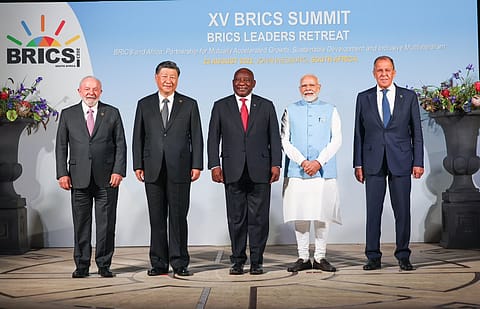
On September 12 and 13, India will host the annual Summit of BRICS, the 11-member bloc of emerging and developing economies, in New Delhi. A key focus of the Summit, currently in its 18th edition, will be on strengthening economic, social, and institutional resilience to navigate global uncertainties, supply chain disruptions, health challenges, and climate risks.
While the outcomes of the Summit will be closely watched, greater attention is likely to be on its broader implications for geopolitical and economic ties among member countries, as well their individual relationships with the world’s largest economy, the United States, which is not a member of BRICS.
The composition of BRICS itself highlights the complexity of the challenge. Of its 11 members, two founding members, India and China, are only beginning to move beyond a period of strained economic ties following the 2020 Galwan Valley clashes between their armed forces along the Indo-China border. Relations with another founding member, Russia, remain under close scrutiny from the US, which is trying to put economic pressure on Moscow through sanctions over Russia-Ukraine war. At the same time, Russia remains an important trading partner for several BRICS members, with India and China amongst its largest economic partners.
Brazil, the fourth founding member - BRICS was originally called BRIC, representing Brazil, Russia, India and China - is heading into a general election next month and is likely to remain focused on domestic priorities. Among the other members, South Africa joined the bloc in 2011, giving BRIC its present name. Egypt, Ethiopia, Iran, Saudi Arabia, and the UAE became full members of BRICS in 2024, followed by Indonesia in 2025. Iran, meanwhile, finds itself at the centre of the current geopolitical crisis engulfing West Asia with its ripples across the world, following its decision to restrict the movement of commercial vessels through the Strait of Hormuz in retaliation for US action against that country.
BRICS has thus evolved from a four-country grouping into a bloc whose members collectively account for 49.5% of world population, 40% of global GDP and 26% of international trade. But the expansion has also made consensus building and decision making more complex, particularly as the US increasingly factors countries’ economic relationships with other nations into its domestic trade policy.
For instance, reducing the near monopoly of US dollar as the dominant currency for international trade is something developing countries would want as part of efforts to de-risk their trade relations and reduce dependence on the US. However, US President Donald Trump has repeatedly warned of strict retaliatory actions against countries that seek to undermine the dollar's role in global trade.
This year’s BRICS Summit is based on the theme “Building for Resilience, Innovation, Cooperation and Sustainability”, reflecting a people-centric and humanity-first approach articulated by Prime Minister Narendra Modi at the 2025 Rio Summit. In the run-up to the Summit, over 350 meetings and high-level engagements have been held across over 25 cities in India to further strengthen the BRICS strategic partnership across three fundamental pillars - political and security, economic and financial, and cultural and people-to-people exchanges. The government says these engagements, and business-to-business and people-to-people initiatives, have helped advance BRICS cooperation through practical and development-oriented outcomes.
This is the fourth time India has hosted the BRICS Summit in the last 20 years. Yet, the upcoming Summit will be the largest so far, particularly because BRICS last year expanded its outreach by allowing Belarus, Bolivia, Kazakhstan, Cuba, Malaysia, Nigeria, Thailand, Uganda, Uzbekistan and Vietnam to join as Partner Countries.
The leaders are expected to deliberate on ways to strengthen intra-BRICS cooperation on common priorities and share views on global and regional matters of mutual importance. However, the Summit will be closely watched not only by the member countries, but also by the US, given the bloc’s economic and geopolitical significance. That wider scrutiny makes this year’s Summit particularly significant.
Follow Fortune India
NEXT STORY