Dharmendra Pradhan resigns as education minister amid NEET paper leak protests
/ 2 min read
Pradhan's exit follows weeks of demonstrations by students and CJP supporters at Jantar Mantar in New Delhi.
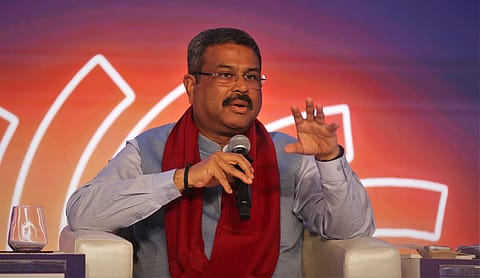
Education Minister Dharmendra Pradhan resigns | Credits: Sanjay Rawat
Union education minister Dharmendra Pradhan resigned on Saturday amid escalating nationwide protests over the alleged NEET paper leak, with the Cockroach Janta Party (CJP) making his resignation a key demand.
In a post on X, Pradhan announced that he had submitted his resignation to Prime Minister Narendra Modi, saying the recent developments related to the NEET-UG examination had caused him "deep anguish."
In his statement, Pradhan said he had taken responsibility for the alleged NEET-UG paper leak from the moment the irregularities came to light following the May 3 examination. "The events of the last 10 days have deeply saddened me. This is not a matter of personal prestige," he wrote, adding that his foremost concern had always been to ensure that the future of deserving students was not adversely affected.
Pradhan's exit follows weeks of demonstrations by students and CJP supporters at Jantar Mantar in New Delhi. Protesters had been demanding the cancellation of the National Eligibility-cum-Entrance Test (NEET), greater accountability for the alleged examination irregularities, comprehensive reforms to the education system, and action over the alleged use of excessive force against demonstrators.
The resignation comes a day after the Union cabinet approved a draft Bill proposing tougher penalties for examination paper leaks, including imprisonment of up to 10 years and fines of up to ₹10 crore. The proposed legislation, which is expected to be introduced in Parliament next week, seeks to amend the Public Examinations (Prevention of Unfair Means) Act, 2024, to strengthen the legal framework against paper leaks and examination-related malpractices.
Under the proposed amendments, individuals found guilty of leaking examination papers could face a minimum prison term of five years, along with financial penalties. In cases involving organised paper leak rackets, the punishment could extend to 10 years in prison and a maximum fine of ₹10 crore, according to government sources.
The existing law prescribes imprisonment ranging from three to five years for individuals involved in paper leaks. For organised cheating syndicates, the current provisions provide for five to 10 years' imprisonment and a minimum fine of ₹1 crore.
Officials said the amendments are intended to deter organised criminal networks and institutions that profit from examination fraud while ensuring that genuine candidates are not penalised under the law.
The proposed changes build on the Public Examinations (Prevention of Unfair Means) Act, 2024, which came into force in June 2024 after receiving President Droupadi Murmu's assent. The law was enacted to curb unfair practices in public examinations, including recruitment tests conducted by agencies such as the UPSC and SSC, as well as entrance examinations like NEET, JEE, and CUET.
The Cabinet's decision followed Prime Minister Narendra Modi's announcement on Thursday that the government would introduce stronger legal measures against paper leaks. In a video message, the Prime Minister said a Bill providing for stricter action against those involved in examination fraud would be introduced in Parliament next week.
Follow Fortune India
NEXT STORY