Economic Survey 2026: India’s exports hit record high of $825.3 bn in FY25; momentum to continue in FY26
/ 3 min read
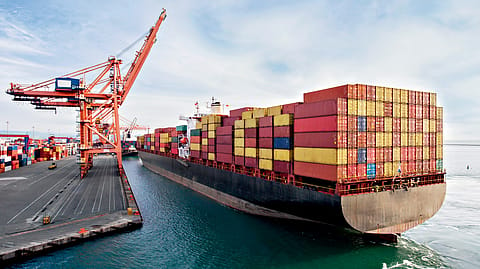
Economic Survey 2026 projected India’s real GDP growth at 6.8–7.2% for FY27 | Credits: Fortune India
Economic Survey 2026: India’s exports hit record high of $825.3 bn in FY25; momentum to continue in FY26
India's Economic Survey 2026 highlights a record $825.3 billion in exports for FY25, with momentum expected to continue into FY26. Despite global trade tensions and US tariffs, India's external sector showed resilience, supported by strong services exports and remittance inflows. The Survey projects GDP growth of 6.8-7.2% for FY27, driven by domestic demand and investment.
This summary is AI-generated, and Fortune India is not responsible for its content or any associated copyright issues.
India’s external sector remained resilient, with total exports of goods and services touching a record $825.3 billion in FY25 and maintaining momentum into FY26, as per the Economic Survey 2026.
Economic Survey 2026 projected India’s real GDP growth at 6.8–7.2% for FY27 | Credits: Fortune India
Ahead of the Union Budget, finance minister Nirmala Sitharaman tabled the Economic Survey 2026 in Parliament Thursday, projecting India’s real GDP growth for FY27 at 6.8–7.2%, aided by resilient domestic demand and investment, even as global uncertainties persist. The FM will present the Union Budget 2026 on February 1.
The survey described FY26 as an unusually challenging year on the external front, marked by heightened global trade uncertainty amid U.S.'s aggressive tariff policies that strained manufacturers, especially exporters, and dented business confidence. The government, however, used the disruption to accelerate structural reforms, including GST rationalisation, faster deregulation, and simplified compliance across sectors.
Exports hit an all-time high
Even against a backdrop of heightened global trade tensions and tariff pressures, India’s external sector remained resilient, with total exports of goods and services touching a record $825.3 billion in FY25 and maintaining momentum into FY26, the Economic Survey 2026 said on Thursday.
Despite higher tariffs imposed by the United States, merchandise exports grew 2.4% during April–December 2025, while services exports rose a stronger 6.5%, underscoring the economy’s growing reliance on services as a key external buffer. Merchandise imports increased by 5.9% in the same period, leading to a wider goods trade deficit, which was largely offset by a higher services trade surplus and robust remittance inflows.
The survey noted that remittances have consistently exceeded gross FDI inflows, reinforcing their importance as a stable source of external financing. As a result, India’s current account deficit remained moderate at 0.8% of GDP in H1FY26, despite global headwinds.
Gross FDI inflows rose 16.1% YoY during Apr–Nov 2025
On the capital account, gross FDI inflows rose 16.1% YoY during April–November 2025. However, a sharp 34.9% increase in outward FDI by Indian companies, coupled with marginally lower repatriation flows, capped growth in net FDI. Foreign portfolio investment (FPI) flows were volatile, with net outflows of $3.9 billion between April and December 2025, compared with net inflows of $10.6 billion a year earlier, amid elevated uncertainty and rising global interest in AI-led investment themes in markets such as the U.S., Taiwan and Korea.
These developments resulted in a balance of payments deficit of $6.4 billion in H1FY26, against a surplus of $23.8 billion in the year-ago period, financed through a drawdown in foreign exchange reserves. The widening BOP deficit, along with uncertainty over the outcome of trade negotiations with the U.S., has put pressure on the rupee, which depreciated about 6.5% between April 1, 2025, and January 22, 2026. The survey, however, stressed that the rupee’s movement has remained orderly and that, over the medium to long term, exchange rates will be guided by structural fundamentals such as productivity gains, export diversification, deeper GVC integration and policy stability.
Foreign exchange reserves cover over 11 months of imports
The survey highlighted that India’s external position remains comfortable in the short run. Foreign exchange reserves cover over 11 months of imports and around 94% of external debt, providing a strong liquidity cushion. A diversified trade strategy—reflected in trade agreements with the U.K., Oman, and New Zealand, engagement with the EU, and ongoing negotiations with the U.S.—also augurs well for export prospects.
However, the medium-term outlook faces challenges from geopolitical fragmentation, trade realignments and tighter immigration policies, which could cap remittance growth. The survey emphasised that enhancing global competitiveness and investment attractiveness must remain a key policy priority, drawing lessons from successful FDI destinations such as Vietnam and Taiwan.
Even amid these uncertainties, India’s growth momentum remains strong. The First Advance Estimates for FY26 peg real GDP growth at 7.4% and GVA growth at 7.3%, reaffirming India’s position as the fastest-growing major economy for the fourth consecutive year. Growth continues to be anchored by robust domestic demand and rising capital formation, while manufacturing has gained traction and services—led by trade, transport, and financial and professional services—continue to drive overall expansion.
As per the report, FY27 is expected to be a year of adjustment, as firms and households adapt to these changes, with domestic demand and investment gaining strength. The survey, however, cautioned that the external environment remains uncertain, shaping the overall outlook.
Follow Fortune India
NEXT STORY