Fiscal deficit hits 42.1% of FY27 target in first half on higher spending, sluggish revenue growth
/ 3 min read
The rise in the deficit from ₹5.7 lakh crore in April-September FY26 reflects higher revenue expenditure and an increase in capital spending, even as revenue receipts grew at a slower pace.
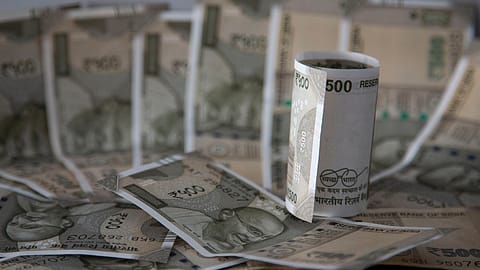
The Centre has pegged its fiscal deficit target for FY27 at 4.3% of GDP, equivalent to ₹16.96 lakh crore. | Credits: Sanjay Rawat
India’s fiscal deficit widened to ₹7.14 lakh crore in the first half of FY27, or 42.1% of the full-year Budget Estimate (BE), compared with 36.5% of the annual target in the corresponding period last year, according to government data released on Friday.
The increase in the deficit from ₹5.7 lakh crore in April-September FY26 reflects higher revenue expenditure and a rise in capital spending, even as revenue receipts grew at a slower pace. The widening deficit could make it challenging for the government to meet its fiscal consolidation target, with elevated global energy prices also posing risks to subsidy expenditure, and revenue collections.
The Centre has pegged its fiscal deficit target for FY27 at 4.3% of gross domestic product (GDP), equivalent to ₹16.96 lakh crore.
Aditi Nayar, chief economist at ICRA Ltd, said the deficit had increased amid a surge in the revenue deficit and robust capital expenditure growth. However, slower growth in revenue receipts and the possibility of higher subsidy spending could put pressure on the government's fiscal position in the second half of the financial year.
Revenue receipts lag expenditure growth
The government's net tax revenue stood at ₹12.76 lakh crore in April-September FY27, accounting for 44.5% of the full-year Budget Estimates. This compares with ₹12.3 lakh crore, or 43.3% of the annual target, in the corresponding period of FY26.
Gross tax revenue grew by a subdued 6.1% year-on-year in the first half of FY27, according to ICRA. The growth was constrained by a sharp fall in excise duty collections following cuts in duties on petrol and diesel, alongside sluggish growth in personal income tax collections.
Nayar said the government would need to achieve growth of around 28-38% in gross tax revenue during the second half of FY27 to meet its annual targets. A shortfall in excise duty and personal income tax collections appears likely, although stronger customs duty receipts could provide some cushion. Customs duty collections grew by 16.5% year-on-year in the first half.
Non-tax revenue increased to ₹4.8 lakh crore in April-September FY27 from ₹4.7 lakh crore in the year-ago period.
The slower growth in revenue receipts relative to expenditure has contributed to the widening revenue deficit. Revenue expenditure rose by 10% in the first half, significantly outpacing the 3.6% increase in revenue receipts.
According to ICRA, revenue expenditure growth accelerated to 13.3% in the second quarter of FY27 from 7.4% in the first quarter. However, non-interest, non-subsidy revenue expenditure grew by just 1.3% in the second quarter.
With revenue expenditure increasing by 10% in the first half, the government would need to limit its growth to around 5.5% in the second half to meet the full-year Budget Estimates, Nayar said.
{{#most-powerful-women-snapshot-individual.slug}} {{/most-powerful-women-snapshot-individual.slug}} {{^most-powerful-women-snapshot-individual.slug}} {{/most-powerful-women-snapshot-individual.slug}} {{#showRanking}} {{current-rank}} {{/showRanking}} {{#photo.0.url}}
{{name}}
Capital expenditure rises in H1 FY27
Capital expenditure increased to ₹6.5 lakh crore in the first half of FY27 from ₹5.8 lakh crore a year earlier. The pace of absorption of budgeted capital expenditure has gone up to 53.1% in H1FY27 compared with 51.8% in H1FY26.
As a result, capital expenditure growth slowed to 2.8% in the second quarter of FY27 from 23.7% in the first quarter. For the full first half, capital expenditure grew by 12.7%, leaving the government needing to achieve growth of around 16.2% in the second half to meet its annual target.
Higher subsidies may lead to fiscal slippage
Elevated global energy prices could further complicate the government's efforts to contain the fiscal deficit. ICRA expects higher-than-budgeted fertiliser and fuel subsidies, alongside a potential shortfall in receipts, to result in a modest fiscal slippage of ₹1.3-1.4 lakh crore relative to the FY27 target.
The government's ability to contain revenue expenditure, sustain capital spending, and manage subsidy pressures will therefore be crucial to achieving its fiscal deficit target for FY27.
Follow Fortune India
NEXT STORY