India-Russia trade target: Piyush Goyal eyes $100 billion bilateral commerce, $50 billion investment by 2030
/ 2 min read
New Delhi and Moscow fast-track investment treaty, EAEU FTA as India seeks to diversify trade beyond energy and expand business participation
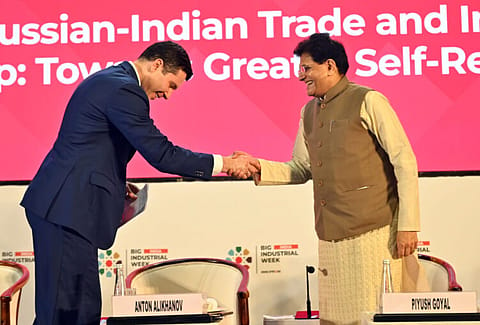
Addressing the India-Russia Business Dialogue here, along with Russian Industry and Trade Minister Anton Alikhanov, Goyal said the leaders of the two countries have set a target of $100 billion in bilateral trade and $50 billion in two-way investments. | Credits: Piyush Goyal's X account
Commerce and Industry Minister Piyush Goyal on Thursday called for an accelerated India-Russia economic and industrial partnership, with the two countries working towards $100 billion in bilateral trade and $50 billion in two-way investment by 2030.
Addressing the INNOPROM India 2026 Co-Chair Plenary Session and the India-Russia Business Dialogue in New Delhi, Goyal said the targets set by the two countries' leaders would serve as a measure of the performance of governments and businesses on both sides.
"A $100 billion target from a $60 billion base means adding about $40 billion in the next four years. That is not a modest task. It requires more than double-digit growth year-on-year sustained, and it requires significant effort from both sides, not just from government but equally from our businesses," Goyal said.
India-Russia trade needs diversification
Bilateral trade stood at around $60 billion in FY26, but remained heavily skewed towards Russian energy imports. India's imports from Russia were around $55 billion, with crude oil accounting for more than 80% of the imports.
Goyal said greater diversification of trade would be critical to meeting the $100 billion target. India's exports to Russia, including aquatic products, vegetables, coffee, tea, spices and milling products, have increased significantly, while pharmaceuticals, engineering goods, chemicals, textiles, marine products, auto components, tractors, food products and manufacturing offer further scope, particularly for MSMEs.
"Our non-energy trade in both directions remains far smaller than it should be--that is the headroom from $60 billion to $100 billion that we are asking to be filled up," Goyal said. "Rebalancing this trade through more diverse Indian exports like pharmaceuticals, engineering goods, chemicals, textiles, marine products, among others are central to achieving our goal."
40 investment projects being tracked
The India-Russia priority investment projects mechanism is currently tracking 40 live projects across advanced manufacturing, energy, mining, railways and emerging technologies. Goyal urged Russia to facilitate greater Indian investment in pharmaceuticals, IT, artificial intelligence, services, engineering and railways.
"We are fast-tracking a new bilateral investment treaty to give investors on both sides the legal certainty that projects and businesses look for when they are finalising investment decisions," he said.
India and the Russia-led Eurasian Economic Union (EAEU) have also begun formal free trade negotiations. The five-member bloc comprises Russia, Armenia, Belarus, Kazakhstan and Kyrgyzstan. Goyal said India was committed to concluding the talks early, with the agreement expected to open new markets, particularly for MSMEs.
Payments, connectivity on agenda
Goyal also called for stronger national and local currency payment mechanisms and improved connectivity through the International North-South Transport Corridor and Chennai-Vladivostok Maritime Corridor.
"We continue to strengthen local currency settlement mechanisms, because payment friction, more often than tariffs, is what slows trade down on the ground," he said.
{{#most-powerful-women-snapshot-individual.slug}} {{/most-powerful-women-snapshot-individual.slug}} {{^most-powerful-women-snapshot-individual.slug}} {{/most-powerful-women-snapshot-individual.slug}} {{#showRanking}} {{current-rank}} {{/showRanking}} {{#photo.0.url}}
{{name}}
Goyal described the first-ever presence of INNOPROM in India as a significant step towards moving the relationship "from protocols to production, from trade to industry", as the two countries seek to translate decades of economic ties into greater manufacturing, investment and technology cooperation.
Follow Fortune India
NEXT STORY