Govt has no immediate plan to raise ethanol blending beyond 20%, says Hardeep Puri
/ 2 min read
Petroleum minister cites ₹1.6 lakh crore in savings from E20 petrol, while defending the programme against claims of engine damage and vehicle breakdowns.
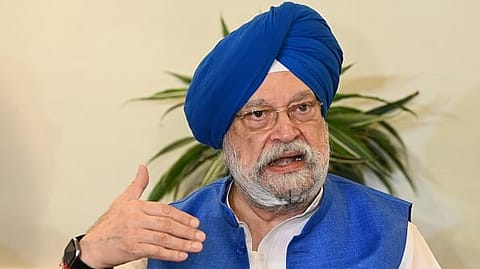
Hardeep Singh Puri, Union Minister of Petroleum and Natural Gas. | Credits: Getty Images
The government has no immediate plans to increase ethanol blending in petrol beyond the existing 20% level, Union Petroleum and Natural Gas Minister Hardeep Singh Puri said on Tuesday, as he pushed back against concerns over E20 fuel compatibility and allegations of engine damage.
Speaking on the sidelines of the 29th Energy Technology and Innovation Meet in South Goa, Puri described the criticism surrounding E20 petrol as a “contrived narrative” and said misinformation was being circulated about the fuel. India has rolled out E20 petrol, comprising 20% ethanol and 80% petrol, as part of its strategy to reduce dependence on imported crude oil.
“In so far biofuels are concerned, yes, the 20 per cent (of ethanol blending) was the target, and there is no desire, just now, to increase by more than 20 per cent,” Puri said.
E20 programme generated ₹1.6 lakh crore in savings: Puri
The minister said the introduction of E20 petrol had helped the government save ₹1.6 lakh crore, of which ₹1.4 lakh crore was returned to farmers. He said the programme had strengthened the role of farmers in the energy economy, describing them as “Urjadata” (providers of energy) alongside their traditional role as “Annadata” (providers of food).
Ethanol blending is intended to substitute a portion of petrol derived from crude oil with domestically produced ethanol. The government has promoted the programme to lower oil import dependence and support the agricultural supply chain.
Puri also referred to social media posts claiming that vehicles had stopped functioning or suffered breakdowns because of blended petrol. He said vehicles designed and certified for E20 were meant to use the fuel, while older vehicles manufactured before 2003 could face compatibility issues.
Minister disputes engine damage claims
Addressing reports of engine damage, Puri suggested that some concerns could be linked to fuel transportation, saying tankers used to carry blended fuel had also been used for other purposes. He added that an automobile manufacturer had filed a case against an individual who made an engine-damage claim.
The minister argued that widespread engine damage would have been more visible given the volume of vehicles using fuel stations. He said around six crore vehicles visit dispensing stations every day.
E100 rules open route for flex-fuel vehicles
The comments come a day after the Ministry of Road Transport and Highways notified amendments to the Central Motor Vehicles Rules, 1989, to facilitate vehicles certified to run on ethanol blends up to E100.
E85 contains up to 85% ethanol, while E100 consists predominantly of ethanol. Such fuels are intended only for vehicles specifically designed and certified to use them; compatibility with E20 alone does not establish suitability for higher blends.
Automakers including Toyota, Tata Motors and Hyundai are developing flex-fuel vehicles for the Indian market as the government pursues alternatives to conventional petrol.
Follow Fortune India
NEXT STORY