“Those days are gone” — India must open up pharma sector to global investment, R&D, says Piyush Goyal
/ 3 min read
Union Commerce and Industry minister calls for regulatory convergence with developed economies, resilient pharma supply chains and a global push to position India as a healthcare hub.
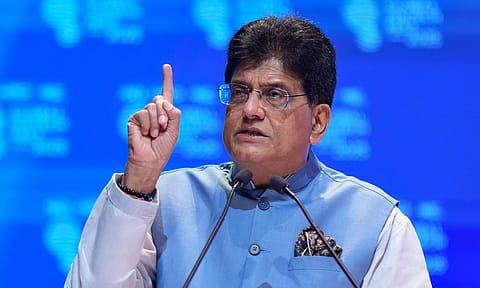
Union Commerce and Industry minister Piyush Goyal
Union Commerce and Industry Minister Piyush Goyal has called for a major rethink of India’s pharmaceutical sector’s regulatory and investment framework, urging greater openness to global investments in clinical trials, research and development while asking the industry to build resilient supply chains that are not dependent on a handful of countries or companies.
Addressing a pharma sector event, Goyal said India needed to move away from a protective approach and make the country more attractive for investments in clinical trials, patenting, R&D and the introduction of new products.
Pharma needs ‘total reorientation’ to attract global investments
"We can't work with a very protective mind; those days are gone. We have to be more inviting for investments coming to India for clinical trials, patenting their products here, for doing R&D here, for introducing new products; it needs a total reorientation of thoughts," he said.
Goyal also asked Indian regulators to examine practices followed in developed economies and work towards greater regulatory convergence.
"And look at your own regulations for more regulatory convergence with the developed world because unless our mindset and thoughts are aligned with the developed world, India cannot aim to become a developed country for 2047," he said.
"We need to hear the investors who want to come to India, hear the demand of governments globally and together craft out a new pathway for success of the industry in the years to come," he added.
India must reduce dependence on single geographies for APIs, KSMs
On supply chains, the minister cautioned against excessive dependence on a single geography or supplier for critical pharmaceutical inputs.
"I don't mind if there is an import content, which is necessary for product development. But you have to see if it is available in many geographies or many companies, all over the world, so that no one or two countries or companies can hold a gun and hold you to ransom," he said.
The whole world, Goyal said, was now looking for greater resilience as countries were increasingly concerned about supply chains being disrupted or weaponised. "We have lost out on APIs and KSMs and all... but now is the time to get back by resilience," he said.
He also noted that India was now competing with developed economies for investments, with countries including the US, Canada, Mexico, Japan, South Korea, Singapore and those in Europe seeking to attract capital. Goyal urged Indian pharma companies to consider investing overseas as well, saying the industry needed to develop a more global outlook.
Goyal sets 10-million annual medical tourism target
Separately, inaugurating Sanjeevani 2026 at the Bharat Health Global Expo in New Delhi, Goyal said India had the potential to emerge as a major global hub for medical value tourism, leveraging its hospitals, doctors, diagnostics, medical equipment and traditional medicine ecosystem.
{{#most-powerful-women-snapshot-individual.slug}} {{/most-powerful-women-snapshot-individual.slug}} {{^most-powerful-women-snapshot-individual.slug}} {{/most-powerful-women-snapshot-individual.slug}} {{#showRanking}} {{current-rank}} {{/showRanking}} {{#photo.0.url}}
{{name}}
"The Indian medical value tourism has huge potential," he said, noting that 3.5 million patients had benefited from India’s medical value tourism ecosystem over the past seven years. He said the target should be to take this figure to at least 10 million patients annually.
"We have the ability, we have the capability, we have the right doctors, we have the right ecosystem," Goyal said, while stressing that high standards, ethics and integrity would be critical to achieving that scale.
He also called for transparent treatment packages, faster insurance reimbursements, cashless payments, tele-consultations and interpreters for international patients. Goyal urged the industry to expand medical tourism beyond major metropolitan centres to tier-2 and tier-3 cities, supported by better air and transport connectivity.
He said India’s healthcare costs are "60 to 80% lower than other parts of the world, particularly the developed world", giving the country a significant opportunity to attract international patients seeking quality and affordable treatment. (With inputs from PTI)
Follow Fortune India
NEXT STORY