BEMES, SEMICON and IMC may be held together as India pushes for unified electronics ecosystem
/ 2 min read
He said the three events could retain their individual identities while being held together to create greater synergies across electronics manufacturing, supply chains, semiconductors and telecom.
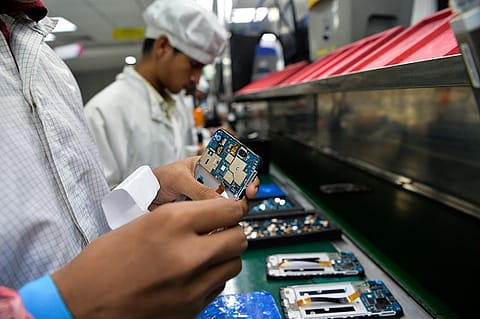
The proposal is part of a broader push to bring India’s fragmented industry associations and sectoral ecosystems closer together. | Credits: Getty Images
India could bring three of its major electronics and technology industry events--Bharat Electronic Manufacturing and Export Summit (BEMES), SEMICON India and the Indian Mobile Congress (IMC) together as the government and industry associations look to build a more integrated electronics and semiconductor ecosystem.
Pankaj Mohindroo, chairman of the India Cellular & Electronics Association (ICEA), said the first edition of BEMES is expected to be held in February, with discussions underway on holding it alongside SEMICON and IMC.
“There is a strong possibility that BEMES, SEMICON and the Indian Mobile Congress can be held alongside,” Mohindroo said at a panel discussion at SEMICON India in New Delhi.
He said the three events could retain their individual identities while being held together to create greater synergies across electronics manufacturing, supply chains, semiconductors and telecom. The proposal is part of a broader push to bring India’s fragmented industry associations and sectoral ecosystems closer together.
Industry bodies push for greater coordination
The discussion, moderated by Amitesh Kumar Sinha, CEO of the India Semiconductor Mission (ISM) and Additional Secretary at the Ministry of Electronics and Information Technology (MeitY), also saw industry leaders call for closer coordination among associations.
Ajit Manocha, president and CEO of SEMI, said the industry should consider creating a permanent steering committee rather than bringing association heads together only periodically. “I don’t think we should just do it once again. I think my recommendation would be that we create a permanent steering committee like this where we do not let those kind of divides happen in the future,” Manocha said.
Mohindroo said associations should not be viewed as competing with one another, arguing that their strengths need to be combined to address India’s broader national priorities. “Do not look at us as we are competing with each other. We are collaborating and want to collaborate,” he said.
Rajoo Goel, secretary general of ELCINA, said the next phase of India’s electronics strategy should cover a wider set of priorities, including the electronics market, trusted value chains, exports, R&D and innovation, skills and talent, employment and strategic resilience. “The point which is required right now is to connect the dots together,” Goel said, adding that the presence of multiple industry associations at the panel demonstrated their willingness to work together.
Goel, who said he comes from a defence background, added that the associations would work towards executing the agenda once the direction was established.
The call for collaboration was also echoed by Ashok Chandak, president of SEMI India and the India Electronics and Semiconductor Association (IESA). Chandak said SEMICON India had improved substantially in terms of its programme, participation and energy, but stressed that the ecosystem would take time to mature. “I think we are moving up the scale very, very quickly. We have to learn definitely. I think it’s not something which we can do overnight,” Chandak said.
He also highlighted the large number of young people attending the event, describing them as the skilled workforce that would take India’s semiconductor mission forward.
{{#most-powerful-women-snapshot-individual.slug}} {{/most-powerful-women-snapshot-individual.slug}} {{^most-powerful-women-snapshot-individual.slug}} {{/most-powerful-women-snapshot-individual.slug}} {{#showRanking}} {{current-rank}} {{/showRanking}} {{#photo.0.url}}
{{name}}
Col. Suhail Zaidi of the Manufacturers’ Association for Information Technology (MAIT) said the industry needs to strengthen the entire electronics value chain, spanning design, intellectual property, equipment, materials, fabs, packaging, components, PCBA, systems and AI equipment. “What we would like to strengthen further is the entire value chain in future,” Zaidi said.
Follow Fortune India
NEXT STORY