BRICS 2026: India braces to host Xi, Putin in Delhi as it seeks to project voice of developing economies
/ 4 min read
India is looking to turn its BRICS presidency into a platform for faster trade payments, easier market access, SME finance and infrastructure funding, while strengthening its role as a leading voice of the Global South
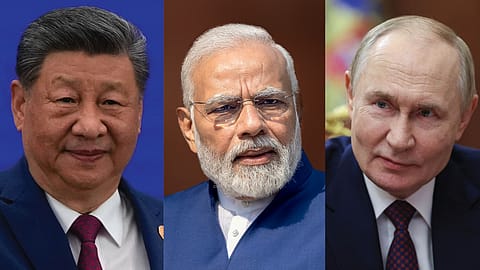
As the 18th BRICS Summit opens in Delhi on September 12-13, the headline will be the leaders in the room. The bigger story is what India wants to get out of them—and whether it can turn BRICS from a talking shop into a more practical economic platform.
Russian President Vladimir Putin is expected in Delhi for the summit, following his December 2025 visit for the 23rd India-Russia Annual Summit, where Prime Minister Narendra Modi described the relationship as "steadfast like the pole star". Chinese President Xi Jinping is also expected to attend, in what would be his first visit to India since 2019.
A Modi-Xi bilateral and a Modi-Putin bilateral are expected on the sidelines. Both carry important economic implications.
With China, India has been working to stabilise ties following the 2020 border crisis, with trade normalisation, market access and supply chains likely to remain important areas. With Russia, energy, fertilisers, trade payments and the large bilateral trade imbalance remain central to the relationship.
Other leaders expected in Delhi include South Africa's Cyril Ramaphosa, Egypt's Abdel Fattah el-Sisi, Indonesia's Prabowo Subianto and Iran's Masoud Pezeshkian, while Ethiopia's Abiy Ahmed is also expected to attend. The UAE is likely to be represented by Abu Dhabi Crown Prince Sheikh Khaled bin Mohamed bin Zayed Al Nahyan, while the level of Saudi Arabia's representation remains unclear.
BRICS now comprises 11 members—Brazil, Russia, India, China, South Africa, Egypt, Ethiopia, Iran, the UAE, Saudi Arabia and Indonesia—alongside 10 partner countries including Belarus, Bolivia, Cuba, Kazakhstan, Malaysia, Nigeria, Thailand, Uganda, Uzbekistan and Vietnam.
What India actually wants
India took over the BRICS chair on January 1 and has held more than 350 meetings and high-level engagements across over 25 cities till date.
Ahead of the summit, on September 7, Union Finance Minister Nirmala Sitharaman chaired a meeting with officials of the department of economic affairs to review the key outcomes and prepare for the final BRICS Finance Ministers and Central Bank Governors meeting in Mumbai.
The broader objective is to strengthen India's position as a leading voice for developing economies while pushing for more practical cooperation on trade, investment, finance and technology.
For businesses, that means the success of the summit will ultimately depend less on the language of the declaration and more on whether it reduces the friction involved in doing business across BRICS markets.
"India should use its BRICS presidency to secure faster export payments, fewer certification hurdles and financed infrastructure projects," Vaibhav Maloo, managing director of Enso Group and president of Enso Foundation, told Fortune India.
{{#most-powerful-women-snapshot-individual.slug}} {{/most-powerful-women-snapshot-individual.slug}} {{^most-powerful-women-snapshot-individual.slug}} {{/most-powerful-women-snapshot-individual.slug}} {{#showRanking}} {{current-rank}} {{/showRanking}} {{#photo.0.url}}
{{name}}
India's exports to BRICS were estimated at $82 billion in goods in FY2025-26, while services exports stood at $31.3 billion in calendar 2024, Maloo said, making easier access to these markets commercially important.
He identified pharmaceuticals, engineering, digital services, energy security and investment in critical mineral supply chains as some of the areas where India could benefit.
UPI as India's pitch
Payments are likely to be one of the clearest areas where India can offer something tangible.
Rather than pursuing a common BRICS currency in the near term, the focus has increasingly shifted towards local-currency settlement and improving cross-border payment infrastructure.
India's UPI and Account Aggregator framework could give it a natural role in that conversation. A CareEdge-ORF report on SME financing across BRICS+ economies argues that India's digital finance infrastructure offers a scalable model for cross-border SME payments and trade finance.
The report recommends developing a BRICS+ Digital Payments and Open Finance Framework, with interoperable national payment systems, common technical standards and secure data-sharing protocols.
Maloo said currency swaps could also support liquidity and local-currency settlement could reduce conversion costs, but warned that members would first need to address customer verification, data rules, capital controls, sanctions compliance and currency liquidity.
The SME financing opportunity
The case for cooperation gets even bigger when it comes to small businesses.
The CareEdge-ORF report estimates potential SME financing demand across eight BRICS+ economies at $8.1 trillion, compared with supply of $3.9 trillion, leaving a $4.2 trillion financing gap, equivalent to 19.8% of combined GDP.
That creates an opening for India to export some of its financial infrastructure and expertise, including digital lending, credit guarantees and invoice financing through platforms such as TReDS.
The report has recommended that India champion a BRICS+ SME Financing Facility, while using institutions such as SIDBI and EXIM Bank to help partner countries develop credit guarantee systems and digital lending frameworks.
The New Development Bank (NDB), the multilateral development bank set up by the BRICS founding countries in 2015, finances infrastructure and sustainable-development projects in member and other emerging economies. Maloo said that by June 2026, the bank had approved $44 billion cumulatively, including $10.5 billion for India, and disbursed $25 billion across member countries.
Its role, he said, would be complementary rather than a replacement for existing development finance, with greater local-currency lending and private-sector co-financing potentially expanding its impact.
For businesses, Maloo said BRICS should also focus on MSME export finance, mutual recognition of testing and simpler customs procedures. Tariff concessions, he noted, could prove harder because member countries have divergent interests.
From declarations to delivery
That may ultimately be the real test for India's BRICS presidency.
India is seeking to use the grouping to strengthen its influence across the Global South, but it also has a chance to make that influence commercially relevant—through payments infrastructure, trade finance, development funding and easier access to markets.
"Summit commitments should name implementing agencies and require public progress reviews, with success measured through lower costs, quicker payments and new orders," Maloo said.
That is a more demanding benchmark than another summit declaration. And for India, it may be the more important one.
Follow Fortune India
NEXT STORY