Floating solar gets a major push as Cabinet clears ₹5,070-crore Surya Sarovar scheme
/ 3 min read
The scheme seeks to develop 5,000 MW of floating solar capacity with co-located battery storage having a minimum storage duration of two hours, or 10,000 MWh of storage capacity.
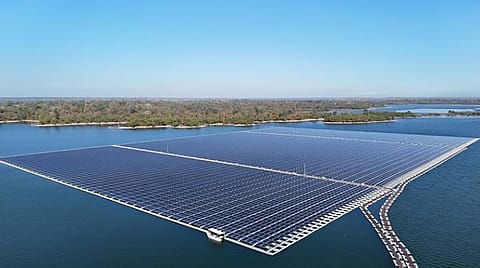
Floating solar expansion | Credits: PIB
India’s push to diversify its renewable energy portfolio received a significant boost with the Union cabinet approving the Pradhan Mantri Surya Sarovar Yojana (PM-SSY), a ₹5,070-crore scheme to accelerate floating solar photovoltaic (FSPV) projects integrated with energy storage systems (ESS).
The scheme seeks to develop 5,000 MW of floating solar capacity with co-located battery storage having a minimum storage duration of two hours, or 10,000 MWh of storage capacity. Projects will be sanctioned between FY2026-27 and FY2030-31, while financial assistance will continue to be disbursed until FY2032-33.
The National Institute of Solar Energy (NISE) earlier estimated India’s floating solar potential at about 102.18 GWp across reservoirs and other suitable inland water bodies, highlighting the enormous untapped opportunity.
Floating solar, also known as Floating Photovoltaics (FPV), involves mounting solar panels on floating platforms installed over reservoirs, lakes and ponds. Besides conserving scarce land resources, the technology improves panel efficiency through the cooling effect of water while also helping reduce water evaporation.
Despite these advantages, India has commissioned only about 700 MW of floating solar capacity so far. Industry experts attribute the slow pace to inadequate site-specific data, absence of a comprehensive implementation framework and lengthy approval processes.
The new scheme attempts to address these bottlenecks by providing Central Financial Assistance (CFA) of ₹1 crore per MW for eligible projects after successful commissioning. Additionally, up to ₹50 lakh per project will be available for feasibility studies, environmental assessments and other preparatory work needed to de-risk project development.
The government estimates that the programme could generate 16,000-17,000 full-time equivalent jobs across the project value chain. It is also expected to stimulate domestic manufacturing of floating platforms, photovoltaic cells and modules, battery energy storage systems and other key components, reinforcing the government’s Aatmanirbhar Bharat manufacturing agenda.
India has developed 700 MW FPV projects
India has already demonstrated the viability of floating solar through several large-scale projects.
Among the most notable is Tata Power Renewable Energy Limited’s (TPREL) 126 MW Omkareshwar Floating Solar Project on the Narmada river in Madhya Pradesh. Built across 260 hectares of water and awarded by NHDC Limited, the project is regarded as one of the world’s largest inverter-based floating solar platforms and supplies power to the Madhya Pradesh Power Transmission Company.
Tata Power has also developed the 101.6 MW floating solar project at NTPC’s Kayamkulam thermal station in Kerala, spread across nearly 350 acres of backwaters.
The 100 MW Ramagundam Floating Solar Project in Telangana, commissioned by NTPC in 2022, remains India’s largest operational floating solar plant. Spread across 500 acres of reservoir area, it is among the country’s flagship FPV installations.
{{#most-powerful-women-snapshot-individual.slug}} {{/most-powerful-women-snapshot-individual.slug}} {{^most-powerful-women-snapshot-individual.slug}} {{/most-powerful-women-snapshot-individual.slug}} {{#showRanking}} {{current-rank}} {{/showRanking}} {{#photo.0.url}}
{{name}}
Other significant projects include the 25 MW Simhadri Floating Solar Project in Andhra Pradesh, 33 MW Kawas project in Gujarat and installations at Rihand Dam in Uttar Pradesh.
Addressing the land challenge
One of the biggest advantages of floating solar is its ability to overcome one of India’s most pressing renewable energy constraints—land availability.
According to a Colliers India report, the country’s planned addition of 270-300 GW of solar and wind capacity by 2030 would require nearly seven lakh acres of land, creating a $10-15 billion market for land aggregation and acquisition.
Floating solar offers an alternative by utilising existing water bodies instead of competing for agricultural or industrial land.
Experts believe the technology could be particularly attractive for states such as Odisha, Kerala, Tamil Nadu and Karnataka, where abundant reservoirs, lakes, dams and backwaters offer significant deployment opportunities despite relatively limited land availability. Some industry estimates place India’s overall floating solar potential at over 200 GW.
Recognising the sector’s importance, the Ministry of New and Renewable Energy (MNRE), along with NISE and IIT Roorkee, held a stakeholder consultation earlier this year to formulate a dedicated floating solar policy. Discussions focused on easing project development through measures such as plug-and-play project models, pre-approved waterbody allotments and streamlined clearances for developers and investors.
Follow Fortune India
NEXT STORY