Bullet Train: Track testing by June 2027; Surat-Vapi section to be ready by December, says Vaishnaw
/ 3 min read
First India-made train body frame sent for structural testing; Vadodara-Mumbai travel time expected to fall to 1.5 hours.
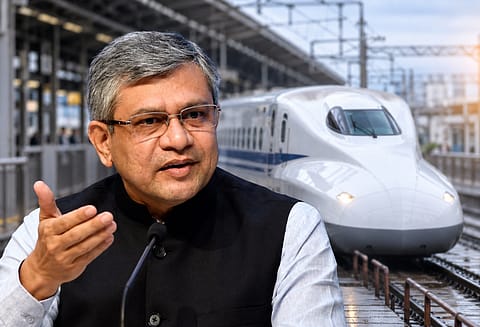
The Mumbai-Ahmedabad High-Speed Rail corridor is being built with Japanese technology and is set to connect major economic centres across Gujarat and Maharashtra.
India's first indigenously manufactured Bullet Train is expected to begin track testing by May-June 2027, with the first body frame completed and sent for a structural squeeze test, Railway Minister Ashwini Vaishnaw said on Tuesday.
Speaking at the ‘NaMo for Viksit Bharat’ event in Vadodara, Vaishnaw said manufacturing of the high-speed train was progressing rapidly and the train would move to track testing next year.
“Regarding the bullet train being built in India — driven by the Prime Minister's vision of Atmanirbhar Bharat — its first body frame was completed just the day before yesterday and sent for a squeeze test. By May or June of next year, India's own bullet train will be on the tracks for testing,” Vaishnaw said.
The minister said the train would undergo two to four months of testing before it is inaugurated by Prime Minister Narendra Modi.
“After a testing period of 2-4 months, the Prime Minister himself will inaugurate the bullet train. When you ride the bullet train from Vadodara, you will reach Mumbai in just an hour and a half,” he said.
The squeeze test is a structural assessment of the train's body frame to check its ability to withstand prescribed compressive forces before it progresses to track and other testing.
Surat-Vapi section to be completed by December
Alongside the progress in train manufacturing, construction work on the Mumbai-Ahmedabad High-Speed Rail (MAHSR) corridor is also moving ahead.
Vaishnaw said construction of the section between Surat and Vapi is expected to be completed by December this year.
“The construction of the section between Surat and Vapi will be completed this year itself by December,” he said.
The minister had earlier said that the first section between Surat and Bilimora is targeted for commissioning next year, while work on the wider corridor is progressing faster than anticipated.
The 508-km Mumbai-Ahmedabad High-Speed Rail corridor passes through Maharashtra, Gujarat and the Union Territory of Dadra and Nagar Haveli and Daman and Diu. It has 12 stations, including Mumbai, Thane, Virar, Boisar, Vapi, Bilimora, Surat, Bharuch, Vadodara, Anand, Ahmedabad and Sabarmati.
{{#most-powerful-women-snapshot-individual.slug}} {{/most-powerful-women-snapshot-individual.slug}} {{^most-powerful-women-snapshot-individual.slug}} {{/most-powerful-women-snapshot-individual.slug}} {{#showRanking}} {{current-rank}} {{/showRanking}} {{#photo.0.url}}
{{name}}
The project is being developed with Japanese technology and cooperation and is India's first high-speed rail corridor.
Vadodara-Mumbai journey to take 1.5 hours
The Bullet Train project is expected to substantially reduce travel time between key economic centres in Gujarat and Maharashtra.
Vaishnaw said the journey between Vadodara and Mumbai would take about 1.5 hours once the service becomes operational.
“The travel time between Vadodara and Mumbai will be reduced to 1.5 hours,” he said.
The corridor is designed to provide faster inter-city connectivity between Mumbai and Ahmedabad, with stations covering major commercial and industrial centres along the route.
The immediate focus is now on completing civil works on the operational sections and moving the domestically manufactured rolling stock through structural, track and other testing stages.
The first body frame undergoing the squeeze test marks a key step in the manufacturing programme, as the project moves from infrastructure construction towards testing of the trains that will operate on the corridor.
The first high-speed rail service on the corridor is expected to commence in 2027, with the Surat-Bilimora section targeted as the first operational stretch.
DFC network completed
Vaishnaw's comments on the Bullet Train came at an event where Prime Minister Narendra Modi also dedicated three sections of the Western Dedicated Freight Corridor (WDFC).
The three sections — Sanand (North)-Makarpura, New Umbergaon-New Saphale and New Saphale-Jawaharlal Nehru Port Terminal (JNPT) — together cover 326 route kilometres and were developed at a cost of more than ₹20,700 crore.
With the commissioning of these sections, India's more than 2,800-km Dedicated Freight Corridor network has been completed.
The DFC provides dedicated capacity for freight movement, allowing goods trains to operate on separate routes and freeing up capacity on conventional railway lines.
For the Bullet Train project, the focus now shifts to the next phase of testing and commissioning, with the first India-made train expected to reach the tracks in May-June 2027 and the Surat-Vapi civil works targeted for completion by December this year.
Follow Fortune India
NEXT STORY