Dedicated Freight Corridor cuts freight travel time, allows 250-truck cargo in one train: PM Modi
/ 2 min read
PM Modi says the 2,800-km freight network is becoming the backbone of India’s trade and business; more than 430 freight trains run daily on its Eastern and Western corridors
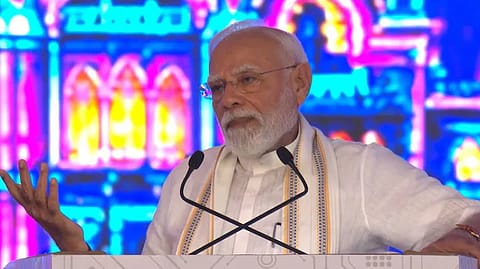
PM stated that the dedicated routes are designed to increase freight capacity while easing congestion on busy passenger railway corridors. | Credits: X/@BJP4India
Prime Minister Narendra Modi on Tuesday said the Dedicated Freight Corridor (DFC) has significantly reduced freight transit times and improved the efficiency of cargo movement, citing the example of a double-stack container train that recently carried cargo equivalent to more than 250 trucks in a single trip.
Addressing the ‘NaMo for Viksit Bharat’ programme in Vadodara, Modi said the freight network was changing the way goods move across the country, with more than 430 freight trains now operating daily on the Eastern and Western Dedicated Freight Corridors.
“Dedicated freight corridors are the lifeline of a fast-developing India. India’s transformation is accelerating because of this modern freight network,” Modi said.
The Prime Minister said the DFC has helped separate freight and passenger traffic, which earlier had to share the same railway tracks and consequently affected the movement of both.
He said a freight journey covering 100 km that earlier took around 6.5 hours can now be completed in less than half the time on the dedicated network. Similarly, a journey that takes about 30 hours by truck can be completed in 10-12 hours using the DFC, Modi said.
The comments came as Modi dedicated three sections of the Western Dedicated Freight Corridor (WDFC), completing the more than 2,800-km DFC network.
The three sections — Sanand (North)-Makarpura, New Umbergaon-New Saphale and New Saphale-Jawaharlal Nehru Port Terminal (JNPT) — together cover 326 route kilometres and have been developed at a cost of more than ₹20,700 crore.
“After 2014, with your blessings, when I reached Delhi, and as soon as we arrived there, we began accelerating this project. Work on the 2,800 km dedicated freight corridors has been completed today,” Modi said.
“Today, the Eastern and Western Freight Corridors are becoming the main backbone of the country's trade and business,” he added.
Modi takes dig at critics
While highlighting the shift of cargo from road to rail, Modi took a dig at those questioning the impact of the freight corridor on truck operators.
Modi also pointed to the project's long gestation, saying the idea for the DFC was first proposed in 2004 and a special company was established in 2006.
{{#most-powerful-women-snapshot-individual.slug}} {{/most-powerful-women-snapshot-individual.slug}} {{^most-powerful-women-snapshot-individual.slug}} {{/most-powerful-women-snapshot-individual.slug}} {{#showRanking}} {{current-rank}} {{/showRanking}} {{#photo.0.url}}
{{name}}
“The idea for the Dedicated Freight Corridor began in 2004. In 2006, a special company was established to carry out the work, and until 2014, files just kept shuffling from one place to another,” he said.
“Unfortunately, even these files weren't fortunate enough to get a dedicated corridor. The files would get stuck, hang around and wander aimlessly,” Modi said.
The Prime Minister said faster freight movement was helping reduce fuel consumption and freight costs while also benefiting the environment. He added that the corridors were enabling farmers to move flowers, vegetables and fruits to major markets more quickly.
Modi also flagged off freight train services from New Sanand, New Makarpura, New Umbergaon and New JNPT.
Separately, he said India's manufacturing capabilities in the railway sector had expanded substantially, with around 50,000 modern rail coaches manufactured since 2014 and 2.5 lakh wagons added to the railway fleet.
Follow Fortune India
NEXT STORY