US flags Make in India, Atmanirbhar Bharat in excess capacity probe; proposes 25% tariffs on Indian goods, 17% under trade deal
/ 2 min read
USTR report cites PLI schemes and industrial policies, alleges excess capacity in steel, solar, pharma and ICT; India rejects charge, says no sector has structural excess capacity
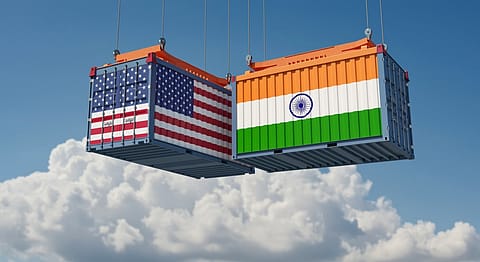
The USTR report identifies steel, solar, pharmaceuticals and information and communications technology (ICT) as sectors where it sees signs of excess capacity. | Credits: Shutterstock
India's flagship manufacturing and self-reliance programmes, including Make in India, Production Linked Incentive (PLI) schemes and Atmanirbhar Bharat, have come under scrutiny in a fresh US trade action, with Washington proposing tariffs of up to 25% on Indian goods on Wednesday. The proposed rate could be adjusted to 17% if India reaches a trade agreement with the US that addresses the findings of the investigation.
In its 189-page report under Section 301 of the Trade Act of 1974, the Office of the US Trade Representative (USTR) specifically lists these programmes among India's policies that, it says, contribute to structural excess capacity and production in manufacturing.
The report describes them as “umbrella industrial policies that promote growth in capacity, production, and exports”, alongside the India Brand Equity Foundation's export-promotion initiatives. It also cites inadequate labour protections, financial policies, market-access barriers and India's growing reliance on manufacturing inputs and investment from non-market economies, particularly China.
“For decades, many of our trading partners have adopted industrial strategies built on targeting manufacturing, wage and labour suppression, financial and other support, non-market economy inputs, and other market-distorting practices that tilt the trade balance in their favour while eroding America's manufacturing base,” US Trade Representative Jamieson Greer said.
Steel, solar capacity under scrutiny
The USTR report identifies steel, solar, pharmaceuticals and information and communications technology (ICT) as sectors where it sees signs of excess capacity. India's solar module manufacturing capacity is estimated at 154 gigawatts (GW), nearly three times domestic demand of 53 GW. It also cites a 26.2% increase in India's steelmaking capacity between 2019 and 2024.
The report says India's intermediate goods imports from China rose 97% to $44 billion between 2017 and 2025, while imports from non-market economies increased 152% to $91 billion.
India has rejected the central finding. In a late night statement on Wednesday, the government said the Department of Commerce had told the US during the investigation that “India does not have structural excess capacity in any sector”.
“The Notice is currently under examination,” the government said, adding that “any trade-related concerns should be addressed within the framework of these negotiations”, referring to the ongoing India-US Bilateral Trade Agreement talks.
The government reiterated its commitment to an early conclusion of the agreement.
The USTR report also records that India had a global goods trade deficit of $309 billion in 2025, even as its goods trade surplus with the US rose to $57.3 billion. It notes that India ran a steel trade deficit of 0.13 million tonnes in the second quarter of 2025.
“USTR is applying to India a diagnosis built for a very different economy. India consumes most of what it produces and buys more goods from the world than it sells, so it is not exporting a domestic glut,” said Abhik Sengupta of the Helsinki Geoeconomics Society.
{{#most-powerful-women-snapshot-individual.slug}} {{/most-powerful-women-snapshot-individual.slug}} {{^most-powerful-women-snapshot-individual.slug}} {{/most-powerful-women-snapshot-individual.slug}} {{#showRanking}} {{current-rank}} {{/showRanking}} {{#photo.0.url}}
{{name}}
Tariff proposals yet to take effect
The proposed 17% rate would give India a one percentage point advantage over Bangladesh, Cambodia, Indonesia, Malaysia and Thailand, and a three-percentage point advantage over Vietnam and China under their respective proposed deal rates.
Greer said the proposed duties were “not really additive” and would work more like a top-up on existing tariffs. The USTR has invited written comments until January 5, 2027, and scheduled public hearings from January 25. The proposed tariffs have not yet come into effect.
(With inputs from PTI.)
Follow Fortune India
NEXT STORY