Xi Jinping arrives in Delhi for BRICS; bilateral meeting with PM Modi likely to focus on border, trade, security
/ 3 min read
Xi’s visit comes at a time when BRICS is also discussing ways to reduce dependence on the US dollar and strengthen trade in local currencies.
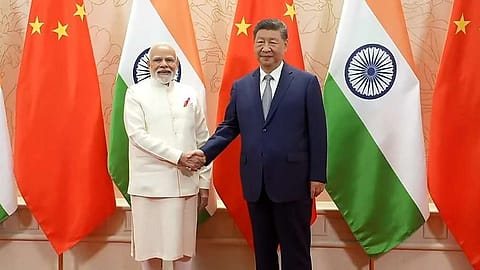
The meeting between the two leaders is expected to cover a range of issues, including the border situation, defence, security, trade, investment, visas, and direct flights. | Credits: From a post on X (formerly Twitter,) by Xu Feihong, Chinese Ambassador to India
Chinese President Xi Jinping on Saturday left Beijing for New Delhi to attend the 18th BRICS Summit at the invitation of Prime Minister Narendra Modi. Xi’s visit marks his first trip to India in nearly seven years and comes as New Delhi and Beijing work to normalise ties following the military standoff along the Line of Actual Control (LAC) in 2020. Xi Jinping to arrive at Delhi around 12.30 pm today.
Xi is accompanied by Cai Qi, a member of the Standing Committee of the Political Bureau of the Communist Party of China (CPC) Central Committee and director of the General Office of the CPC Central Committee, and Wang Yi, a member of the Political Bureau of the CPC Central Committee and China’s foreign minister.
Chinese Ambassador to India Xu Feihong said in a note that China and India are planning for a bilateral meeting between Xi and Modi.
Modi-Xi meeting: What’s on the agenda?
The meeting between the two leaders is expected to cover a range of issues, including the border situation, defence, security, trade, investment, visas, and direct flights. The meeting will be the third consecutive year in which Xi and Modi have held talks, following their meetings in Kazan and Tianjin.
China has said it will work with India to implement the strategic guidance provided by the two leaders, manage bilateral relations from a strategic and long-term perspective, strengthen communication, expand cooperation and properly handle differences. The Chinese leadership has also stressed the importance of maintaining ties as “friends enjoying good-neighborliness and partners helping each other succeed.”
What will be India's stand on BRICS common currency?
Xi’s visit comes at a time when BRICS is also discussing ways to reduce dependence on the US dollar and strengthen trade in local currencies. However, India is unlikely to fully embrace China’s more aggressive de-dollarisation approach. New Delhi is expected to favour practical measures to facilitate cross-border payments and local-currency trade rather than push for a common BRICS currency.
Commerce Minister Piyush Goyal on Saturday called on BRICS members to link their payment systems to facilitate trade in local currencies.
Speaking at the opening session of the BRICS Business Forum 2026 in New Delhi, Goyal also called for greater global access to digital trade and highlighted India’s digital public infrastructure. “India has taken significant initiatives in laying out a digital public infrastructure. India's Unified Payments Interface (UPI) has crossed over 250 billion transactions a year, representing more than half of the transactions by volume across the world,” Goyal said.
“Today, it (UPI) is also accepted in 11 countries, and I would urge the BRICS member countries and partner countries to link our payment systems, trade in each other's local currencies, make digital trade global and build together for the future emerging technologies,” he said.
Why Xi’s India visit matters
Xi’s visit is significant as it is his first trip to India since the 2020 Galwan Valley clash, which triggered a prolonged deterioration in bilateral relations and a sharp military build-up along the border.
The visit comes against the backdrop of renewed efforts by India and China to stabilise and normalise ties after years of tensions. The two sides have taken steps towards easing the situation along the border, while diplomatic and economic engagement has gradually resumed.
{{#most-powerful-women-snapshot-individual.slug}} {{/most-powerful-women-snapshot-individual.slug}} {{^most-powerful-women-snapshot-individual.slug}} {{/most-powerful-women-snapshot-individual.slug}} {{#showRanking}} {{current-rank}} {{/showRanking}} {{#photo.0.url}}
{{name}}
However, for India, the thaw in ties is likely to remain calibrated. While New Delhi could seek greater economic and diplomatic engagement with Beijing, it is also expected to maintain its concerns over border security, trade imbalances and strategic competition. India may also resist efforts to turn BRICS into a strategic security bloc, preferring to retain the grouping’s focus on economic cooperation, development, trade, and reforms of global institutions.
Follow Fortune India
NEXT STORY