Amaravati will be a world-class city India has not seen, says Nara Lokesh
/ 3 min read
The IT, Electronics and HRD Minister of Andhra Pradesh on his vision for Swarna Andhra @2047.
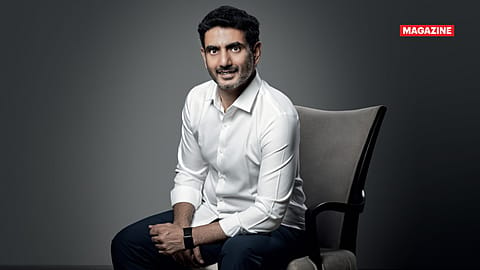
Nara Lokesh | Credits: Sanjay Rawat
This story belongs to the Fortune India Magazine August 2026 issue.
MINISTER FOR IT, Electronics and HRD, Andhra Pradesh, Nara Lokesh has been leading the state’s efforts to galvanise investments across sectors. He talks about his vision for Swarna Andhra @2047 — including building Amaravati — how it is anchored in a disciplined work ethic and execution, and how it spills over to the entire ecosystem. Edited excerpts:
Growing up in a household that was distinct from a typical political household — given the charisma that N. Chandrababu Naidu had — and later your education at premier foreign institutions, take us through the journey.
I was born within a month of NTR [N. T. Rama Rao] being sworn in as the Andhra Pradesh chief minister for the first time [in 1983]. So, I have grown up seeing the entire system... NTR ji had a legacy and a character of his own. My leader, Naiduji, also has a character and a legacy to himself. For me, it has been the best of both worlds and an opportunity to leverage.
How did Carnegie Mellon shape you as a person?
In the Indian education system, only exams matter. It was a shift to a system that focusses on critical thinking. I am not a hard learner. So, I excelled far better. Carnegie Mellon is one school with a bunch of overachievers. It was inspiring. Every summer and winter break, I used to work. I rarely came home.
I worked at DaimlerChrysler in Germany and GE. I worked in the Singapore Prime Minister’s Office for PS21 — public service for the 21st century [a movement aimed at inculcating innovation and high performance among public officers]. So, I was well-exposed and travelled a lot. Then I went to the World Bank. I always believed that it was more of a knowledge bank than a financial institution. Later, I thought both Stanford University and Kellogg School of Management would be good, but I finally opted for the former for my MBA.
You have seen your father’s playbook of tech-led growth. Today, is it the same wisdom that you are using 2.0, or is it a new way of thinking?
More Stories from this Issue
Firstly, this is Naiduji 4.0; it is the fourth time he is in power. We borrow a lot of things from what he has done in Hyderabad. But we are not doing it in one city. We have decentralised in multiple locations. We have multiple corridors — electronics, defence, quantum, spacetech, deeptech, etc. We have 22 such clusters.
Secondly, times have changed. What took Hyderabad 30 years can be delivered in Andhra with one decade of a continuous government. Development cycles are shrinking. The economy is on a hyperdrive. Globally, wars are happening, but there is no recession. The economy has become more resilient. This presents new opportunities. So, yes we borrowed [his] playbook, but have backed [it] with a new team, which has the energy to take it to the next level.
Amaravati is a mega development project. What thought process has gone into it?
Naiduji is known for building cities. It is well known that Cyberabad is his creation. But he says Cyberabad was brownfield. His vision is to build a greenfield city between Vijayawada and Guntur. And let’s build a greenfield city in between, which is extremely well-planned and has world-class infrastructure. The vision is to build a world-class city that India has not seen. We are building quantum computing ecosystems, hotels and hospitals.
{{#most-powerful-women-snapshot-individual.slug}} {{/most-powerful-women-snapshot-individual.slug}} {{^most-powerful-women-snapshot-individual.slug}} {{/most-powerful-women-snapshot-individual.slug}} {{#showRanking}} {{current-rank}} {{/showRanking}} {{#photo.0.url}}
{{name}}
What would you consider the biggest achievement in the last two years?
I will tell you the outcome first. Around 106,000 students have migrated from private to government schools in the last one year.
How did you do that?
[Earlier] we had only 3% of our primary schools with one-class-one-teacher. From first grade to fourth grade, [if] only one teacher is teaching 25-30 kids, what are they going to teach? We enhanced that to 33% with structural reforms. I powered it with teacher recruitment and parallelly developed a dashboard.
How does it work?
We have about 27 key performance indicators (KPIs) on the dashboard. The KPIs I look at will be the same that my headmasters would be able to access for their schools, the mandal education administration will access at the mandal level, and the commissioner will look at his/her level for the entire ecosystem. At the top of it, I have access to everything. We have developed it [the dashboard] in-house.
We have an app — Learning Excellence in Andhra Pradesh (LEAP) — for parents and teachers. Everything is linked. Through triangulation of data, I have access to teachers’ and students’ attendance, and the quality of mid-day meals.
My government schools have improved the pass percentage by 7.5-8%, year-on-year. This year I believe it will be far better.
Follow Fortune India
Sign in to read full story
To access our exclusive magazine content, sign in to your Fortune India account.
Sign In NowNEXT STORY