Banking is about taking risks, but most mistakes are made in good times: Amitabh Chaudhry
/ 9 min read
Axis Bank MD and CEO says some segments will simply grow faster than others, but what each bank goes after depends on where it is in its cycle, which assets are doing well and where it has market share.
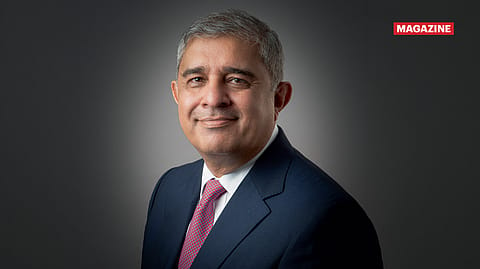
Amitabh Chaudhry, CEO, Axis Bank: “The Indian economy will keep growing between 6.5% and 8%, and for that to happen, the financial system must step up, which means the banking system needs to grow faster than the economy.”
This story belongs to the Fortune India Magazine November 2026 issue.
In an increasingly competitive business environment, Amitabh Chaudhry, MD & CEO of Axis Bank, believes private sector banks will continue to score over state-owned peers, even as AI becomes a big customer experience differentiator.
Is this a structurally different phase for Indian banking?
Fundamentally, for any bank to do well sustainably, deposits remain the core, and to grow consistently, deposit growth must be right up there.
Second, there is a secular decline in CASA (current account, savings account) as retail depositors get savvier and have more choices. So, more money is going into time deposits, mutual funds and pension funds, and it comes back into the banks as wholesale deposits. The pace may be slow, but the decline will continue. If it is a structural change, we should accept it as one. But it also raises questions on, just as in markets abroad, whether banks should be allowed to raise wholesale deposits differently because they will become a mainstay of what we do.
Third, the private sector’s market share gain over the public sector will continue. People will assess it at the total deposit level but look at it by category. To win current accounts today, you need solutions that work from the smallest proprietorship to the largest corporate: efficient cash management, trade finance, connected systems, automatic reconciliation, etc. A relationship will take you only this far. You need solutions and, with the world moving to APIs (application programming interface), also the technology behind them, which ensures that you gain market share in current accounts. You can gain market share even on the SA side, as customers expect digital experiences they get from other sectors, and Gen Z experiences a bank mainly digitally as they rarely visit a branch. So, physical presence must be backed by a solid understanding of the customer, analytics, AI-led personalisation and an unmatched digital experience.
So, is the fight now more on the liability side than on growth?
You cannot win on the asset side without the liabilities to support that growth, and that is why deposits are the starting point. For the past couple of years, PSBs enjoyed high LCRs (liquidity coverage ratio) and some still have a little bit of headroom where they could just draw down on their LCR to fund their asset growth. They could draw down LCR to fund asset growth even when deposit growth was not meaningful. The smartest way to do that was to go after good wholesale clients or mortgages, where the risk is low, and win on price. They did that. But the LCR story is ending; the ratios are now at levels they need to maintain. So, it comes back to deposits. Public sector banks are growing deposits, but much of it is bulk, which comes at a cost and cannot be the only way to grow. I am making a generic statement, not talking about any one bank.
More Stories from this Issue
On the asset side, foreign currency non-resident bank [FCNR(B)] now matters as we have recently mopped up $135 billion. When FCNR money comes in, in the first phase it gets deployed only in government securities. Next, for slightly better interest, it can go towards wholesale clients. Over time, if retail growth is good, they move to retail. It can also be used on the liability side by not renewing or repaying high-cost borrowings or repaying dollar borrowings. So, I look at both sides, and see where I can deploy fastest, and then move the money to where I ultimately want it. Every bank will act differently, depending on its balance sheet.(1)
With that liquidity, will you lend more aggressively now, or wait?
Wrong lending is the last thing one would want to do because of surplus liquidity. When there is so much liquidity in the system, chasing the same kind of clients, it is easy to say, “Let’s take a little more risk.” Banking is about taking risks, but most mistakes are made in good times. In bad times, everyone shuts their doors.
Over the past two years, deposits were constrained, and the RBI wanted loan-deposit ratios kept below a certain number. So, banks focussed on retail, where you get the most bang for your buck. Then the retail cycle turned, and they pulled back on unsecured lending and shifted towards other asset classes.
{{#most-powerful-women-snapshot-individual.slug}} {{/most-powerful-women-snapshot-individual.slug}} {{^most-powerful-women-snapshot-individual.slug}} {{/most-powerful-women-snapshot-individual.slug}} {{#showRanking}} {{current-rank}} {{/showRanking}} {{#photo.0.url}}
{{name}}
As deposit growth picked up, everyone vacated wholesale. We diverted money there and got good risk-adjusted returns. The risk profile of our incremental lending has stayed the same, and we disclose that data. Three quarters later, other banks started doing the same thing.
Retail done right is a granular business and takes time to pick up. We were not doing enough mortgages because it was, and remains, the lowest-yielding asset, and in other products we had to limit ourselves during the retail cycle. Our retail business is now gradually picking up, and that will show in AUM growth. We have also launched, after a lot of work, a product that approves and disburses an auto loan in 30 minutes. We are using technology and AI to offer differentiated customer experiences.
As a top-tier player, the bank would want to do everything...
We are doing everything; some segments will simply grow faster than others. What each bank goes after depends on where it is in its cycle, which assets are doing well and where it has market share. FCNR will push wholesale growth higher, because that is the easiest place to deploy large sums. It is difficult in retail.
NIMs (net interest margins) will fall, because with FCNR you raise the money first and deploy it initially in government securities. Even wholesale takes time. If I have ₹50,000 crore to deploy, people are not standing outside the door waiting for me to cut five cheques. But the fall is temporary. Once the money is in the right assets, it evens out. FCNR at this price is a great boon, and many banks have raised decent sums. But it has also meant bigger banks are getting bigger. The gap with smaller banks keeps widening, because some can raise far more money than others.(2)
Private corporate investment has been weak, and with the economy increasingly becoming consumer-oriented, even traditional commodity players are getting into low capex businesses. As a result, we may not see a repeat of the earlier capex cycle. What’s your view?
We see four themes in wholesale. One is digital infrastructure: data centres and digitisation. Two is manufacturing. Both the government and entrepreneurs realise that without our own technology and the ability to compete globally we have a problem. We are pretty good at manufacturing once we get into the details, and defence and space are opening up large contracts. Third is energy transition: solar and wind. Fourth is urbanisation, in which I include real estate and government infrastructure spending. These four will drive investment. But even in these four themes, you can lose money if you are not careful.(3)
That said, when you have the technology, the solutions, and the syndication, bond and equity-raising capability to meet every requirement of a corporate, why should we not be a strong player? Wholesale will be a mainstay for us, as will SME and retail. We have said retail will be 55-60%, wholesale 30-35% and SME the balance. It may swing a little with policy, but we are happy in that range.(4)
Are you aiming for the top spot in wealth management as well?
One of the big reasons we acquired Citibank India’s consumer banking business was wealth. We started seriously just before Covid, and today we are the No. 3 player: Burgundy Private is a well-known brand, and we will keep investing heavily in technology, platforms and people.
While the market is big enough, we are the only ones who can afford to go to Tier II, III, and IV towns, because of our presence. Pure wealth firms are focussed on the metros, and the foreign players are in just a handful of pockets. But wealth in the hinterland is rising rapidly. These families often put money back into their own companies, but they also want to keep some aside. Their children are coming back educated and want to do different things. They are looking for advice. Banks can reach them much faster than the others, which is why we can expand our wealth franchise quickly.(5)
We have One Axis that offers Axis AMC, Axis Securities and Axis Capital as an integrated platform. When we work with a promoter on an IPO, we seek Burgundy Private relationship or salary accounts. Everyone is pushed to have those conversations, and everyone sees it is a two-way street; the IPO lead may itself come from the mid-corporate team.
Of late, a growing number of MSMEs are scaling up and listing. Has your corporate mix changed?
The share of mid-corporate, and MSME in our balance sheet has gone up by 650 basis points (bps) since I joined. That is a big change. We have also pivoted to better quality. We rate SMEs on our own scale, SME 1 to 7. The share of the lower-quality book has come down to a small number. So, we have both grown and improved quality, and we will continue, because the opportunity is huge.
When the structural and cyclical factors collide, NIMs can’t get a bigger lift than today’s, can they?
Our NIMs have dropped by almost 50 bps. We have told the market we will do 3.8% through the cycle; last quarter we did 3.46%. If we get back to 3.8%, RoE lifts straightaway. If expenses come down further, that lifts it too. So, there is scope left, and every bank is asking what it can do to lift returns.
What will be a steady-state RoE for Axis Bank?
We have aspired for 18%, and we hit it for seven quarters, admittedly in a benign cycle. We believe 16+% should be par for the course, and we are very close to 16% now, even with NIMs down sharply. With good execution, 17.5-18% is possible.(6) That includes our subsidiaries, many of which are sub-scale but are executing well and moving steadily towards profitability. The aspiration remains 18%. We have not walked away from it.
What kind of acquisition would add value to Axis Bank: a portfolio, a geography?
We are a full-suite bank now, so size and scale come first. The few geography-focussed banks that are interesting are too small for the time a deal takes. NBFCs are a bigger problem. A bank merger can happen quickly under the Banking Regulation Act; Citi took longer only because we bought assets and liabilities. An NBFC takes 18 months from signing up to getting your hands on the company, and in that time what you paid for and what you get can differ hugely. So, we are wary of NBFCs.(7) We have looked at many portfolios that foreign banks have offered. They are often too small to take you far, and valuation expectations are always high. If you don’t see us in those conversations, it means the value to us is not significant enough.
Bank CEOs used to say “digital first” and now it is “AI first”. Can banks really push technology in a highly regulated environment such as banking?
We have no choice. If we don’t do it, someone else will eat our lunch. It is also a once-in-a-lifetime opportunity. We have been investing in AI for some time, and if you ask the vendors and hyperscalers selling AI solutions to banks, I am sure you will hear that Axis Bank is at the forefront. Technology lets us create a different customer experience, and it shapes how customers perceive the bank.
We are reimagining 8-10 large domains by asking: if we were starting from scratch as a completely AI-driven business, what would the customer journeys and the business model look like? It is a journey, and it is not done. We are also building horizontal capabilities that any business can pick up, such as reading documents, conversational AI and eliminating operations, as modules that plug into any domain solution. And we are working hard, and spending a lot, on governance. It is easy to get caught up in this wave, and if something goes wrong, you end up with a lot of mud on your face.
For real impact, you first need the architecture: the data lake, APIs to call the data, latency, controls, access, and model checks. That is a 2-3-year investment. We were lucky. We started 3-4 years ago, not knowing AI would do this, simply because it was the right thing to do.(8) So, our infrastructure is ready. Then you build the right solutions domain by domain, and watch the platform economics, because if it uses too many tokens the cost side of the equation may not work.
How aggressive will you be?
We are very aggressive. Ultimately, six or seven banks, or rather financial institutions, can invest in AI and will get there. The problem with any technology is that someone catches up: they can make the investment too, and people who worked with us will go and help them implement. The difference lies in your vision, in the time you get before the next player arrives, and in what you do with that time. If I have tied up the market by the time the second bank comes online, an offering that is 10% better is too late. Speed to market, relevance and execution give you a once-in-a-lifetime chance to become a market leader, or at least a significant player, quickly. Smaller players who can’t invest will lose out. Look at mobile apps: the public sector app is a generation behind the private sector. The same will happen in AI. Customers will gradually migrate to the better solution.
How do you see the banking landscape evolving in the near term?
The Indian economy will keep growing between 6.5% and 8%, and for that to happen, the financial system must step up, which means the banking system needs to grow faster than the economy. That gives enough institutions the room to gain customers and market share. Who wins will depend on execution on the ground and the customer experience, and technology will be an important part of that.
Follow Fortune India
NEXT STORY