Berger Paints: Defending its turf
/ 5 min read
The company is covering all bases as Birla Opus disrupts India’s paint market.
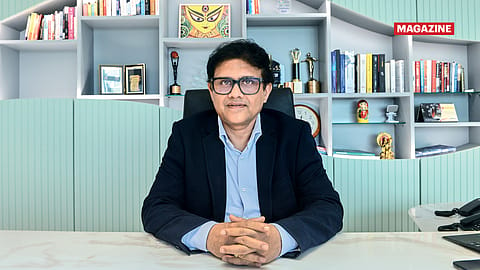
Abhijit Roy, MD and CEO, Berger Paints.
This story belongs to the Fortune India Magazine october-2026-the-indian-luxury-boom issue.
FOR YEARS, Berger Paints was only second to Asian Paints in India’s decorative paints market. But that position is being threatened by new entrants, especially Birla Opus. In a crowded market that also has Pidilite and Astral, Berger Paints’ challenge is not only to defend its market share, but to do so without getting pulled into a price and discounting battle that could erode profitability.
So far, the company has shown resilience, backed by a distribution network and dealer relationships built over decades. It began FY27 with double-digit sales growth to ₹3,583.75 crore and profit after tax of ₹405.01 crore in Q1, a 29% growth year-on-year. Abhijit Roy, MD and CEO, expects the momentum to continue.
According to Nuvama, a research and brokerage firm, Berger crossed 1,900 outlets and installed over 2,100 tinting machines in Q1, with a FY27 target of 10,000 machines.
But analysts predict an impending shift.
As raw material inflation eases and challengers get more room to compete on price, competitive intensity is likely to remain elevated. Systematix Research, in its recent report, said paint companies had collectively hiked prices by 13-14% between March and July owing to higher crude oil, packaging, and titanium dioxide costs. “[Yet] as inflation eases, the aggressive challengers, Birla Opus and JSW Dulux, would find greater room to manoeuvre on product pricing to drive market share gains,” the brokerage stated.
But that’s where Berger’s long-established dealer network gains importance. “It’s not a transactional relationship,” Roy tells Fortune India, adding, discounts may entice only 5-7% of dealers. The vast majority value their longstanding relationship with Berger, thanks to its product quality, supply, and margins. The company has lost “very, very few” large dealers, Roy asserts, with most losses concentrated in the small dealer network.
That said, he doesn’t shy away from admitting that FY26 was a tough year for the industry, with prolonged rain and lower raw material prices impacting value growth. Then came Birla Opus. According to Roy, Birla Opus was discounting 20-22% below the normal industry price when free material, a lower dealer price list, and additional marketplace spending were taken together. Yet Berger’s volume growth remained around 7-9%, even as value growth was much weaker. Antu Eapen Thomas, senior research analyst at Geojit Investments, echoes Roy’s views. He says Berger’s distribution expansion, strong rural presence, dealer engagement, and product innovation have helped it sustain superior volume growth and maintain market share. “Berger’s execution-led strategy and planned addition of tinting machines position it favourably relative to peers.”
More Stories from this Issue
However, as challengers move from acquisition to profitability, Roy believes the competitive intensity could begin to change. Birla Opus was initially priced about 5% below the industry level in the dealer price list. After the price hikes between April and June, it has now moved to industry price levels. Roy adds that aggressive discounting becomes harder to sustain as volumes grow and losses accumulate. He expects the new entrant could take at least 2-3 years to reach breakeven, depending on how quickly it raises prices.
Brokerage data shows just how quickly Birla Opus has scaled. Systematix estimates its Q1FY27 volume growth at 64% YoY and 17% sequentially, while Nuvama notes that the new entrant had taken about 5.5-6% market share, primarily in the mid- and lower-end segments.
Despite that, Ajay Thakur, research analyst at Anand Rathi, feels pricing discipline has broadly been maintained in the paint segment, which is good for the industry as a whole. That said, for Abneesh Roy, MD (research) at Nuvama, Berger is the favourite paint stock due to “consistent volume growth momentum across decorative and industrial” and “better market-share resilience” during periods of high competitive intensity.
Move over discounts
As the battle moves beyond discounts, one way for Berger to avoid being trapped in a pure price war is to change its business mix. Roy says the sharpest discounting is happening in the economy segment, where consumers are more price sensitive and brands have less influence. “If you have to retain your share, you will have to be competitive on pricing.” The answer, therefore, is to grow premium and luxury paints, along with waterproofing and wood coatings, where profitability is higher. Berger has launched new products, increased advertising, and expanded distribution in these categories.
{{#most-powerful-women-snapshot-individual.slug}} {{/most-powerful-women-snapshot-individual.slug}} {{^most-powerful-women-snapshot-individual.slug}} {{/most-powerful-women-snapshot-individual.slug}} {{#showRanking}} {{current-rank}} {{/showRanking}} {{#photo.0.url}}
{{name}}
“What has been working for Berger is their innovations and paint solutions such as washable and stain-resistant surfaces, dust-resistant coatings, and heat-reflective paints,” says Thakur, adding that though much smaller than Asian Paints, Berger is trying to ensure it matches the best in the industry in terms of technology. The numbers suggest this strategy might already be gaining traction. In Q1, Berger’s decorative paint volumes grew 8.4%, while revenue rose 12% to ₹3,584 crore. Ebitda was up 15% at ₹607 crore, with the margin expanding 44 basis points YoY to 16.9%.
Systematix, however, cautions that some of the quarter’s growth may have been aided by channel stocking ahead of price increases. Its checks also indicated some volatility in secondary offtake as painters and contractors adjusted to multiple rounds of price changes. That shifts the attention to the next few quarters. Berger had a weighted average price increase of around 5% in Q1, with another price hike of nearly 3% expected to flow through in Q2, according to Systematix.
At the same time, Berger is also trying to make the competitive equation less dependent on decorative paints. Construction chemicals and waterproofing have already crossed ₹1,000 crore, as is the protective coatings business. Roy estimates the automotive and general industrial powder coatings business, currently around ₹700 crore, touching ₹1,000 crore in two years.
This matters because the competition is not uniform across categories. Berger remains strong in protective coatings and general industrials, where infrastructure spending and new manufacturing capacity are creating demand. Hence, Roy spots three major growth opportunities for Berger: expanding its distribution network, growing construction chemicals and waterproofing, and building its protective, industrial coatings businesses.
The company is also investing in capacity. Berger plans to invest around ₹1,800 crore over four years in two greenfield plants in West Bengal and Odisha, requiring roughly ₹450 crore of additional annual capex, on top of its normal ₹450-500 crore annual spending. Roy plans to fund the investments through internal accruals.
Then comes Berger’s less visible but potentially more important strategy: finding areas — like the south and west — where the company’s distribution remains weak. That is an opportunity to tap into. It has taken cues from rivals by adding manpower to build its network in smaller towns. The company sees distribution expansion across upcountry and urban markets as a major growth lever.
The paint market may have acquired a new challenger, but Berger’s level-headed response is likely to hold the core, widen the footprint, and make growth more profitable.
Follow Fortune India
Sign in to read full story
To access our exclusive magazine content, sign in to your Fortune India account.
Sign In NowNEXT STORY