DeHaat: Sowing the seeds of success
/ 6 min read
The Patna-based agritech offers a complete ecosystem of agricultural services to more than 13 million farmers.
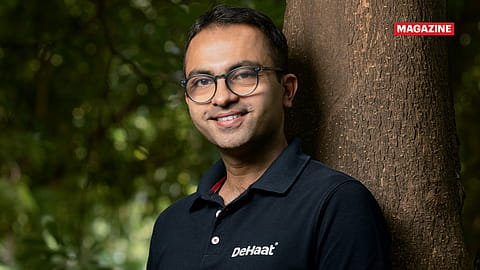
Shashank Kumar, co-founder and CEO, DeHaat. | Credits: Sanjay Rawat
This story belongs to the Fortune India Magazine october-2026-the-indian-luxury-boom issue.
GAUTAM SINGH, from Bihar’s Vaishali district, had been working as a driver in Delhi for more than a decade. In that time, he had faced multiple challenges that every migrant worker does: living away from family, the drudgery of a menial job, and poor savings. On top of that, his land parcel back home in Jaitapur village had become a “non-performing” asset — that is, he couldn’t put the two-acre plot to any productive use.
Meanwhile, his wife had her hands full taking care of their three children. The land parcel’s non-performance was slowly but surely impacting the family’s education, healthcare, and other social needs in 2015. That’s when he heard about Patna-based agritech startup DeHaat.
Sensing an opportunity, Singh signed up for the startup’s micro-entrepreneurship plan and set up a DeHaat Centre in his village in 2016. Today, Singh serves 726 local farmers from his DeHaat Centre, and has logged total transactions of about ₹5 crore in a decade. “DeHaat has changed my life. My income has doubled, and more importantly, it has given me recognition,” he tells Fortune India.
A DeHaat Centre is the startup’s retail ecosystem for agricultural inputs, from where it sells seeds, fertilisers, and pesticides under its own brand as well as those procured from other companies. The moat is competitive pricing on the back of bulk purchases and superior quality.
Singh’s isn’t the only life DeHaat has touched. Pawan Kumar gave up his job in the private sector to run a DeHaat Centre in Nalanda district. In the past three years, he has generated business worth ₹88 lakh, says a beaming Kumar while browsing the DeHaat app on his smartphone. “All the products are available on a single platform. There is a faceless interface for product procurement. Farmers say the productivity of the seeds is really good,” he adds.
Then there’s Pappu Kumar from Nalanda district, who used to grow vegetables earlier, and has been running a DeHaat Centre for the past five years. “My annual income has doubled from what I was earning as a vegetable farmer,” he says. Like Singh, Pawan Kumar and Pappu Kumar, there are about 800 micro entrepreneurs associated with DeHaat in all 38 districts of Bihar. Today, this full-stack, tech-based business to farmer (B2F) startup caters to a community of more than 13 million farmers and has around 18,000 rural entrepreneurs across 11 states.
Decoding DeHaat
DeHaat — founded in 2012 by IIT alumnus Shashank Kumar with Shyam Sundar Singh, along with Amrendra Singh and Adarsh Srivastava — offers a complete ecosystem of agricultural services to farmers and follows the motto of ‘Beej se bazaar tak’ (from seeds to markets). The agritech offers high-quality agricultural inputs, customised farm advisory, access to financial and farmer services and market linkages for farm produce.
More Stories from this Issue
As part of its business model, DeHaat sets up a warehouse at a taluka or panchayat level. It then onboards micro-entrepreneurs (like Singh or the others) and sets up DeHaat Centres, digitising the full district, finding the details of land parcels with the help of satellite imagery. It then engages with local farmers in the form of advisories, and then the procurement of seeds, fertilisers, and chemicals or the selling of their crops — whichever they grow.
Talking about the micro-entrepreneurs, DeHaat co-founder and CEO Shashank Kumar tells Fortune India that they are from the local community and connected with agricultural businesses or farmers. “They are [engaged] in small agricultural businesses locally, purely at an individual level with zero institutional support. For example, a local aggregator of certain crops, or an input retailer, procuring seeds and fertilisers,” he says.
“The criteria [to be associated with DeHaat] are familiarity with agriculture and the local community, and basic business sense and intent. They become our franchisees, and we call them micro-entrepreneurs. We have designed a full bouquet of institutional support for them,” says Kumar.
The CEO explains that all inputs are sourced directly from manufacturers. “Based on advisories from our side on the app, the farmers walk into the DeHaat Centre and purchase seeds, etc. This ensures full support on the supply side and the liquidation side for the micro entrepreneur.”
{{#most-powerful-women-snapshot-individual.slug}} {{/most-powerful-women-snapshot-individual.slug}} {{^most-powerful-women-snapshot-individual.slug}} {{/most-powerful-women-snapshot-individual.slug}} {{#showRanking}} {{current-rank}} {{/showRanking}} {{#photo.0.url}}
{{name}}
Similarly, DeHaat offers assured offtake for the crop that the entrepreneur plans to aggregate, says Kumar. With the visibility the startup provides from sowing to procurement, it is a win-win situation for all the stakeholders, it claims. At one of the centres for procurement of farm produce at Madhopur in Nalanda district, farmers vouch for the facilitation. “We grow paddy, wheat, and maize. We get timely payments for our produce. We also get better rates. The rate differential is ₹15-20 per quintal,” says Rajesh Kumar, a resident of Gauri village.
The startup also facilitates funding for its associates. “For access to capital, we have onboarded different banks and NBFCs on the platform. We offer institutional support around the year along with capital support to increase the business,” says Kumar.
It is this input-output linkage and a host of handholding of the agricultural ecosystem in the journey from seeds to markets that makes investors bullish on the startup. “DeHaat is one of those few startups that started thinking of farmers as a whole. Most of the competition would either be focussed on purchase from the farmers or sale of inputs,” says Jinesh Shah, co-founder of Omnivore VC, DeHaat’s first institutional investor. “But from the farmer’s perspective, unless you solve all the problems, unless he is able to get the right input and right price for the produce, his problems remain unresolved,” he says, adding that DeHaat had been attempting to do that.
While DeHaat once catered to only farmers in Bihar, it has expanded to 10 more states. With a focus on creating impact via tech-enabled 360° solutions throughout the crop lifecycle, DeHaat crossed the boundaries of Bihar in 2018-19, and is now present in Uttar Pradesh, Madhya Pradesh, Rajasthan, Haryana, Maharashtra, Chhattisgarh, West Bengal, Jharkhand, and Odisha, among others. The startup has built the last-mile supply chain in more than 120,000 villages across the country via DeHaat Centres, while also onboarding more than 2,000 agri-business institutions (input manufacturers, FMCG players), banks, insurance partners, and bulk output exporters, offering them direct access to farmers.
Expansion plans
“We have our footprint across 123 districts of India, with warehouses, processing units, and thousands of DeHaat Centres. It requires massive investments,” says the DeHaat CEO, adding that he is convinced to do so because that is where the inefficiencies lie. “So, we go with an engagement-based model. It is more like a co-operative approach,” he says.
DeHaat has major expansion plans for the future. The startup has witnessed a steady rise in revenues and became profitable for the first time in FY25, with net profit of ₹369.1 crore, according to data from Tracxn.
The startup has grown its revenue almost ninefold to ₹3,040 crore in FY25 compared with ₹355.6 crore in FY21. Since the first institutional funding in 2019, it has gone through a total of 12 funding rounds from 32 investors, raising equity worth $224 million. The last funding round was for $1.53 million in January this year (Series E), valuing the company at $822 million.
“Engagement with the farmers builds trust. Once this is done, we move to the high-end offerings. Because if you have to enhance the farmers’ income and at the same time the company has to maximise profit, then one has to move beyond the conventional offerings,” Kumar explains. The next frontier, he says, is how one graduates to high-margin offerings on the same platform. “From 2019 to 2024, we expanded the geography and set up the base. But since 2024, when the base was created and the trust was built, we got into food processing, exports, and packaging,” he says. “And similarly on the input side, we got into high-end biologicals and molecules. So, with this, we were able to make higher margins and pass on the benefits to the farmers.”
The value-added services are available in every state where the startup is present. “Today, we export different produce in 26 countries. This includes bananas, grapes, pomegranates, certain varieties of rice and spices, and makhana... you graduate upwards vertically in the form of packaging or processing,” he says.
Kumar says DeHaat has also ventured into the processing of vegetables and fruit pulp. For instance, he says, it supplies fruit pulp to ITC or Nestlé. On the input side too, the startup has launched multiple exclusive and proprietary products (biologicals and seeds), which helped increase margins.
DeHaat now has more than 52,000 MT annual food processing capacity for multiple crops across pulses, fruits, vegetables, and spices, serving 850+ domestic and global buyers. It has set up complete value chain integration in crops like corn, tomato, banana, paddy, and spices, among others.
Powered by these plans, DeHaat is looking to double its revenue to ₹600 crore by 2030 and is lining up major expansion in three major states — Andhra Pradesh, Telangana, and Karnataka, says Kumar. The first priority is to go deeper in the existing states. “In states such as Maharashtra, Gujarat, MP, and Rajasthan, we still see enough headroom to go deeper.”
On the back of these planned mega initiatives, DeHaat is also eyeing an IPO. The seeds of success are certainly taking wings.
Follow Fortune India
Sign in to read full story
To access our exclusive magazine content, sign in to your Fortune India account.
Sign In NowNEXT STORY