Fortune India Best Banks & NBFCs 2026: AU Small Finance Bank’s 10-year innings
/ 5 min read
The winner in the small finance bank category, AU SFB has spent a decade building deposit franchises and retail assets, and is poised for future growth.
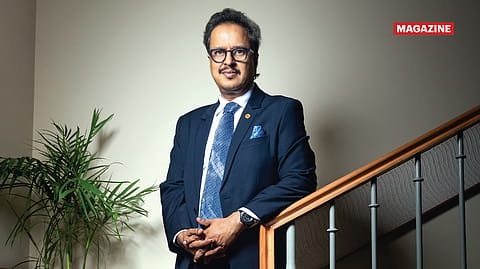
Sanjay Agarwal, MD and CEO, AU Small Finance Bank | Credits: Sanjay Rawat
This story belongs to the Fortune India Magazine november-2026-best-banks-and-nbfcs-2026 issue.
SANJAY AGARWAI knows the importance of spending time in the middle. As a former opening batsman, he is well aware of staying rooted to the pitch and guarding his wicket. “When the weather is not favourable, the ball swings. The strategy should be to stick to the pitch,” he says, adding that like cricket, this philosophy is applicable in life as well. “Challenges will come and go, but one has to continue to be on the pitch,” Agarwal, MD & CEO of AU Small Finance Bank, points out.
An operner for Rajasthan’s Under-19 team in the 1980s, Agarwal later trained as a chartered accountant and tried his hand at multiple businesses before settling for finance.
The pitch may have changed, but Agarwal remains connected with cricket. Sitting in his home office in Jaipur, he points to an autographed bat gifted to him by Mahendra Singh Dhoni, and tells Fortune India, “Rajasthan did not have a ranking [when I played] and was nowhere close to the teams from Delhi and Mumbai. Coming from a middle-class family — my father was a government employee — one had to think about the next course of action.”
Agarwal explains that when he completed his CA, India was rapidly changing after liberalisation of the economy. At the same time, he admits that then he didn’t have the “courage to go to the big cities”. “I tried my hand at many businesses like transport, exports, a granite factory. But I did not have any expertise,” he says, adding that he was working in finance as well, where he wasn’t dependent on anyone. “So, I decided to focus on the core area of finance. I took that decision in 2003. It has been over two decades since then and I haven’t done anything else after that,” Agarwal says, adding that he has stayed on the pitch.
And now that he knows the pitch so well in the world of banking and finance, he is batting on the front foot. No wonder that AU Small Finance Bank — AU is the symbol for gold on the periodic table — which he founded, has aced the sector on multiple counts in FY26 and continues to do so in the current fiscal. It delivered solid growth in FY26, with deposits rising 23% to around ₹1.53 lakh crore, with profit after tax (PAT) growing 25% to ₹2,641 crore. Its gross loan portfolio witnessed growth of 21%, with secured businesses (retail + commercial) leading at 23%. During the fiscal, the balance sheet grew 22% to nearly ₹1.92 lakh crore.
The momentum continues in FY27, with the balance sheet growing to ₹2.11 lakh crore in Q2. Net profit grew 53% year-on-year (YoY) to ₹858 crore, while net interest income (NII) was up 32% YoY to ₹2,820 crore from ₹2,144 crore in the corresponding quarter of FY26. Deposits grew 28% YoY to ₹1.70 lakh crore, and the loan book logged 25% growth to ₹1.53 lakh crore. Share price compounded at 7.38% over the past five years to ₹864 (as on October 30).
Agarwal points out that building a strong franchise on both deposits and retail assets has been the key differentiator, and the bank is harnessing a decade of efforts that have gone into building the franchise. “This is our 10th year. The decade has been an eventful one, right from the launch of GST to tax reforms, and challenges too, ranging from bank crises, Covid, wars, and high interest rates, etc. But I would say the last year’s performance came up on the back of nine years of strategy and distribution,” he says.
More Stories from this Issue
AU Small Finance Bank’s key strategy over the years has been to justify its status as a small finance bank along with building a brand around the trust for its services. The bank, says Agarwal, has tried from day one to provide holistic product offerings, be it in deposit franchise, retail franchise, MSME/commercial banking franchise, or its digital offerings.
He points out that it gives the bank a lot of confidence that deposits have grown in FY26, surpassing the industry average, despite “strong” headwinds. “It gives us a lot of confidence that the franchise has been well accepted in the system. Industry growth was around 15-16%, and we have grown at 23%,” he says.
“Ten years ago, we were not sure how the public would accept us. You cannot push people to open an account with us,” he says, adding that the organisation is sorted now. “The flow is very visible. We know where we are headed. Deposit franchise remains a priority. On the asset side, the priority is retail followed by commercial.”
Resilience test
Agarwal says that the momentum continues despite the West Asia crisis. He points out that even though the situation looks tough at the macro level with high inflation and monetary tightening having kicked in, the situation on the ground for this fiscal was not that grim. “On the ground, Q1 and Q2 have not been so weak, barring some pockets. Growth remains strong. In Q1, we achieved 20% of our overall targets compared with 16%, the norm for the quarter,” he says.
{{#most-powerful-women-snapshot-individual.slug}} {{/most-powerful-women-snapshot-individual.slug}} {{^most-powerful-women-snapshot-individual.slug}} {{/most-powerful-women-snapshot-individual.slug}} {{#showRanking}} {{current-rank}} {{/showRanking}} {{#photo.0.url}}
{{name}}
Q2, he says, was not even that bad, despite challenges emanating from the West Asia crisis — high crude oil prices, inflation, and a depreciating rupee.
“Our economy has shown resilience. People are taking credit and repaying on time. Credit quality has not deteriorated. This is a very complex situation where, on a sentimental or emotional side, one is not so bullish. But the actuality on the ground provides a different view,” says Agarwal. But he also warns about the lag effect and the impact playing out in the subsequent quarters.
For him, the mantra to navigate the current crisis is cautious optimism. “We have to monitor every day. It is not a clear picture. One can’t take long calls. But there is no harm in taking short calls with caution.”
Agarwal, who founded the organisation as a vehicle finance/NBFC business in 1996, has been in the financial space for close to three decades. While he has been at the helm of the bank since 2016, he has led its transformation through various stages since 2003. AU Small Finance Bank commenced banking operations in 2017, after the Reserve Bank of India granted it a small finance bank licence. The bank has received RBI’s in-principle approval and is awaiting final approval for transition to a universal bank.
Agarwal calls Covid the worst challenge he has faced. “I was 50 at that time. I told someone that if I live another 50 years, I won’t see anything worse than this,” he says, adding that the worst is behind us. “Wars or global power games may affect business cycles temporarily. One needs to be patient,” he says, adding that one needn’t be pessimistic. “And let’s not be too overcautious either.”
Going forward, the bank maintains its long-term growth guidance at 2-2.5x nominal GDP and is looking at new vistas for growth, Agarwal says. But it will take a very nuanced approach to growth, ensuring balance for the entire set of stakeholders.
Axis Direct said in a note that AU’s growth potential remains strong and is gradually marching towards 1.8% RoA. “Its strong execution across loan growth, deposit franchise strengthening and asset quality reinforces confidence in its medium-term growth and profitability trajectory. The bank’s expanding secured franchise, gradual re-acceleration in the unsecured portfolio and granular liability build-up provides a strong foundation for sustainable growth,” research analyst Dnyanada Vaidya said in the note.
It also looks to capitalise on the acquisition of Fincare Small Finance Bank, and its subsequent merger into it, to expand distribution in South India. AU had 3,103 touchpoints as of Q2FY27. It is also looking at expanding its network in the semi-urban, urban, and metropolitan touchpoints. Agarwal says that from close to 800 such branches (semi-urban, urban, and metropolitan) at present, it is looking to nearly double the number to 1,500 in the next five years, translating into the addition of 100-150 branches every year.
Leveraging its decadal prowess for future growth, AU Small Finance Bank is gearing up for a bright future.
Follow Fortune India
Sign in to read full story
To access our exclusive magazine content, sign in to your Fortune India account.
Sign In NowNEXT STORY