Fortune India Best Banks & NBFCs 2026: C.S. Setty earns his place in the legion of legends
/ 6 min read
Two years into his term, C.S. Setty, Banker of the Year, has shown how scale can bolster the DNA of the country’s oldest lender.
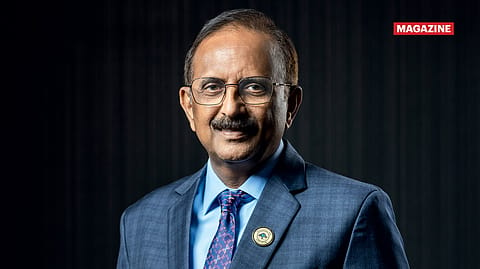
C.S.setty, Chairman, State
Bank of India. | Credits: Nishikant Gamre
This story belongs to the Fortune India Magazine november-2026-best-banks-and-nbfcs-2026 issue.
WE ARE ON THE 18th floor of State Bank Bhavan, the Mumbai headquarters of India’s largest public sector bank, which this July completed 71 years of its formal consecration under the State Bank of India Act 1955. In reality, however, the institution first came into existence in 1806 as Bank of Bengal under British India. That makes SBI, by lineage, the country’s oldest bank, carrying two centuries of Indian finance in its DNA.
The man who runs it does not pretend the job is easy.
“I think nobody is ever prepared to become the chairman of SBI… However much you think you are trained for it. It’s a different plane you need to operate on,” says Challa Sreenivasulu Setty, or C.S. Setty, who took over as the 27th chairman of SBI in August 2024.
It’s a disarmingly honest admission from someone who has spent more than three-and-a-half decades inside the bank. “You think that after 30 years, you broadly know what happens in the bank. Then you take the corner office and discover that you didn’t,” says Setty with a smile. That’s not being modest. Setty presides over a standalone balance sheet of ₹76.62 lakh crore and a consolidated annual profit of over ₹83,299 crore (FY26), a figure that rivals the combined profits of top four PSBs.
The franchise is exhaustive with SBI serving more than 530 million customers, roughly one in every three Indians. If Maruti Suzuki, the country’s largest passenger vehicle manufacturer, once sold itself with the line that India comes in Maruti, SBI made a simple claim: the banker to every Indian.
From macro to granular
Setty was born in a village in undivided Andhra Pradesh, now in Telangana. He joined SBI in 1988 as a probationary officer after completing his BSc in agriculture, a degree that seems fitting for a man who now oversees one of the largest rural banking networks in the world. Over the following three decades, he ran corporate credit, retail, digital and international banking, and served in developed markets abroad, before taking charge as chairman in August 2024.
Over the three decades, India’s GDP, too, went up 13-fold to $3.92 trillion, punctuated by several macro and geopolitical challenges. Yet through the thick and thin, the bank has embedded itself into the growth story. With 23,265 branches across 17 circles, including 8,442 rural branches, Setty sees the physical reach as only a part of the story of why Indian banking is sturdier today than in earlier cycles.
More Stories from this Issue
Structurally, Setty believes the country is doing well with strong growth momentum, robust credit growth and consumption reflected in both lending and GST collections. The headwinds have been largely external: geopolitics, supply chain fragmentation, energy prices, and a volatile tariff regime. “What is striking about the economy is the resilience that it has shown in recent years with Covid, tariff shocks, the Russia-Ukraine war and the Middle East crisis in quick succession,” says Setty.
While public sector banks went through recapitalisation, restructuring, recognition and provisioning, and their balance sheets came out stronger, what also worked in favour of the industry was the availability of granular data. “Banks used the period to rebuild underwriting on richer data, invest seriously in credit and operational risk management, and to catch up on digital, which today is a great difference from one bank to another,” says Setty.
The deeper change, though, that came through in recent years was the granularity: 15 years ago even small banks carried outsized corporate books, because lending to corporates was easy. Today the system leans heavily towards retail, agriculture, and MSME (RAM) lending. Setty offers a vivid comparison: imagine writing a ₹10,000-crore cheque to a corporate, versus disbursing ₹10,000 crore in home loans. The second is hard work, but technology and better processes have made it possible. “Which means that even assuming cycles come periodically, the pain in the banking system will be much lower, because your risk is distributed now,” says Setty.
The saver turned investor
Current account and savings account (CASA) deposits of SBI, the source of low-cost deposits for banks, grew by 9.53% to ₹22.62 lakh crore in FY26, the highest in the past four years, resulting in a CASA ratio of 39.46%.
{{#most-powerful-women-snapshot-individual.slug}} {{/most-powerful-women-snapshot-individual.slug}} {{^most-powerful-women-snapshot-individual.slug}} {{/most-powerful-women-snapshot-individual.slug}} {{#showRanking}} {{current-rank}} {{/showRanking}} {{#photo.0.url}}
{{name}}
But once taken for granted by bankers, this may no longer hold true. Setty is clear this is not a passing phase. “The structural shift is here to stay,” he says. Some years deposits will grow faster, some years investments will, but money is not going to stream back that easily into bank deposits.
The numbers support the view. According to the Association of Mutual Funds in India, monthly systematic investment plan (SIP) contributions hit a record ₹32,490 crore in September 2026, up from ₹7,788 crore in September 2020. The result is a steady pressure on savings accounts, even within the bank, because shifting money from savings to fixed deposits is one click away. The system-wide CASA ratio of 40-41% is unlikely to return. For a bank of SBI’s size, Setty considers 38-39% a healthy level.
But what fascinates Setty, though, is that while banks will have to live with lower CASA ratios, the engine is not going to die down. He illustrates the point with the example of a young professional in his first job. “For the first year or two, the SIP is the priority because savings are small. But after a promotion or an increment, the extra money doesn’t go into another SIP. Instead, the questions change. Should I buy insurance? Should I open a fixed deposit? Each stage of life sets its own preference,” explains Setty.
Understanding what customers do with their money and personalising the offer is the way ahead. Setty makes a pertinent observation: “Balances tend to rise when a savings account is linked to an SIP or a demat account. Products that look like competitors turn out to be complementary, because otherwise the money for those investments gets parked somewhere else.”
Here the bank has an advantage that only few rivals can match. For instance, SBI has life insurance, general insurance, mutual fund and pension fund businesses. Whether the money flows into funds, insurance, equities, pensions or wealth products, it stays within the SBI ecosystem. Setty believes it’s a powerful construct. He expects insurers, pension funds and mutual funds to play a far larger role in financing India’s capital formation over the next decade.
August 2027 is when Setty will complete his three years at the helm and whether he gets another year as extension, given that the SBI chairman’s age of retirement is 63 and Setty will be 62 in August 2027, is not clear.
But Setty is happy about the journey thus far and knows what he carries on today is a legacy shaped by several of his predecessors. One of which is YONO (You Only Need One), SBI’s core digital platform that he was closely involved in building between 2016 and 2019. He insists it was never meant to be just a banking app, nor primarily a cost-cutting tool.
The big takeaway from YONO, according to Setty, is that legacy processes must be fixed before anything is digitised. Setty mentions that the newest version of YONO is not an upgrade but a complete rebuild of microservices, with fintech partners designing some journeys and a new marketing technology player enabling hyper-personalisation. That process reengineering, he believes, is the precondition for adopting AI effectively.
Standing on the shoulders
On whether any predecessor, in particular, shaped his thinking, Setty is quick to reply: “All of them.” Having personally known and worked for close to seven SBI chairmen, Setty mentions why each had a distinct approach to shaping the organisation. O.P. Bhatt fought to restore SBI’s market share and heft. A.K. Purwar took the bold step of moving an organisation of SBI’s size onto core banking. Arundhati Bhattacharya began the bank’s digital orientation. Rajnish Kumar arrived in the most difficult period and strengthened the balance sheet, a philosophy Setty says still guides the bank. Dinesh Khara built on that foundation to bring growth and profitability into focus.
His own contribution, as he sees it, is to consolidate those ideas while making the bank more cost efficient, and more effective at reaching customers. “Customer first, and that cannot happen without being digital first,” says Setty.
Given that the economy is growing at 7% or more in real terms and 12% nominal, Setty sees room for credit growth of about 15%. He joined the bank when India’s GDP was $296.59 billion in 1988. It is $3.92 trillion today (2026), over 13 times larger. The math is still in the bank’s favour. SBI’s business, deposits and advances combined stands roughly at ₹115 lakh crore (as on September 30, 2026), a number Setty believes could reach ₹200 lakh crore by 2030.
Personally, Setty’s leadership philosophy is simple: “If you lead large teams, stay just 100 metres ahead of them. Far enough to lead, but close enough to hear what they are saying.” Professionally, his advice to colleagues is straightforward: “Stop worrying about the next promotion. Instead, invest in your current job.”
On what would be his biggest learning as the chairman, Setty offers an interesting anecdote: Fewer people have become CEOs of Fortune 500 companies than those who climbed Mount Everest. “So, I’m glad I’m one of them. It’s a great opportunity, but comes with greater responsibility.”
Going by the numbers, Setty has more than done his job, and he isn’t done yet.
Follow Fortune India
Sign in to read full story
To access our exclusive magazine content, sign in to your Fortune India account.
Sign In NowNEXT STORY