Fortune India Best Banks & NBFCs 2026: HSBC India, the growth compounder
/ 7 min read
The winner in the Best Foreign Bank category, India’s largest global bank has nearly doubled its profit in four years and expects growth to continue amid the country’s economic resilience.
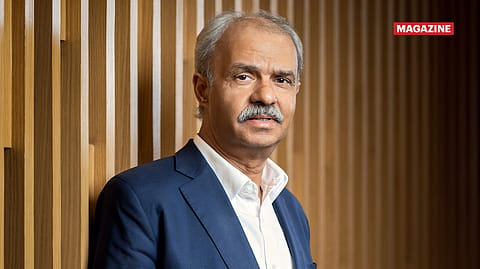
Hitendra Dave, CEO, HSBC India; Best Foreign Bank | Credits: Nishikant Gamre
This story belongs to the Fortune India Magazine november-2026-best-banks-and-nbfcs-2026 issue.
IN1985, amid a recessionary phase in the U.S., Bruce Springsteen released My Hometown, a singles track that spoke of empty shops, textile mills shutting down, and jobs gone for good. It’s a song one wouldn’t expect a bank chief to bring up, but that’s exactly what Hitendra Dave did, halfway through an argument about central bankers.
The 57-year-old picked up on an opening observation I made, that central bankers, specifically Alan Greenspan and his ilk in the U.S., were responsible for creating wealth disparity through decades of cheap money and near-zero interest rates. Instead of choosing the easy way out, had they followed the Paul Volcker “bitter” formula, asset prices would not have run so far ahead.
Dave doesn’t duck the question. “Policy decisions ultimately involve difficult trade-offs,” he says. Under the presidencies of Jimmy Carter and Ronald Reagan, Volcker brought U.S. inflation down from 14-15% to around 4%, but it also cost America years of recession. “If you puncture demand, people can lose jobs, housing and stock prices can fall, and demand across the economy can weaken,” says Dave.
“These are very good discussions to have in the comfort of a nice setting. But those making these decisions live in the real economy, not an unreal one,” explains Dave.
Dave, who took over as CEO of HSBC India in June 2021, likes to talk straight, and Covid is his clearest example. “If the system had not been flooded with liquidity, half the factories would have shut,” he says. Since the pandemic began, the RBI injected ₹17.2 lakh crore (8.7% of GDP) into the banking system. This liquidity flowed from banks to factories and to workers.
Had it not been for the support, the pain in the system would have been disproportionate. “A pay cut affects a business owner very differently from an employee. An employee runs his household on his monthly income,” points out Dave. Tighter money would have meant far higher job losses across services and manufacturing sectors.
While India’s unorganised labour did lose livelihoods during Covid, it was spared the dire fate of My Hometown: India’s GDP, which shrank to 6.6% in FY21, bounced back to 8.7% in FY22, and has since stayed on the growth trajectory.
More Stories from this Issue
As head of India’s largest global bank, with a balance sheet of about $50 billion, Dave knows the inherent strength of the economy.
“If an year ago, I had told you that there would be a war between the U.S. and Iran, that oil would go from $60 to $90-100 for 6-7 months, that the rupee would go from 85 to 95, you would have expected a lot of macro instability,” he says.
Instead, first-quarter growth in FY27 came in at 7.8%. Full-year forecasts of 7.1-7.3% are higher than a year ago. GST collections are still growing at double digits and direct taxes at 13-14%. The current account deficit is 0.5% of GDP in Q1, and remittances are holding up. “Some resilience has come into every part of our economy. Only with the benefit of hindsight will we understand what caused it. This is an unbelievable amount of resilience,” says Dave.
Banks have never looked healthier, he says. Capital, liquidity and provision coverage are the best he has seen in his career. Corporates have repaired balance sheets with equity and cash flow. Households, surprisingly, have behaved well since the pandemic even as the RBI raised risk weights to temper retail credit that was growing 30-35% before. What is also helping lenders is a far richer data repository covering employment history, bureau records, and salary credits. Banks are being cautious, which is why personal loan growth is 17-18% rather than much higher. “We (bankers) may seem overly cautious at times, but there’s good reason behind it,” says Dave with a smile.
{{#most-powerful-women-snapshot-individual.slug}} {{/most-powerful-women-snapshot-individual.slug}} {{^most-powerful-women-snapshot-individual.slug}} {{/most-powerful-women-snapshot-individual.slug}} {{#showRanking}} {{current-rank}} {{/showRanking}} {{#photo.0.url}}
{{name}}
HSBC India’s own numbers back that observation.
GROWING FOOTPRINT
Under Dave, HSBC India’s numbers have only got better. Profit before tax reached about $1.9 billion in FY25, nearly double of what it was four years ago. India is now the second-largest profit contributor to HSBC in Asia and the third largest globally, and it has been among the group’s top five profit contributors for a decade. In the first half of 2026, it posted a pre-tax profit of $965 million.
For the parent, India is a “priority growth market”. Under Dave’s tenure, the India business has not needed fresh capital from London. “For now, the India franchise is self-capitalising,” says Dave.
The formula for growth is simple.
“Keep your cost of funds low. Keep your credit costs low. Deal with customers you know and understand,” says Dave. That last line, he stresses, is the most important. “Then even when they go through a bad cycle, you can understand them.”
The bank’s footprint is growing too and so is its influence. Last year, the bank got the RBI’s approval to expand into 20 more cities, from the existing 26, the largest by a foreign bank in a decade. It has opened eight new branches thus far, with 12 more expected in the coming 18 months. With over 50% of companies’ treasury needs being handled through GIFT City, the bank’s balance sheet in the country’s first international financial hub now exceeds $20 billion, up from $10 billion two years ago. Of the total $133 billion raised through the special FCNR scheme, HSBC India mobilised $14.5 billion through FCNR deposits in two months, the largest by an international bank. The country is also the bank’s largest employment hub, with over 48,000 people.
HSBC is the only global house in India present across the full suite of banking, asset management, insurance, and securities. On the corporate side, it ranks first in India G3 bonds and in syndicated loans out of India for the third year, with a 21% share. It is the preferred banking partner of MNCs with 63% of Fortune Global 500 firms operating in India and 37% of global capability centres. The fact that it’s closely intertwined with the economy is evident from the fact that it handles 7% of India’s exports, 8% of forex and 9% of FDI inflows.
THE NETWORK EFFECT
As Indian depositors turn investors, the fight in Indian banking has moved decisively from assets to liabilities with the CASA ratio hitting a recent low of 39% in FY26 even as monthly mutual fund SIP average contribution has surged to over ₹31,000 crore. Dave believes banks that get their liability strategy right will be the winners: “It is the raw material and without raw material, your finished product cannot come out well.”
Even as bankers are jostling for deposits, Dave believes the answer lies in finding transactions where a bank is irreplaceable such as salaries, taxes, school fees. HSBC expects CASA to grow at a 24-25% CAGR between 2023 and 2026, off a modest base. But Dave is clear that he will not chase deposits by paying 7% on savings accounts. “You can’t have a liability model distinct from your asset model,” he says. Low-cost funds let HSBC lend to the best borrowers and keep credit costs close to zero.
HSBC wants to be number one in cross-border wealth, top-end cards, and large-ticket mortgages. “Saying I’ll be the size of the country’s largest national bank makes no sense,” says Dave. But the bank is fortifying its moat. The mortgage book has tripled in four years to ₹25,700 crore. Premier cardholders spend over ₹1 lakh a month on average, and close to ₹2 lakh on the invitation-only Taj card. After the L&T Mutual Fund acquisition, the asset management arm’s AUM has grown from ₹81,478 crore in December 2022 to ₹1.53 lakh crore.
Talk to HSBC India’s senior team and one idea keeps coming up: Indian families and firms are going global, and HSBC wants to help them get there.
Sandeep Batra, head of international wealth and premier banking, sees it in affluent clients whose outlook, assets, and ambitions now cross borders. “We are focussed on being present where wealth is being created and were global connections matter most. Our expansion strategy will be based on high-growth cities, internationally minded entrepreneurs, emerging affluent segments, and vibrant NRI diaspora.”
What about home-grown wealth firms moving into cross-border? “If you look at us purely head-to-head with a local private wealth firm, you miss what differentiates us,” admits Dave. But they (wealth firms) lack a bank account, a cross-border network and multiple products. A client parking ₹1 crore in wealth may want a ₹20-crore mortgage. “How many banks can give you that? Three or four. No standalone wealth platform can match it,” explains Dave. The biggest lever, however, is cross-selling.
HSBC counts many of India’s top companies as clients, and its Innovation Banking arm covers about half of India’s Top 100 unicorns, backed by a $1-billion lending pool. Dave wants their CEOs, CFOs and employees as personal customers too. Of roughly 1.3 million customers, at least half a million are cross-sell candidates, with near-zero acquisition cost. “We can grow by deepening relationships with our existing customers, not just adding new ones,” says Dave.
Ajay Sharma, head of commercial banking, sees the bank’s global heft coming into play for companies going abroad and buying assets overseas, which means cross-border financing, liquidity management and foreign exchange. “Our focus on helping Indian companies expand internationally has worked well. Our international network allows us to support those ambitions across markets and sectors,” says Sharma
Hiren Sanghvi, head of markets and securities services, deals with clients managing multi-currency exposures and complex cross-border acquisitions. His business has momentum in cash, forex, synthetic financing, derivatives and precious metals hedging, and is now investing in automated hedging, AI-based analytics and more products in GIFT City. “Clients need a partner who understands their commercial ambitions and makes complex financing and risk management simpler,” says Sanghvi.
Leveraging relationships is a common thread that runs across the bank’s businesses. Amitabh Malhotra, vice chairman, investment banking, says HSBC treats a company’s financing needs as one long conversation. “Our strategy is to connect Indian companies’ next phase of growth with capital across markets, whether that’s expanding capacity, making acquisitions at home or overseas, refinancing debt or going public.” In fact, HSBC is the top international bank for completed IPOs in 2026 thus far, and the only bank on all three of the year’s biggest, the National Stock Exchange, SBI Mutual Fund, and Jio Platforms.
From the company, the relationship moves to the family. Batra wants ties that last generations, the founder-to-wealth-client path Dave describes. Sharma thinks today’s geopolitics only helps as companies want trusted advice when the world is this uncertain. Batra’s aim is to be the leading international wealth bank for Indians, while Malhotra wants HSBC to be a top two franchise in every segment it serves.
With aspirations to be among the four top-tier private banks in India by profit by 2030, Dave believes there is room for only one foreign bank to think at that scale. “Fortunately for me, there isn’t another, and nobody else wants to.” Call it Dave’s own version of My Hometown.
Follow Fortune India
Sign in to read full story
To access our exclusive magazine content, sign in to your Fortune India account.
Sign In NowNEXT STORY