Fortune India Best Banks & NBFCs 2026: ICICI Bank, basic banking, better returns
/ 8 min read
The winner in the Best Large Bank and Best AI Adoption categories, a calibrated profit growth mantra and customer focus help ICICI maintain the lead among private lenders.
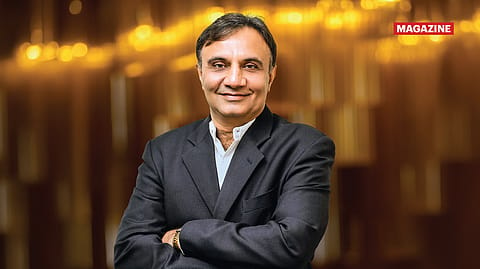
Sandeep Bakhshi, MD & CEO, ICICI Bank.
This story belongs to the Fortune India Magazine november-2026-best-banks-and-nbfcs-2026 issue.
A QUIET BUT decisive shift in leadership among India’s top private sector banks is reflected in their financial performance, stock market returns and valuations. For years, HDFC Bank held the top spot, delivering consistent execution and strong performance under the leadership of its former MD and CEO, Aditya Puri, who retired in 2020. Over the past five years, however, the balance has begun to tilt in favour of its closest rival, ICICI Bank.
While HDFC Bank’s advances have grown at a slower pace, ICICI Bank has continued to expand its lending business. The divergence is even more pronounced on the bourses: ICICI Bank’s stock has compounded at 11.67% over the past five years, while HDFC Bank’s has fallen 2.63%.
The difference is also evident in their valuations. As of October 30, ICICI Bank traded at a price-to-book (P/B) multiple of 2.61x, compared with 1.77x for HDFC Bank. This represents a valuation premium of 47.46%, or an absolute difference of 0.84x in their P/B multiples.
Though HDFC Bank remains the larger institution in terms of assets, deposits and market capitalisation, its outlook has changed considerably since its 2023 merger with Housing Development Finance Corp. (HDFC). The year 2026 has been particularly challenging, with a series of developments raising questions about whether the bank can retain the governance premium it once commanded. The board imposed penalties on senior management over what was described as business “overreach”, while class-action lawsuits were filed in the U.S. against the bank’s leadership, which were ultimately dismissed.
The uncertainty deepened when MD and CEO Sashidhar Jagdishan decided not to seek a third term and stepped down on October 26. His departure came seven months after former part-time chairman Atanu Chakraborty resigned, citing “happenings and practices” at the bank that he said were inconsistent with his personal values and ethics.
Against this backdrop, ICICI Bank’s rise stands out. Its performance reflects not merely a shift in market sentiment but a sustained effort to repair its balance sheet, strengthen underwriting standards and pursue growth without compromising profitability.
Leaving the rival behind
The external environment was challenging for the entire banking sector. Non-performing assets (NPAs) remained elevated, particularly at PSBs, with the collapse of Infrastructure Leasing & Financial Services (IL&FS) in September 2018 triggering widespread liquidity concerns across the NBFC sector.
More Stories from this Issue
Against this backdrop, Sandeep Bakhshi, who took charge as ICICI Bank’s MD and CEO in October 2018, began addressing the bank’s legacy bad-loan problem. Working largely away from the public spotlight, he focussed on strengthening underwriting, improving recoveries and reducing exposure to riskier forms of lending. The bank stayed away from large, concentrated corporate infrastructure loans and project finance, while shifting its focus towards retail customers and small businesses.
This strategy coincided with a broader corporate deleveraging cycle, as companies reduced debt and cleaned up their balance sheets. For ICICI Bank, the combination of better underwriting, strategic recoveries and a more diversified lending portfolio helped reduce risk, ease provisioning pressures and improve profitability.
The benefits of this shift have become increasingly apparent over the past five years. ICICI Bank’s net interest margin (NIM) rose from 3.6% in FY21 to 4.32% in FY26. HDFC Bank, by contrast, saw its NIM decline from 4.1% to 3.16% over the same period, with the merger contributing to the pressure on margins.
Loan growth tells a similar story. ICICI Bank’s loan growth increased from 13.7% in FY21 to 15.8% in FY26. HDFC Bank, meanwhile, had to moderate growth from 14% to 12% as it sought to manage its elevated loan-to-deposit ratio, which stood at around 96%.
{{#most-powerful-women-snapshot-individual.slug}} {{/most-powerful-women-snapshot-individual.slug}} {{^most-powerful-women-snapshot-individual.slug}} {{/most-powerful-women-snapshot-individual.slug}} {{#showRanking}} {{current-rank}} {{/showRanking}} {{#photo.0.url}}
{{name}}
ICICI Bank has continued to expand its lending franchise, with retail and rural banking among its strongest growth drivers. In Q2FY27, this segment grew 14.8% to ₹9.45 lakh crore, accounting for 51.7% of the bank’s portfolio. At the same time, asset quality improved significantly: gross NPAs as a proportion of total advances fell to 1.2% in Q2FY27 from 7.87% in Q2FY18.
The combination of stronger asset quality, healthier margins and steady loan growth has helped ICICI Bank consolidate its position among private sector lenders. But the turnaround has not been driven by growth alone. At its heart lies a philosophy of balancing expansion with the risks inherent in lending.
One of the most important shifts since 2018 has been the emphasis on risk-calibrated, profitable growth. “Metrics such as RoE, RoA or margins are outcomes, a part of business. We have to look at profitability with a calibrated approach,” a senior executive, who declined to be named, recalls Bakhshi often telling colleagues in internal meetings.
This approach has not meant abandoning unsecured lending. Personal loans and credit cards, much of it driven by digital cross-selling, remain important parts of the business. The emphasis has been on ensuring that growth is supported by sound underwriting and appropriate risk assessment.
Explaining the rationale behind ICICI Bank’s valuation premium, another insider says: “We simply stayed with the fundamentals. The ERM (enterprise risk management) framework was put in place post-AQR by Bakhshi’s predecessors around 2014-15. We kept the same team, didn’t make disruptions and executed on the framework. It was basic banking, simple customer focus.” The emphasis on continuity is significant. Rather than dismantling existing systems, Bakhshi retained the ERM framework established by his predecessors and focussed on execution. The objective was to preserve what worked while making the bank more disciplined, customer-focussed and profitable.
A mechanical engineer by qualification, Bakhshi has kept his message simple: let the work speak for itself.
One bank one RoE
The focus on fundamentals extends beyond lending and risk management to the way ICICI Bank serves its customers. A central element of its strategy is the principle of ‘One Bank, One RoE’, which seeks to bring different businesses together to maximise value for customers and the bank alike. “That has meant that all teams within the bank and within group companies are working together in terms of all products and services,” executive director Rakesh Jha said at a recent analyst meet.
In practice, the strategy involves looking beyond individual products or accounts to understand the full potential of a customer relationship. A corporate customer, for instance, may need loans, transaction banking, trade finance, treasury services and wealth management for its promoters. By coordinating across these businesses, the bank can deepen relationships, serve customers more comprehensively and improve the profitability of each relationship.
The strategy appears to have delivered results. ICICI Bank’s return on equity (RoE) rose to 16.1% in Q2FY27 from 7.1% in FY18. The objective is not simply to sell more products, but to understand customers better while maintaining lending discipline. As the bank noted in its FY26 annual report, “By fostering collaboration across functions and bringing decision-making closer to customers, empathy flows across every level of the organisation, from support teams to frontline colleagues, and from frontline colleagues to customers.”
A complementary principle, ‘Fair to Customer, Fair to Bank’, reinforces the same philosophy: deliver fair value to customers while creating sustainable value for shareholders.
Together, these principles underline the approach that has shaped ICICI Bank’s turnaround. Customer relationships and profitability need not be competing priorities, provided growth is pursued with discipline and a clear understanding of risk.
The FCNR(B) impact
Even a bank with strong fundamentals must contend with external developments that can affect margins and returns. ICICI Bank’s Q2FY27 results illustrate this balancing act. The bank continued to report growth in operating profit, its loan portfolio and total deposits, but NIM moderated to 4.18% from 4.30% a year earlier.
One of the key factors was the mobilisation of foreign currency non-resident (bank), or FCNR(B), deposits. ICICI Bank garnered the largest share of the market, at 14%, mobilising $17.88 billion, or ₹1.70 lakh crore. The scheme, which became operational in early June, was seen as a measure to boost dollar inflows and support the rupee amid pressure on the currency.
Analysts and economists viewed the deposit mobilisation as a positive development, particularly as it demonstrated the strength of the bank’s NRI franchise. The deposits strengthened its funding base, but came at a near-term cost.
Although the Reserve Bank of India (RBI) has taken steps to absorb excess liquidity from the banking system, the higher cost of FCNR(B) deposits has added to pressure on banks’ margins. These deposits are relatively expensive to service and offer tighter spreads than conventional funding. Moreover, banks initially deploy a portion of the funds into liquid assets that typically yield less than loans, further weighing on margins.
For ICICI Bank, the immediate pressure is expected to persist before the benefits of this funding become more apparent. Speaking to analysts on October 18, group CFO Anindya Banerjee said: “The FCNR(B) deposits were raised during Q2. So the full impact of this on the average balance sheet will come in Q3, and we will see a further moderation in margins, offset a little bit by the rate hike, which has already taken place. But then from Q4, I would expect margins to come back in a healthy way as these factors start to reverse out, even assuming that there are no further rate hikes.”
The management has indicated that the temporary pressure on margins is a trade-off it is prepared to accept in return for the longer-term benefits of stronger funding.
“From an overall perspective, this sort of decline in margins for one or two quarters on an optical basis doesn’t worry us at all,” Banerjee said. The bank has raised a substantial amount of fixed rate funding, which management expects to support business growth and franchise expansion over time.
He also described the FCNR(B) opportunity as a one-off. “It is not something that we weighed in the context of short-term impact on margins, but rather the strength that it gave us in terms of business growth for a period of time going forward... the impact on margins is anyway going to be transient.”
The focus now shifts to whether the anticipated recovery materialises. Following the results, Rishit Savla, research analyst at SMIFS Ltd, says he expects margins “to recover from Q4FY27, in line with the management’s guidance, while healthy loan growth and benign asset quality should support the bank’s return profile.”
The FCNR(B) episode is, therefore, another test of ICICI Bank’s calibrated approach to growth. The challenge is to absorb the temporary impact on margins while ensuring that the funding supports expansion without undermining profitability.
The customer at the centre
Ultimately, the balance between growth and discipline depends on how well a bank understands and serves its customers. For Bakhshi, the underlying principle has remained straightforward: get the basics right and keep banking simple.
Nitin Aggarwal, senior group vice president and head of BFSI research at Motilal Oswal Financial Services, attributes the bank’s success under Bakhshi to precisely this approach.
Technology is another area where ICICI Bank intends to stay ahead. Bakhshi’s emphasis has been on ensuring that organisational change keeps pace with technological progress. “Institutions which are able to change their structures, change their people, change the mindset of the people, are the ones who respond better,” he has often told his team.
Adopting new technology, therefore, is not enough; the bank must also adapt to it as well. Digital tools can help ICICI Bank offer more products to existing customers. But to make the most of these tools, its employees, processes and decision-making must keep up with customers’ changing needs.
The bank’s lending strategy is also built around a sector-agnostic approach, with the emphasis on rigorous credit assessment rather than blanket preference for one industry. The underlying question is not which sector a borrower belongs to, but whether the counterparty is creditworthy.
Under Bakhshi, ICICI Bank has focussed on cleaning up its balance sheet, maintaining lending discipline, building customer relationships and pursuing profitable growth. The road ahead will depend on the bank’s ability to maintain asset quality and navigate margin pressures without compromising returns. But one thing is clear. For Bakhshi, the formula will remain unchanged: basic banking, focus on customers and calibrated growth.
In banking, bigger is not always better. ICICI Bank’s journey shows that steady growth and strong fundamentals matter more than size alone.
Follow Fortune India
Sign in to read full story
To access our exclusive magazine content, sign in to your Fortune India account.
Sign In NowNEXT STORY